Why Did President Hayes Visit a “Backwater” Like Chico?

Larry commented on my previous post about bridges that “Someone asked me why these dignitaries came to a “backwater” place.” What was the president of the United States, the First Lady, Secretary of War Ramsey, General William Tecumseh Sherman, and the rest of their traveling party doing in a small out-of-the-way place like Chico? What could have attracted them to Chico?

President Rutherford B. Hayes made his tour of the western United States in September 1880. He was nearing the end of his term; he had vowed that he would not run for a second term, and the Republican Party had nominated James Garfield as its candidate the previous June. He was the first sitting president to visit the West Coast.

General Sherman made the travel arrangements for the presidential party. Bidwell notes in his diary for August 26 that he wrote to Sherman about the trip. The plan was for the president to travel by train from Chicago across the western states to San Francisco and Sacramento, and then northward until the end of the railroad line in Northern California. After that the party traveled by stage coach through Oregon to Portland and all the way to Seattle before turning back east in October.

General Bidwell had the finest home in all of California north of Sacramento. Bidwell Mansion was an ideal overnight stopping place for the presidential party. General Sherman knew he could count on John Bidwell to entertain the president in style and comfort.
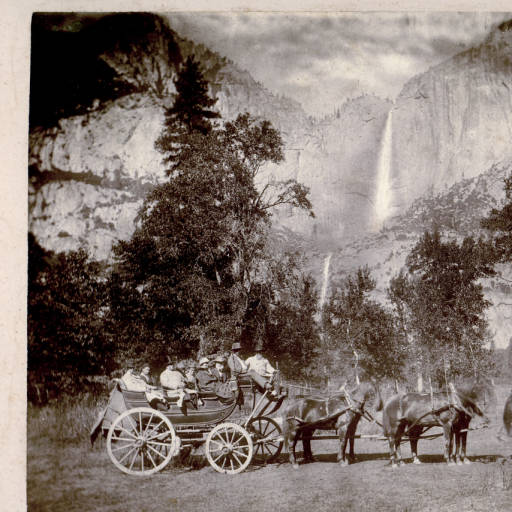
President and Mrs. Hayes visit Yosemite, California. Image courtesy of Ohio Memory Collection.

President and Mrs. Hayes visit Yosemite, California. Image courtesy of Ohio Memory Collection.

Bidwell joined the presidential party on its train at Roseville on Sept. 8th. He accompanied the president in Sacramento and on to Oakland and San Francisco. Then while the president and Mrs. Hayes visited Yosemite, San Jose, and other sites, Bidwell returned to Chico on the 13th to finalize preparation for their visit. On the  19th he traveled back to Sacramento to visit the State Fair. The entries in his diary for the actual visit to Chico are annoyingly brief:

Tues., September 21. Sacramento -Davisville – Sacramento Events: Went to Davisville to meet Presidential party – Dined with them at Gov. Stanford’s – Introduced Mr. Rideout to Pres. Hayes. Weather: fine – warm – fine –

Wed., September 22. Sacramento. Pavilion.

Thurs., September 23. Sacramento> Chico with President Hayes & party: Gen. Sherman, Sec. Ramsey.

Fri., September 24. Chico, Cherokee, Chico  President & party went to Cherokee and returned – and left for Oregon.

It was just an overnight stay, with an excursion to see the mines at Cherokee. But no one could entertain the president in finer style or with greater cordiality than General John Bidwell.
Posted in Rutherford B. Hayes, Uncategorized, William Tecumseh Sherman | 3 Comments

Dmitry Zavalishin’s Bold Plan

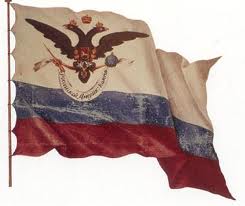
Flag of the Russian-American Company

Flag of the Russian-American Company

If Dmitry Zavalishin’s colonial visions had come to pass, Northern California would be New Russia, not the State of Jefferson or any other part of the United States. It’s pretty hard to imagine, but he certainly used all his charm and powers of persuasion to try to make it a reality, and how different California’s history would be if he had succeeded!

Writing some 40 years after his visit to California, he still regrets that Imperial Russia did not seize the opportunity. Even without its well-known mineral wealth, it was a prize to be sought after.

The superior climate, rich soil, and capital location on the Great Ocean, with one of the best ports in the world [San Francisco], constitute the unalterable and inalienable advantages of California, and from this naturally sprang the desire to expand our colony of Ross at least as far as the northern shore of San Francisco Bay and the Sacramento River, and to that extent it was still possible.

He believed that “California’s subjection to Russia would have brought mutual and considerable advantages.” He was sure, from his conversations with the Mexicans in California, that Mexico’s neglect of its northernmost province would make it easy for Russia to expand its foothold. Mexico was weak, it had no navy to defend California, and the Californios were dissatisfied with Mexican rule. They seemed amenable to a pact with the Russians to protect them from the Americans, who it was feared would seize their lands without compensation.

In their eyes the Americas were heretics, and the specimens of United States citizens that they had come to know–adventurers and petty traders–had done little to recommend their nation. . . . As they themselves realized, almost the only means of deliverance from the terrible danger and at the same time from their disastrous situation was union with Russia.

And so Zavalishin envisioned a colony (led by himself he hoped), that would stretch from the northern shores of the San Francisco Bay to the 42 ° parallel (the Oregon border).  It would have Russian farmers, a school, a doctor, and friendly relations with the Indians. It would give Russia a magnificent warm-water port and a firm foothold in North America.

Alas for Dmitry, it was not to be. Many years later, after the Mexican War, the Gold Rush, and the annihilation of the Indians, he remembers the Californios who welcomed him so cordially, and writes,

I am sure in the light of everything that has happened, they often remember how much better it would have been if, instead of the events that occurred, our mutual proposals and desires had been realized at that time.

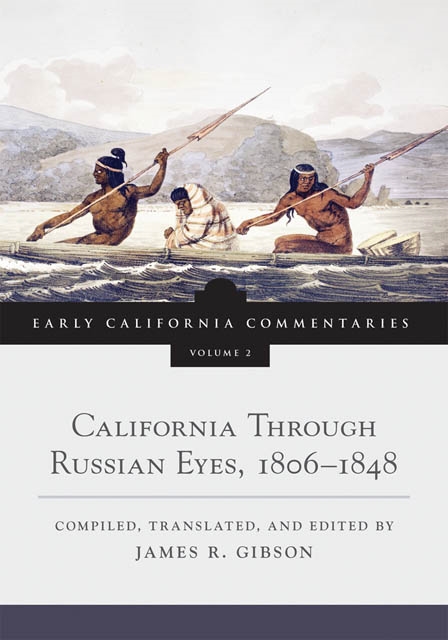
(Quotations are taken from California through Russian Eyes, 1806-1848)


Posted in Dmitry Zavalishin, Russian American Company | Leave a comment

California through Russian Eyes

California Through Russian EyesAnyone interested in the Russian presence in early California can do no better than to read California through Russian Eyes, 1806-1848, compiled translated, and edited by James R. Gibson (Arthur H. Clark Company, 2013), the second volume in a series entitled Early California Commentaries. It consists of 32 documents–letters, reports, and journal entries–by Russians who visited and lived in Alta California, from the earliest explorers to the last manager of Fort Ross. (I checked the book out from the Butte County Library.)

The Russians were careful and curious observers of life in California. Dmitry Irinarkhovich Zavalishin was a 20-year-old midshipman in 1824 when he spent several months in California purchasing provisions, learning Spanish, and conversing with various Californios.  Many years later, after the Gold Rush had made California famous, he recounted his experiences for Russian readers. Here he is reporting on the native population:

Compared with other Indians of North America glorified in the novels of Cooper and other writers, California’s Indians were a meek lot. Of course they were sometimes driven to ferocity by brutal treatment,and then they committed atrocities on Californios who fell into their hands . . . Undoubtedly with good treatment and proper upbringing they were capable if development; this was proven by numerous examples in the missions. Even in the wild state they displayed remarkable abilities in many respects. They made many artistic and very durable articles. Their root baskets and hats were waterproof and combined unusual lightness and durability with resilience; head ornaments, belts, the outsides of baskets, and other articles, which were minutely decorated with the different and multicolored feathers of local birds, were splendid examples of art and patience.

Regarding weapons, their bow, strung with sinew, was usually so taut that the strongest among us could not pull it without practice and skill. Their arrows were made from rushes with stone heads daubed with poison; wounds from them, regardless of the poison, were very dangerous, for they had a rough finish and a jagged edge.

A typical European, perhaps, but one who was open to appreciating the people he observed. He was positive that the Russians could get along better with the California Indians than the Spaniards and Mexicans did.

In conclusion, with regards to the Indians I will say a few words about their relations with the Russians. Whoever has studied the Russian national character knows very well that Russians, if they have not been aroused by some special external circumstance, are very good-natured and well-disposed toward everyone, despite differences in religion, nationality, and social status. A Russian disdains neither a savage nor a heterodox . . .  No wonder that the Indians liked the good-natured Russian sailors, especially the generous and affectionate officers.


Posted in Uncategorized | 2 Comments

What Ever Happened to Josiah Belden?

Josiah Belden

Josiah Belden

From time to time I’ve written about other members of the Bidwell-Bartleson Party and followed up on their subsequent adventures. Many of them returned to the States after a short time, and very few of them were successful in California. One man who made a name for himself, much like John Bidwell, was Josiah Belden.

Josiah Belden was born in Connecticut in 1815. As a young man he had a typical case of “itchy feet” and traveled to New York, throughout New England, over to Liverpool and back, down the Mississippi River to New Orleans and up the river to St. Louis. There he heard about California and joined the first emigrant group to attempt the overland journey to California.

Josiah dictated a statement of his experiences on the trail and in California in 1878. After arriving at Marsh’s ranch in November 1841 he headed first to San Jose to obtain a passport, and then to Monterey to seek employment.

About a dozen of us, after resting a day or so at Marsh’s Ranch, started out to go down to the Pueblo San Jose, with directions from Marsh how to find our way there. We came on to that place, crossing what is now Livermore’s Ranch, but there was no settlement there then. We proceeded, and stopped one night at Geary’s [Joaquin Higuera] ranch, two or three miles south of the mission of San Jose. We excited a good deal of interest as we passed by the mission of San Jose.

He went to work for Thomas O. Larkin, a merchant and later the American consul in Monterey.

[I] made arrangements with him to go over to Santa Cruz and take charge of a store there, which he wished to establish as a branch, and I went over to manage the business there for him–a store of general merchandise. We carried on the usual business there, selling goods and taking pay in hides and tallow, and buying lumber . . . mostly the redwood lumber.

In 1844, during the ruckus known as the Micheltorena War, Belden recruited some Americans to guard the governor’s home and family. In reward Governor Micheltorena granted Belden a 21,000 acre land grant on the upper Sacramento River.  Together with Robert Thomes he traveled to Rancho Barranca Colorado, at the present site of Red Bluff, but before long he hired William B. Ide to manage the ranch for him, while he went back to the mercantile business in Yerba Buena.

He tried his hand at mining in 1849, but soon realized he could make more money selling supplies to miners. His astute merchandizing deals and real estate investments made him a wealthy man. (It’s an advantage to be already on site when great events transpire.) He sold his interest in the Rancho Barranca Colorado to Ide, and settled in San Jose. He was elected the first mayor of San Jose in 1850, which must have given him a great deal of satisfaction, since he had spent six days in jail there when he first arrived.

He occasionally met his old traveling companion, John Bidwell. For instance, on June 19, 1871, Bidwell records in his diary: “Josiah Belden & son (George) arrd. fm Tehama.” They stayed overnight at the Mansion and left the following day.

Belden married and in 1855 built a fine home in San Jose. The family traveled extensively and lived the good life. In 1881 he moved to New York City and in 1892, nearly 77 years of age, he died there. He was a man to whom California had been very good indeed.

Home of Josiah Belden in San Jose (no longer in existence.)

Home of Josiah Belden in San Jose (no longer in existence.)

Posted in Josiah Belden | 4 Comments

Bidwell and Bridges

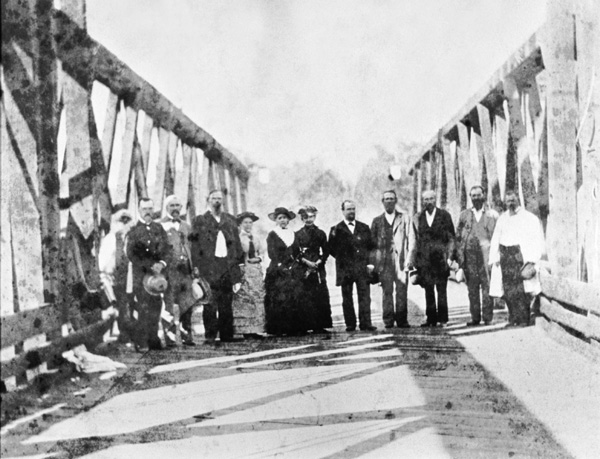
I have been puzzling over these two photos. Both come from CSUChico Meriam Library Special Collections, and both show John Bidwell standing with a group of people on a bridge. Where was the bridge? Who are the other people in the photos?

sc17321 "First toll bridge across Sacramento River, Chico, 1879."The title on this one is “Gianella Bridge”, and the date is 1879. Since the Gianella Bridge, which crossed the Sacramento River at Hamilton City, wasn’t built until 1910, it can’t be that bridge. The description goes on to call it the Sacramento Bridge, the first toll bridge across the Sacramento River, and states that it washed out in the 1883-84 flood.

It’s easy to spot John Bidwell in this photograph. He is the tallest man in the picture. At six feet, or maybe 6′ 2″, (descriptions differ), he was much taller than most men of his era. He was also rather portly by this time in his life.

The woman beside him is his wife Annie. This is the only photo I can think of that shows them standing side by side, which makes it the best photo to demonstrate the difference between their heights. Annie was 4′ 8″, which is quite small today, but not very much shorter than many other women in her day.

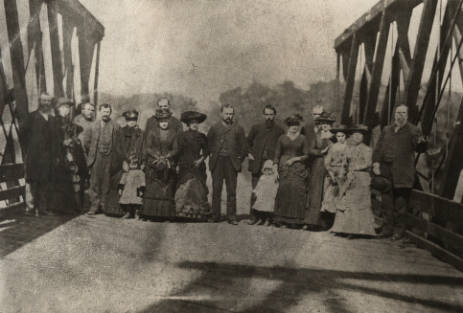
Here’s another bridge photo:

John_Bidwell_Entertaining_President_HayesThis comes from the John Nopel collection, and is titled “John Bidwell Entertaining President Hayes.” The note says that this is the “bridge over Big Chico Creek near Sacramento River.”

It looks like the same bridge to me in both photos. Is it a bridge over Chico Creek or over the Sacramento River? If anyone knows, let me know.

President Hayes visited Chico while on a tour of the western states in September 1880. Hayes is on the left, and the woman next to him is presumably his wife, Lucy Hayes.

That is definitely John Bidwell on the right. Who could mistake him? And it looks like it might be Annie next to him, except that Annie was not at home when the president came to call. Annie was on an extended visit to her family in Washington D.C. when the president took his western tour. She left it up to John to entertain the president, and he called on other leading ladies in the town for assistance. So that’s not Annie.

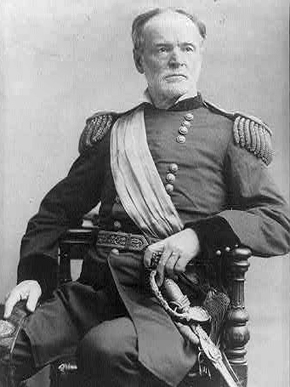
The note with the photo also says that General Sherman is in the picture.  I’dWilliam Tecumseh Sherman Library of Congress like to know which one he is. William “War is hell” Tecumseh Sherman accompanied the president and should be in the picture, but none of these men look like him. Here is a picture of him taken during this period. I don’t think any of these men is a good match.
Lots of questions for two old photographs. What do you think?


Posted in bridges, Rutherford B. Hayes, William Tecumseh Sherman | 6 Comments

Rotchev and Bidwell (not)

Rotchev House on the right.

Rotchev House on the right.

I was hoping that John Bidwell met Alexander Rotchev before the latter left California, but evidently not. Rotchev, having sold the assets of the Russian-American Company in California to John Sutter, departed for Sitka on January 1, 1842. Bidwell had arrived at Sutter’s New Helvetia settlement in November 1841. Sutter promptly hired him and he spent a few weeks learning Spanish and getting to know Sutter. Then Sutter assigned him to manage the dismantlement of Fort Ross.

Bidwell arrived at Bodega Bay, where the Russians also had holdings, in mid-January. He just missed meeting the Russians by a couple of weeks.

My first occupation in California was at Bodega and Fort Ross, taking charge with Robert T. Ridley, who preceded me there, of the Russian property still remaining at those points, and removing the same as fast as practicable to Sutter’s settlement in Sacramento, whither everything was eventually transferred.

Ridley was a former English sailor who also worked for Sutter, married into a Mexican family, acquired a land grant near Sonoma, and took part in the Bear Flag Revolt.

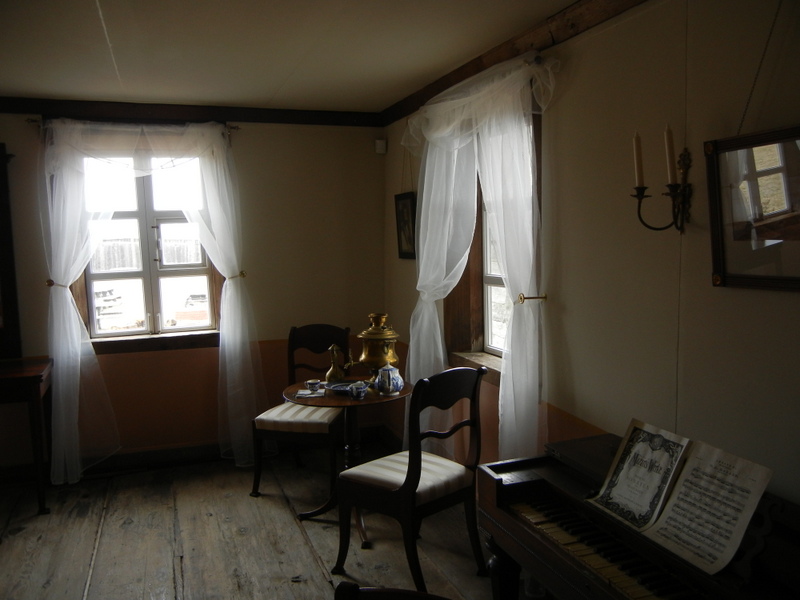
It’s too bad the Russians were all gone when Bidwell arrived; it would be interesting to have Bidwell’s impressions. I can’t find a picture of Rotchev, but the house he built at Fort Ross still stands. It is the only original Russian-built building there. (Other buildings are replicas.)

The interior of Rotchev House.

The interior of Rotchev House.

I like to imagine John Bidwell sitting in the Rotchev’s parlor, writing letters to Sutter and revising the journal of his overland trip to California.


Posted in Alexander Rotchev, Fort Ross, Uncategorized | 3 Comments

Another Russian in California

Fort Ross in 1828.

Fort Ross in 1828.

From 1838 to 1841 Alexander Gavrilovich Rotchev was the last manager at Fort Ross, the Russian-American Fur Company’s outpost in California. The Company sold the Fort and all its assets to John Sutter in 1841, and Rotchev was the man who negotiated that sale, although personally he opposed it. He believed that the Company should hold on to Russia’s foothold in the New World. We can only speculate how events might have differed if the Russians still had a presence in California in 1849.

But by 1849 Rotchev was back in St. Petersburg, where, having left the employ of the Russian-American Company, he supported himself by writing and translating. In 1849, stimulated by the newly awakened world-wide interest in California, he wrote his impressions of life in northern California before the Gold Rush.

The Overland Journal has recently published James R. Gibson’s new translation of A New Eldorado in California, by Alexander Rotchev. The following quotes are taken from his article.

What an enchanting land is California! For eight months of the year the sky is always clear and cloudless, and during the remaining months, beginning with the last days of November, it rains periodically; the heat in the shade does not exceed 25 degrees Reaumur.

That would be 88 degrees Fahrenheit, but he was on the coast, not in the Central Valley.

In January everything comes to life–the flora is in full bloom, everything is fragrant, and iridescent hummingbirds flutter and sparkle on a stalk or quiver like precious stones over the blossoms.

The virgin soil of California bears astounding fruit: I happened to see a wheat harvest of one hundred and fifty-fold there! Corn and frijoles a thousand, one hundred and fifty-fold! And with what slight effort: a pointed, curved branch, the end of which is shaped into a kind of blade, is a plow, and after scratching one and a half vershoks the plowman starts to sow.

A vershok is an obsolete Russian unit of measurement equaling 1 3/4 inches, so the farmer is planting his seed about 2 1/4 inches deep.

You pick a peach from the tree and the discarded stone falls to the ground, and after three years on that same spot you will see a mature tree and watch them pick and use its fruit!

I really think our Russian correspondent is exaggerating here, or passing on a tall tale. He was only in California three years, so I don’t think he personally witnessed this prodigy of nature. Still, California is a great place to grow fruit!

Posted in Alexander Rotchev | Leave a comment

Bidwell’s Diary, 1871

Every so often I post an entry from John Bidwell’s diary on the Bidwell Mansion Association’s Facebook page, just to give folks a taste of what he was doing all those years ago. Here are three days from the end of March, 1871:

Tues. March 28.
Went to skating rink – Weather fine except some north wind – Fulton’s Patent Plow came by express – Planting artichokes –

rollerskates

I don’t know whether it was ice or roller skating, but probably not ice–not in Chico. I would love to see John Bidwell on roller skates. Roller skating became quite the fad in the 1870’s, after James Plimpton invented the 4-wheel skate in 1863.


Wed. March 29.
Tried Fulton’s Plow – Farewell prayer meeting at study – [for] Bryant children died from eating toad stools -. Sent Hannah Maloys check for $70 to her father (Michael Maloy) – Draperstown P.O., County Derry, Ireland – Planting artichokes Wind from the north –

Maybe I’ll check the newspaper microfilm for the story of the poor Bryant children who were poisoned by toadstools. I surmise that Hannah Maloy was a servant at Bidwell Mansion. They often employed Irish maids.

Thurs. March 30.
Wind still from N. but not cold – Went over Sandy Gulch to try plow – Hill was there, also Silsby & Kleis, Cochran & R.H. Allen – Mr. Merchant went in carryall with us. Finished planting artichoke – Mrs. Bryant died –

And the children’s mother died too. Very sad.

Although almost all the artichokes grown in the U.S. today are grown in California, mostly in Monterey County, they must have been a new thing for Bidwell to grow in 1871. He was always experimenting with new crops.

fulton_plow_patentWhat was Fulton’s Patent Plow? This was another of Bidwell’s experiments. The typical plow was drawn by two horses. In 1870 David Fulton, a vintner from Napa, invented a plow that could be drawn by one horse, making it possible to plow and plant rows of grapevines closer together. Ever the experimenter, Bidwell would have been quick to try out the new tool. The David Fulton Winery still exists and you can read more about the plow and other historical tidbits on their webpage.

Bidwell, of course, was not planting wine grapes. Annie forbid! But he had just planted table and raisin grapes at Sandy Gulch, so it is not surprising that he would be eager to try out the new plow.

Posted in agriculture | Leave a comment

Nikolai and Conchita, the Conclusion

Sorry that it’s taken me so long to get around to the end of the story. But it is no where near as long as Conchita had to wait to learn the fate of her lover, Nikolai Rezanov.

Rezanov left San Francisco Bay on May 11, 1806. By June 7 the Juno was back at Sitka, where he found the colony about to go under from a combination of starvation and the threat of an attack by Tlingit warriors. The provisions and reinforcements they brought were the salvation of the Russian colony in Alaska.

Rezanov did not hasten to cross the North Pacific and begin his return trip across Siberia. He spent most of the summer in Alaska, supervising the revival of the colony and writing lengthy dispatches to the directors of the Russian-American Company and the Tsar. In his dispatches he revealed his intention to marry Conchita, but couched the news in terms of business and politics to make it palatable to his superiors.

At the end of July he set sail for Okhotsk, on the eastern shore of Russia. Arriving in late August, he started off on the trip across Siberia. He fell ill at Irkutsk (by Lake Baikal) and spent three months there, then resumed his travels, only to relapse again at the trading post of Krasnoyarsk, halfway to Moscow. He would never leave it. He died of fever and exhaustion in Krasnoyarsk on March 8, 1807.

Conchita waited, and it was not until 1808 that she heard rumors, brought by Russian otter hunters, that Rezanov had died on his way to St. Petersburg. Still she hoped, but as the years went by she must have known that he would never return. She moved with her family to Santa Barbara, and later to Monterey, when her father became governor of California in 1814. By 1818, 10 years after she first heard rumors of her fiance’s death, she was living in Mexico. As a young woman of good family and renowned beauty, she received many offers of marriage, but she refused them all.

Without exception, the men who sought my hand were worthy and honorable. After much deliberation and prayer I concluded that I could not and would not be joined in marriage to one whom I did not love . . . I felt that a certain lasting loyalty was demanded of me by a Higher Power–a loyalty to Nikolai and myself.

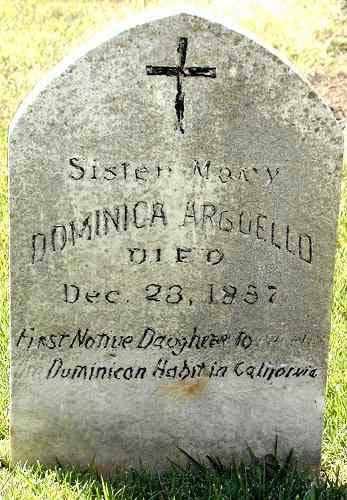
After the death of her parents, Conchita returned to California in 1829 and became a Franciscan lay sister. When a Dominican convent was established in Monterey in 1851, Conchita joined as a novice, and as Sister Maria Dominga, became California’s first native-born nun. She befriended a 13-year-old novice, and it was to this young friend, Sister Vincentia, that she confided the story of her romance with the courtly Russian. Decades later Sister Vincentia related the story to a priest, who wrote down her recollections of Conchita.

Although she never doubted as to his (Nikolai’s) deep loyalty and intense sincerity in her regard, she told me that from the evening he sailed away out through the Golden Gate she had somehow a deep, hidden, eerie feeling that stayed with her night and day.

Maria de Concepcion Arguello died at the convent in Benicia on December 23, 1854. The legend of Nikolai and Conchita, a compound of Spanish gaiety and passion and Russian melancholy and ardor, lives on in novels, poetry, and opera.

conchitatombl

The tombstone of Conchita in the nuns’ cemetery in Benicia.

The tomb of Rezanov in Krasnoyarsk, destroyed by Bolsheviks in 1932.

The tomb of Rezanov in Krasnoyarsk, destroyed by Bolsheviks in 1932.

Posted in Uncategorized | Leave a comment

Nikolai and Conchita, continued

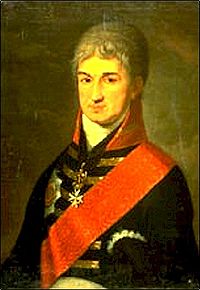
N.P. Rezanov

N.P. Rezanov

Nikolai Rezanov must have looked pretty impressive in his dress uniform, with the diamond Order of St. Anne on his breast and a laced bicorne hat under his arm. He went out of his way to be charming and courteous, and distributed presents to one and all. He was aware of the need to “hide from the Spaniards our distress and needfulness,” so no mention was made of just how bad conditions were at the Russian colony in Alaska, or the real reason that they had come to California. He assured the Spaniards that Russia had no interest in extending their colonies southward.

Conchita was smitten with this courtly, handsome gentleman, resplendent in his uniform. She had never met anyone like him; he was an emissary from another world, the world of glittering courts and grand balls. He danced with her; he told her stories of his travels in Europe, Asia, and the isles of the Pacific. She had never been farther from home than Monterey, and here was a man who had sailed around the world. In spite of her position as the daughter of the comandante of the presidio, she was leading a humdrum life in a small town in a cultural backwater. She was eager for a new life and Rezanov was the only chance she was ever likely to meet to change her fortune.

After only two weeks in California, Nikolai made a proposal of marriage to Conchita, and she accepted. Conchita began to dream of travel to Europe, of wearing beautiful dresses and meeting the noble and great. But what would her parents think?

Her parents were shocked and appalled. How could their daughter think of marrying a foreigner? He wasn’t even a Roman Catholic. It was impossible.

But Rezanov was not an expert diplomat for nothing, and a mere difference in religion was not going to stop him. If the marriage required a dispensation from the Pope, then he would see to it. He assured Conchita’s parents that once he was back in St. Petersburg, the Tsar would appoint him ambassador to Spain. He would make every necessary arrangement to bring about the marriage and return via Mexico to claim his bride. He was willing to make another trip around the world for love. And so her parents consented to a betrothal.

Many years later, Conchita told a friend how “Nikolai Rezanov came bounding into her life. How she loved him and how they planned for a life of love and happiness in far-off Russia.” Such were her dreams.

Stay tuned for the conclusion of the tale of Nikolai and Conchita.

Posted in Nikolai Rezanov | Leave a comment