The many names of the Humboldt River

“October 1st. The stream had already attained the size of which we supposed Mary’s river to be, and yet its course was due N.W. Distance 20 miles.”

Still in doubt about whether they had found Mary’s River or not, the company continued on.

Without the Humboldt River, the journey across the Great Basin would have been impossible, for Bidwell’s group or any subsequent travelers. By the time emigrants reached this point in their trek, their supplies, their animals, and their own bodies were exhausted. The river made it possible for them to traverse the harsh environment of the Great Basin.
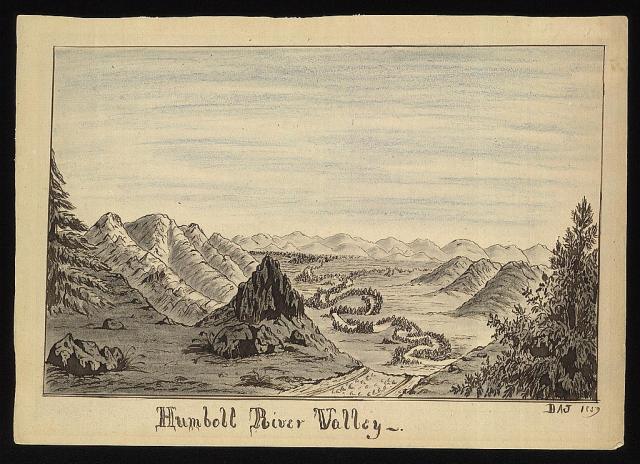
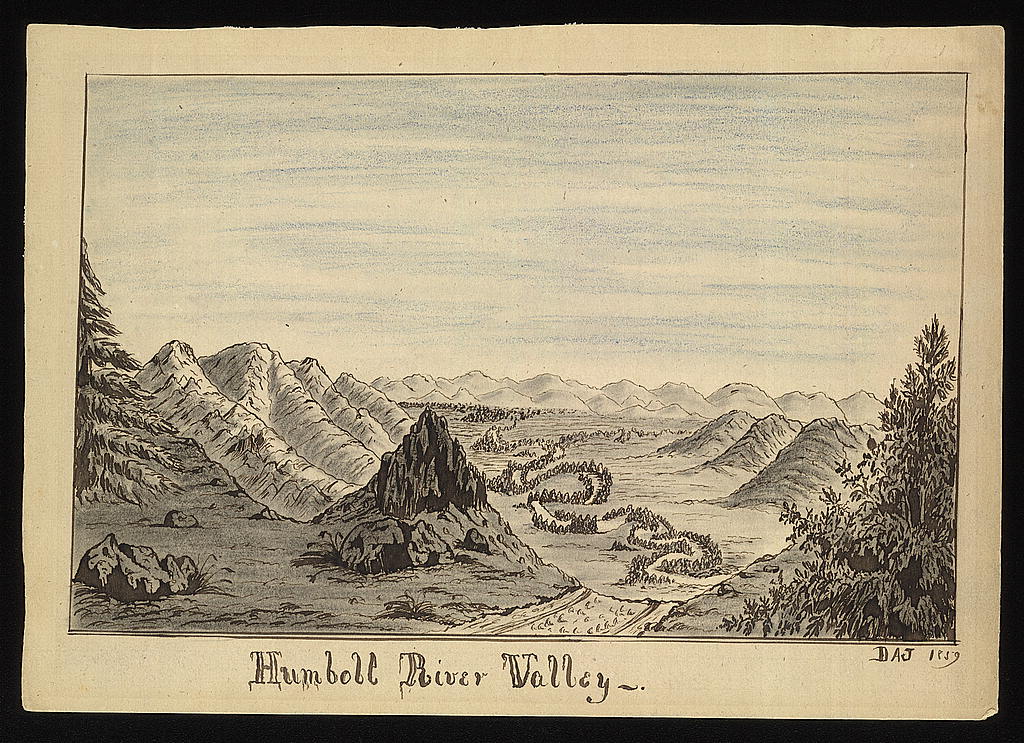
Drawing the the Humboldt River Valley by 49er Daniel Jenks.

The Humboldt was known to Bidwell as Mary’s River. Before he came that way it had had other names, and by the time the Gold Rush came the name would change again.

This area of northern Nevada was sparsely inhabited by Paiute and Shoshone Indians,  What they called this river I don’t know. The first recorded sighting of the river was on November 9, 1828, by Peter Skene Ogden, a fur trapper for the Hudson Bay Company.  Ogden explored the river for several hundred miles, making the first known map of the region. He initially named the river “Unknown River”, since he had no idea where it came from or where it went, but later he named it “Paul’s River”, after one of his trappers who died on the expedition and was buried on the river bank.

Ogden later changed it again to “Mary’s River,” after his Native American wife, and this is the name that “Broken-Hand” Fitzpatrick used.  Ogden, who couldn’t seem to make up his mind, later suggested calling it “Swampy River,” because it ended in a marshy sink.

Evidently the explorers Benjamin Bonneville and Joseph Walker hadn’t got the word about any of these names, or else they just wanted to put their own mark on the map. When they came exploring in 1833 they called it “Barren River.”  Not content with this, Washington Irving, who made Bonneville famous with his book about the expedition, called it “Ogden’s River”, a name that was used by many early travelers. But at Fort Hall they hadn’t heard of Washington Irving, and still called it “Mary’s River.”

In 1845 the river was explored by the “Pathfinder”, John C. Fremont. By his day the explorations of the German naturalist Alexander von Humboldt were well-known to all.  Humboldt had never been anywhere near either the Humboldt River or Humboldt County on the northern California coast, but his explorations of South and Central America were famous, so Fremont must have thought it fitting to give his name to this river. It’s certainly better than “Swampy River” or “Barren River.” Although I must admit “Unknown River” has a certain appeal.
Posted in Humboldt River, Uncategorized | Leave a comment

The Mighty Buenaventura River (Legend)

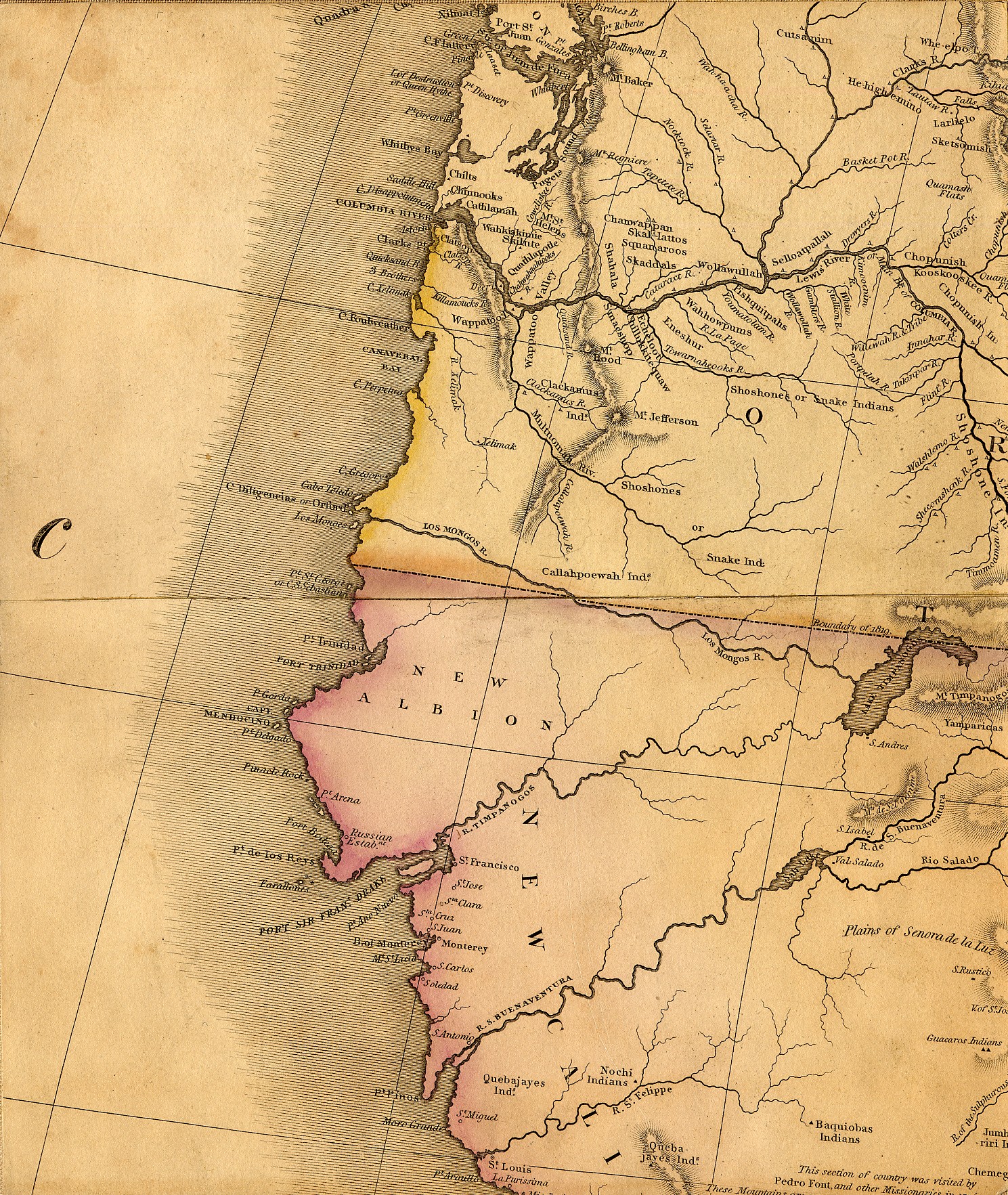
A portion of an 1822 map of North America by Henry S. Tanner

“Our ignorance of the route was complete. We knew that California lay west, and that was the extent of our knowledge. Some of the maps consulted, supposed of course to be correct, showed a lake in the vicinity of where Salt Lake now is; it was represented as a long lake, three or four hundred miles in extent, narrow and with two outlets, both running into the Pacific Ocean, either apparently larger than the Mississippi River.” (Echoes of the Past, p. 111)

The map shown above (which can be examined in its entirety at the University of Tulsa website) doesn’t correspond exactly to Bidwell’s description, but it does show two large rivers flowing from the Rocky Mountains unimpeded to the Pacific Ocean. One is labeled R. Timpanogos, and the other R. S. Buenaventura. Other maps of the period are similar.

The legend of these non-existent rivers had a fairly long life in American cartography. Explorers and settlers wanted a river that would link the Rockies to the West Coast, and make trade and transportation possible. They fastened on reports of much smaller rivers in Utah, like Green River, to create these waterways to the Pacific. You can see from the map that the distance from the Rockies to the Pacific is underestimated, and the Sierra Nevada range is not shown at all. The distance north to south, from the Columbia River to San Francisco Bay (labeled Port Sir Francis Drake) is also much less than it actually is.

With what feelings of dismay and alarm did Bidwell and his companions face the Nevada desert and the looming Sierras? By this point they knew the maps were wrong, and they were alone. Entirely dependent on their own resourcefulness, they traveled onward, with no way of knowing how far they had yet to go.

Posted in Uncategorized | Leave a comment

September 28-29, 1841

“Tuesday, 28th. Traveled about 70 miles. Several Indians came to our camp this evening–no timber excepting willows, grass plenty.”

70 miles?  How did they do that? Most days they made 18 or 20 miles, which was a good rate of travel for weary men and beasts.  Either the 70 is a typo in the printed version of the journal, or in Nunis’s The Bidwell-Bartleson Party , or else they made rafts out of those willows and traveled on the river. Bidwell doesn’t mention making any kind of watercraft.

“Wednesday, 29th. Traveled about 20 miles, course of the stream was W.N.W. According to the map Mary’s river ran W.S.W. Strong doubts were entertained about this being Mary’s river. The men who got directions at Fort Hall were cautioned that if we got too far south, we would get into the Great Sandy Desert–if too far north, we would wander and starve to death on the waters of the Columbia, there being no possibility of getting through that way. We had now been 6 days on this stream, and our course had averaged considerably north of west.”

Between Elko and Battle Mountain the Humboldt River runs west, and then at Battle Mountain it takes a turn north and runs northwest for some 50 miles. This is where Bidwell & Co. got very worried. If they kept going north they were going to end up in those bewildering canyons they had been warned about.

I didn’t think that the group had a compass with them, but Bidwell frequently indicates their direction. Someone may have had a compass after all, or maybe he was simply estimating the direction by the sun. He mentions a map, but they definitely did not have a map. There was not an accurate map to be had. Possibly the men who went to Fort Hall had seen a map.

Bidwell had been shown a map of the West before he left Missouri. It showed two mighty rivers flowing out of the Great Basin all the way to the Pacific Ocean. Possibly that was the map he had in mind.  That map, which he had seen at the home of Elam Brown, where he boarded during the winter of 1840-41, showed both rivers traveling southwest to the sea. No wonder he was worried.

Posted in Humboldt River, Uncategorized | Leave a comment

September 26, 1841

“Sunday, 26th. The valley, seen yesterday evening, was but 4 or 5 miles in length and led into another difficult defile, though not so long as the one of yesterday, for we passed it into another valley. Distance 18 miles–the stream continued to increase in size.”

They were by now on Mary’s River, but didn’t know it. They were still unsure of their position.  How do you know you have gotten to the place you have been looking for, when you don’t know what it looks like, and there are no signposts?

In Echoes of the Past Bidwell states that the day after some men climbed up the precipice and saw a valley a few miles ahead, they arrived at the river. This would have been the 26th. “By one o’clock that day [we] came out on what is now known as the Humboldt River.” But this is looking back from the vantage point of 40 years later. At the time, in his journal, the company debates their position for several days before they decide that they are indeed headed in the right direction.

Posted in Humboldt River, Uncategorized | Leave a comment

September 24-25,1841

“Friday, 24th. As we descended the stream it rapidly increased in size, and proved to be the branch of a larger stream. The country was desolate and barren, excepting immediately on the streams . . .”

“Saturday, 25th. The creek became perfectly dry and its banks rose to high perpendicular precipices, so that there was no other road than the dry bed of the stream. Having come about 15 miles, we encamped in a place affording a little grass and water, where we could see nothing but the sky. But the men who ascended the precipice to see what was in the prospect ahead said that in about a mile we would come to a valley–this was delightful news.”

Humboldt River, Nevada

For a larger version of the map see http://en.wikipedia.org/wiki/File:Humboldtrivermap.jpg

Traversing the stony dry creek bed made the animals “tender-footed and sore,” a new worry to add to their many others.  The prospect was gloomy; this canyon was leading them directly north, not west or south, and the advice they had been given at Fort Hall warned:

“You must not go too far north; if you do you will get into difficult canyons that lead towards the Columbia River, where you may become bewildered and wander about and perish.”  Could they be too far north, when just days before they had been too far south?

But the report of the scouts who climbed up the the top of the cliff gave them heart.  There was a valley and a river ahead, and it might be Mary’s River.

I surmise that they were on one of the creeks that flows out of the Ruby Mountains north to the Humboldt River, about halfway between present day Elko and Wells. Or possibly they were on a stream that would take them to the South Fork of the Humboldt, and thence north to the river.

Posted in Humboldt River | Tagged | Leave a comment

September 23, 1841

“Thursday, 23rd.  We could see no termination of the valley, nor any signs of Mary’s river. We therefore concluded that we were too far south, and passed over the mountains to the north, where we struck a small stream running toward the NW. On this we encamped and found plenty of grass, a few fish were caught, some of which were trout, which led us to the conclusion that this was a branch of Mary’s river. Distance 18 miles.”

Back on September 9th Captain Bartleson and another man had returned from a scouting trip with the news that the head of Mary’s River (the Humboldt River) was only 5 days travel away.  Two weeks later the company still hasn’t reached the river, and Bidwell makes no mention of Bartleson’s exploration. Were they following the trail forged by Bartleson? It doesn’t seem so. Instead, the men were questioning the four who had gone to Fort Hall for instructions.  What was the advice?

“If you go too far south you will get into a desert country and your animals will perish; there will be no water or grass.” Well, they had seen some of that, which is why they turned northward. But it wouldn’t be long before they would be quizzing the men again, because the other half of the instructions said:

“You must not go too far north; if you do you will get into difficult canyons that lead towards the Columbia River, where you may become bewildered and wander about and perish.” A difficult canyon was exactly what they soon found themselves in.

What a dilemma! North, south, desert, canyon, was there no end to the search for Mary’s River?

Posted in Uncategorized | Leave a comment

September 22, 1841

“Wednesday, 22nd.  This morning 80 or 90 Indians were seen coming full speed from the W. Many had horses–one was sent about a half a mile in advance from the rest–so we ought also to have done, but Capt. B. was perfectly ignorant of Indian customs, and the whole band of savages were suffered to come directly up to us, and almost surround our camp, when Mr. B. Kelsey showed by forcible gestures they would be allowed to proceed no farther. The Indians were well armed with guns and bows and arrows. The only words I recollect hearing Capt. Bartleson say were “let them gratify their curiosity!!”

This incident further sunk Bartleson’s reputation in John Bidwell’s eyes. The custom on the plains was for parties meeting for the first time to send out “ambassadors” to check each other out and find out what the other party’s intentions were. Did they want to trade? Did they need help? Or were they looking for trouble? Bartleson, by carelessly ignoring this custom, was endangering the entire company.

The Indians, as it turned out, were Shoshones, and friendly, although obviously capable of inflicting damage if they so chose. “Besides,” says Bidwell, “they were not a little acquainted with warfare, for they undoubtedly visited the Buffalo Country (having many robes) which requires much bravery to contend with the Blackfeet and Chiennes, who continually guard their buffalo in the region of the Rocky mountains.”

The Indians did want to trade, and offered a dressed buckskin for a handful of ammunition. They then rode on either side of the Bidwell-Bartleson Party for several hours, until they gradually dropped off and went their way.

Posted in Uncategorized | Leave a comment

September 21, 1841

“Tuesday, 21st.  Hunters returned; many antelope were seen and 2 or 3 killed. About 10 o’clock a.m. as we were coasting along the mountain in a W. direction, we came to some hot springs, which were to me a great curiosity. Within the circumference of a mile there were perhaps 20 springs, the most of which were extremely beautiful, the water being so transparent we could see the smallest thing 20 or 30 feet deep. The rocks which walled the springs, and the beautifully white sediment lodged among them, reflected the sun’s rays in such a manner as to exhibit the most splendid combination of colors, blue, green, red, etc. I ever witnessed. The water in most of them was boiling hot. There was one, however, more beautiful than the rest; it really appeared more like a work of art than nature. It was about 4 feet in diameter, round as a circle, and deeper than we could see–the cavity looked like a well cut in a solid rock, its walls being smooth and perpendicular. Just as I was viewing this curiosity, some hunters came up with some meat. We all partook, putting it into the hot spring, where it cooked perfectly done in 10 minutes—this is no fish story!”

George R. Stewart, in The California Trail, writes: “One sure point is marked by the hot springs which they passed on September 21 and which Bidwell described in some detail. These beautiful springs still bubble out near the base of the Ruby Mountains, just as they did when Bidwell saw them.”

If I can find any more information about where these springs are, or any pictures of them, I’ll add that in a subsequent post.

Posted in Uncategorized | Leave a comment

September 18-19, 1841

“Saturday, 18th. Morning found us on the east side of a mountain not far from its base but there were no signs of water; the lost oxen not having come up, I, in company with another young man, went in search of them while the company went on, promising to stop as soon as they found water. I went back about 10 miles, but found nothing of their trail–the sun was in a melting mood–the young man became discouraged and in spite of all my entreaties returned to the company.”

The young man who went with John Bidwell to search for the oxen was “Cheyenne” Dawson. Under the hot summer sun he gave up, saying that there were plenty of cattle in California. Which was true, but Bidwell had to go on, since the oxen were carrying everything he possessed.

Water in the company was in very short supply. Before they left on their search they were given about a half cup (4 oz.) of water each. This was all they had until the next day.

“About an hour after [Dawson departed] I found the trail of the oxen which bore directly north. After pursuing it some distance, I discovered fresh moccasin tracks upon the trail, and there began to be high grass, which made me mistrust the Indians had got the oxen. But my horse was good and my rifle ready. . . . But what made me most anxious to find the oxen was the prospect of our wanting them for beef. We had already killed 4 oxen and there were but 13 remaining, including the lost ones, and the Co. was now killing an ox every two or three days.”

After 10 miles of following their tracks, Bidwell found the oxen where they had stopped to lay down in the grass. He got them up and moving, hastening to rejoin the company. They had promised to stop and wait for him when they found water.

“I traveled all night,and at early dawn came to where there was plenty of water and where the company had taken their dinner the day before, but they had failed to stop for me according to promise.” (Bidwell was decidedly miffed at this.) He searched in ever widening circles until he saw three men who were coming to find him.

“It was a great relief. I felt indignant that they party had not stopped for me–not the less so when I learned that Captain Bartleson had said, when they started back to find me, that they “would be in better business to go ahead and look for a road.” He had not forgotten certain comments of mine of his qualities as a student of Indian character.”

Obviously there was no love lost between those two. Bidwell, who considered himself a good judge of character and a man of “self-possession,” considered Bartleson to be a hot-headed ignoramus. Certainly it is true that Bartleson would do nothing in the future to distinguish himself.

Posted in Uncategorized | Leave a comment

September 15-17, 1841

I’m still playing catch-up with John Bidwell.  When last we saw our intrepid band of 32 men, 1 woman, and a baby, the Kelseys had abandoned their wagons and packed everything on horses. On the 15th, after “two or three fatiguing days,” the rest of the company decided to do the same.

“Thursday, 16th. All hands were busy making pack saddles and getting ready to pack.”

In “Echoes of the Past” Bidwell describes the process. “On Green River we had seen the style of packing saddles used by the trapping party, and had learned a little about how to use them. Packing is an art, and something only an experienced mountaineer can do well so as to save his animal and keep his pack from falling off. We were unaccustomed to it, and the difficulties we had at first were simply indescribable. It is much more difficult to fasten a pack on an ox than a mule or a horse.

The trouble began the very first day. But we started, most of us on foot, for nearly all the animals, including several of the oxen, had to carry packs. It was but a few minutes before the packs began to turn; horses became scared, mules kicked, oxen jumped and bellowed, and articles were scattered in all directions.”

It was a scene both comic and desperate. As they went along those who had their packs tied securely got ahead, while others lagged behind to pick up the items that fell by the wayside and repack their animals. On the 17th they traveled throughout the day and into the night. They crossed a dry plain, where the salt on the grass in the moonlight, and the cool evening nighttime temperature, gave the impression of a winter scene. During that night Bidwell’s two oxen went astray.

“Two of the oxen that were carrying packs got lost from the Company in the night, about 8 miles from where we encamped, but it was supposed they would follow on.” But they didn’t, and Bidwell had to go in search of them.

Posted in Uncategorized | Leave a comment