September 12, 1841

“Sunday, 12th. Mr. Kelsey left his wagons and took his family and goods on pack horses, his oxen not being able to keep up. Distance today about 12 miles.”

The Bidwell-Bartleson Company party was finding out just how arduous travel in the desert could be. Their wagons bogged down in the dry sandy soil, and the travel-weary oxen had not the strength to pull the wagons through the shifting sand. Precious time was passing while they struggled to move the wagon train along.

When their animals could no longer drag the wagons through the sand, Ben and Nancy Kelsey decided to abandon the wagons and pack all their goods on the horses. The rest of the company would do the same shortly.

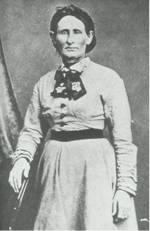
Nancy Kelsey many years later. This is the only photograph of her.

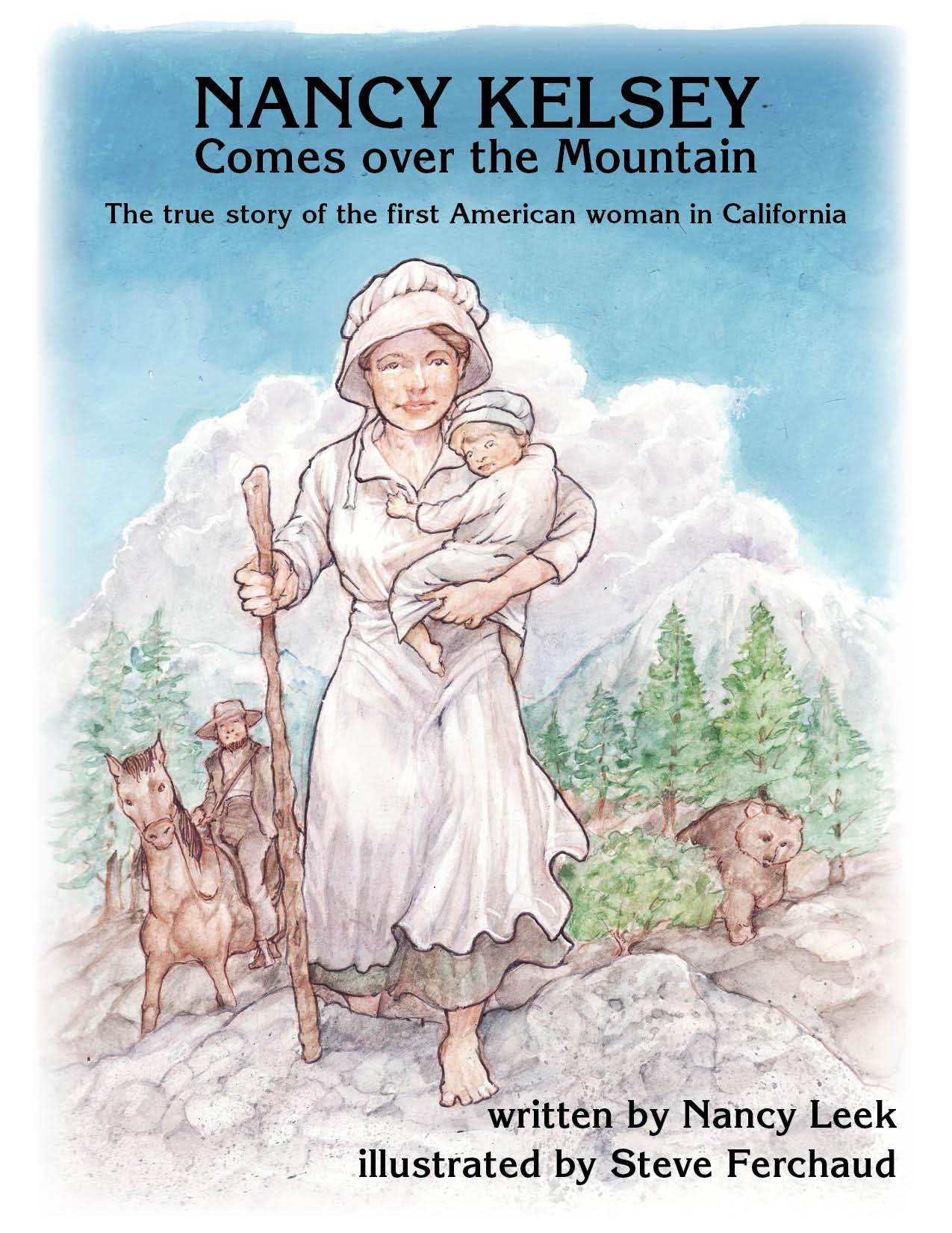
Benjamin Kelsey must have had two wagons, pulled by oxen, as well as horses to ride. His wife Nancy rode most of the trail on a horse, with baby Ann riding in front of her.  Ann was about one year old, and Nancy was eighteen.

Nancy was the only woman in the group that headed for California. She had said goodbye to her sister-in-law and the other women when the company split in two at Soda Springs. When people asked Nancy why she had ever started on such a difficult journey into unknown dangers, she said, “Where my husband goes I can go. I can better stand the hardships of the journey than the anxieties for an absent husband.”

Posted in Uncategorized | Leave a comment

September 9, 1841

I have fallen behind on the trail!  John Bidwell & Company are getting ahead of me. Let’s go back a week and see where our intrepid pioneers were on Sept. 9th.

“Thursday, 9th.  The part of the Company that remained yesterday went on and overtook the 2 wagons.  Capt. Bartleson & Hopper returned, bringing intelligence that they had found the head of Mary’s river—distant about 5 days’ travel. Distance traveled today about 12 miles S.W. direction. The Indians stole a horse—day cool. ”

Two wagons (or the men with them) had gotten tired of waiting and moved on ahead a couple of days previous. Then on the 5th the rest of the Company began moving forward, with the aim of meeting up with the returning scouts, “grass having become scarce” where they had camped for a week.

At last on the 9th Bartleson came back with the cheering news that Mary’s River (the Humboldt) was only 5 days away. The company pressed on, unaware that it would take more than 5 days to get to the river.

Posted in Uncategorized | Leave a comment

September 3-4, 1841

“Friday, 3rd. Four or 5 Indians came to camp–bought three horses of them.

Saturday, 4th.  Bought a few serviceberries of the Indians.”

Bidwell & Co. were still encamped by a spring in the foothills, while Capt. Bartleson and one other man went ahead to search for Mary’s River. Their animals were worn out and under-nourished, and they stayed here a week to allow the livestock to recuperate.

Bidwell doesn’t say who in the company bought the horses, but he may have bought one of them. He didn’t start out the journey with a horse, but pretty soon, when he has to go looking for his two lost oxen, he will have a horse to ride. So either someone loaned him a horse, which seems unlikely, or he bought one along the way.

The local Indians—Shoshones—were happy to trade horses, game, or berries for cartridges and other useful items. The travelers were still wary of the Indians, because they never knew whether the natives they encountered would be friendly or not. But once they had established a friendly trading relationship, things went well.

Posted in Uncategorized | Leave a comment

August 29-September 2, 1841

“Sunday, 29th. Capt. Bartleson with C. Hopper started to explore the route to the head of Mary’s river, expecting to be absent about 8 or 9 days–the Company to await here his return.

Monday, 30th. Nothing of importance occurred.

Tuesday, 31st. No success hunting.

September. Wednesday, 1st. An ox killed for beef.

Thursday, 2nd. Idle in camp.”

Having found “an excellent spring of water” in the foothills on August 27, the Company decided to stay put until the route ahead to Mary’s River (the Humboldt River) could be explored. They had determined to “run no more risk of perishing for want of water in this desolate region.” This was the best they could do under the circumstances, with no map and no guide.

Thomas “Broken-Hand” Fitzpatrick had given them the idea that they would come to the river a few days west of the Great Salt Lake, and by following the river they could cross “this desolate region.”  But he wasn’t really very familiar with this part of the territory, and they hadn’t found it yet. The head of the river was actually more than 100 miles from where they were now located, some 50 miles northwest of the Great Salt Lake.

So Captain Bartleson went off to explore, and the rest of the company settled in to wait. They had met a few Shoshone Indians, and traded with them for venison and berries, using cartridges of powder and ball as currency. Their only worry was, would they be able to make it across the desert and the mountains before winter blocked the way?

Posted in Uncategorized | Leave a comment

130 years of Casaba Melons, part II

Back in May I planted the seeds, and now this has invaded my kitchen.It looks like something from a space aliens movie. What is it?

It’s a Casaba melon, and this is my best year yet growing Casabas. This one is a typical specimen. It weighs about 20 pounds. Casabas are huge football-shaped melons from Turkey, first grown in California (and maybe the United States) right here in Chico by John Bidwell. I got the seeds last year from Seed Savers Exchange, and this year planted seeds that I saved from last year. 

They are absolutely delicious. Out-of-this-world wonderful. The flesh is pretty much the same as a cantaloupe, but better than any cantaloupe I’ve ever had—creamy, sweet, yummy, and highly aromatic. The only problem is getting in the fridge.

For some reason, there is another melon that goes by the name casaba, which is more like a honeydew, and not as sweet as a Bidwell Casaba.  As far as I know, this is the real deal, just like General Bidwell used to grow.

Posted in Casaba melon | Leave a comment

August 26, 1841

“Thursday, 26th. Traveled all day over dry barren plains, producing nothing but sage, or rather, as it ought to be called, wormwood, and which I believe will grow without water or soil. Two men were sent ahead to search for water, but returned a little while before dark, unsuccessful.

Our course intersected an Indian trail, which we followed directly north towards the mountains, knowing that in these dry countries the Indian trails always lead to the nearest water. Having traveled till about 10 o’clock p.m. made a halt, and waited until morning. Distance about 30 miles.”

This was one of those days when they traveled all day in the hot sun, hoping to find fresh water, and saw nothing but sand, salt, and sagebrush. Another day like that might have killed them all.

Sagebrush will certainly grow with very little water. Although its scent is similar to sage, it is not related to true sage (Salvia). It is a species of the genus Artemisia, which also includes wormwood and tarragon, so Bidwell got his plant identification right. It covers large swaths of the Western plains, and is the state flower of Nevada.

Posted in Uncategorized | Leave a comment

August 24, 1841

“Tuesday, 24th.  Cattle strayed this morning to seek water–late start–day was warm–traveled about 10 miles in a W. direction, encamped where we found numerous springs, deep, clear, and somewhat impregnated with salt. The plains were snowy white with salt. Here we procured salt of the best quality. The grass that grew in small spots on the plains was laden with salt which had formed itself on the stalks and blades in lumps, from the size of a pea to that of a hen’s egg. This was the kind we procured, being very white, strong and pure.”

10 miles in a day was good progress under the conditions.  Oxen could pull a wagon at 2 or 3 miles per hour for about 5 hours a day, so 15 miles a day was pretty much the maximum. But day after day of 10-15 miles a day would wear a team down. They had to eat, they had to have water, and they had to have rest.

By the time Bidwell & Co. got to the Great Basin, they had been traveling for nearly four months. The last few weeks had been especially hard on the animals. They couldn’t keep up this pace–not on salty water and dry grass. Bidwell and his friends were finding that they had to rest the animals more and more often, and indeed on the 25th they would stay put, giving the oxen a chance to recuperate. But they couldn’t afford to delay either, so the next day they would harness up the oxen and be on the trail again.

Posted in Uncategorized | Leave a comment

August 22, 1841

“Sunday, 22nd.  This morning a man (Mr. Brolaski) returned from the Fort, and said the reason why he came alone was the other men had left him, because he was unable to keep up with them; he having a pack horse laden with provision. He had seen the paper at the intersection of the trails, and was guided by it to the camp; the other were undoubtedly going the rounds of the triangle. Sure enough, they came up in the afternoon, having gone to the river and back; no pilot could be got at the Fort. . . . They procured flour at 50 cents per pint, sugar same price, and other things in proportion. Near where we were camped here were a few hackberry trees.”

Hackberry trees bear small, sweet, edible fruit resembling cherries. That must have been welcome, although Bidwell also mentions finding excellent chokecherries.

The lack of a pilot was not welcome news. The company badly needed a guide across the Great Basin, but there was none to be had. They were on their own. Cue the ominous music.

Posted in Uncategorized | Leave a comment

August 21, 1841

“Saturday, 21st. Marched off in a NW direction, and intersected our trail of Thursday last, having made a complete triangle in the plain. At this intersection of the trails we left a paper elevated by a pole, that the men returning from Fort Hall might shun the tedious rounds we had taken. Found grass and water which answered our purpose very well, though both were salt. Distance ten miles.”

Having passed unawares through Cache Valley, they reached the point at which the Bear River emptied itself into the Great Salt Lake. Thomas Fitzpatrick had told them to turn west before they reached the lake, in order to find the Humboldt River, so they headed northwest, crossing their tracks in the process.

They were still waiting for the four men who had gone to Fort Hall for provisions and a much hoped-for guide to catch up with them. Clearly they could have really used a guide. It would get worse before it got better.

Posted in Great Salt Lake | Leave a comment

August 19, 1841

Bidwell & Co. were traveling slowly southward through Cache Valley, in what is now northern Utah. Sometimes they followed the Bear River, other times they had to leave the river and “journey over hills and ravines, going to almost every point of the compass to avoid them.” It was August, the weather was hot, and basically they were lost.

“Thursday, 19th. Started early hoping soon to find fresh water [they had found none the day before], when we could refresh ourselves and our animals, but alas! The sun beamed heavy on our heads as the day advanced, and we could see nothing before us but extensive arid plains, glimmering with heat and salt. At length the plains became so impregnated with salt that vegetation entirely ceased; the ground was in many places white as snow & perfectly smooth–the mid-day sun, beaming with uncommon splendor upon these shining plains, made us fancy we could see timber upon the plains, and wherever timber is found there is water always. We marched forward with unremitted pace till we discovered it was an illusion, and lest our teams should give out we returned from S. to E. and hastened to the river which we reached in about 5 miles.”

It sounds like they were wandering around the Bonneville Salt Flats, but that area is further west. They were actually a few miles north of the Great Salt Lake, in a similar desert region that is still largely uninhabited.

The water was so salty that they couldn’t use it, and yet they had to use it or die of thirst. “It would not quench thirst, but it did save life.” They would spend several days in this perilous region before they found good water.

Posted in Uncategorized | Leave a comment