Friday, 28th: Started about sunrise, travelled about 5 miles and stopped to take breakfast. The heat was oppressive and we were compelled to go 20 miles farther before we came to either wood or water. The stream on which we camped is a fork of the Kanzas and is well known to all the mountaineers, by the name of the Big Blue; an antelope was killed.
They are in the northeast corner of Kansas, traveling toward Nebraska. (All of this was Indian Territory at the time.) It still sounds like a typical camping trip: the weather is hot and they have to go farther than they expected to find good accommodations.
Thursday, 27th: Started late, being detained at repairing the waggons. The day was warm, but the evening mild and pleasant. Encamped in a commodious valley, well-watered by a beautiful little stream which glided smoothly through the scattering grove, come about 15 miles.
Sounds like a typical camping trip: a little delay with the vehicles, but altogether a pleasant day and a lovely camping spot. The next few days will be like this — rather mundane. More exciting events are yet to come.
Wednesday, 26th. Two wagons were broke today; about a dozen Pawnees came to our camp, stopped to repair the wagons, having come about 15 miles. A deer was brought in by C. Hopper.
Charles Hopper was a native or North Carolina and an expert hunter. He later brought his family to California and settled in the Napa Valley.
A man by the name of Williams, a Methodist preacher, overtook the company this evening on his way to Oregon Territory. He had not arrived in time to start with the company from the settlements, and had traveled entirely alone, without any gun or other weapon of defense, depending wholly on Providence for protection and support.
The Reverend Mr. Joseph Williams was 64 years old in 1841 when he set out to visit the Protestant missionaries in Oregon. (You may recall that Marcus and Narcissa Whitman had gone to Oregon in 1836 to proselytize the Indians.) He was the oldest member of the Bidwell-Bartleson Party. He left a short record of his experiences on the trail entitled Narrative of a Tour from the State of Indiana to the Oregon Territory in the Years 1841-2.
Williams intended to go west with the members of the Western Emigration Society, but on arriving at Westport found that they had already departed. “With much pain of mind” he went to the Shawnee Mission to consult with his Methodist brethren. There he learned the the company was only four days ahead of him. “I said within myself, surely the Lord is opening my way to go on.”
His church brethren tried to dissuade him from going, saying, “It was almost presumptuous for so old a man as I to attempt such a hazardous journey,” but Williams felt the call of God and was determined to answer it. He set off to catch up with the company, traveling with another missionary and “two Indian chiefs of the Caw Tribe.”
On the 26th he rode across the prairie, “happy in my soul,” until about 4 o’clock, when he spotted the company a few miles ahead. He stopped to feed his horse, then traveled on and by evening he joined the company. They told him how narrowly he had missed being captured by Indians. Williams didn’t seem particularly surprised, for he was confident that God was watching over him.
Passed the stream without much trouble and made a stretch of about 20 miles when we encamped on the border of a beautiful forest where we found plenty of grass and water. The country over which we passed was similar to that of yesterday.
Wood, water, and grass were the holy trinity of pioneer travelers. They could get along a few days without wood for fuel (and use buffalo chips instead), but they could not do without water and grass for their animals. The journey could not begin until the grass began to grow on the prairie, which is why wagon trains always left in mid-April or early May.
Twenty miles in a day was good traveling. Oxen could only make about two miles an hour, so that’s ten hours on the move. Plenty of time had to be given morning, noon, and evening for the oxen to graze, too.
Monday, 24th. Travelled about 13 miles today over rolling prairies and arrived at the Big Vermillion, a branch of the Kanzas. Here we were obliged to stop, the water being so high as to render it impossible to cross the waggons.
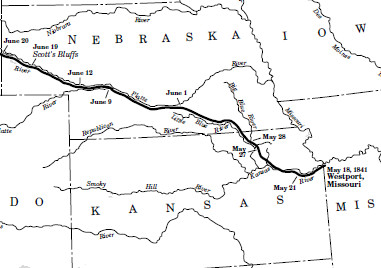
Detail of map from The Bidwell-Bartleson Party, by Doyce B. Nunis. Used by permission.
The river that Bidwell calls the Big Vermillion is the little unlabeled tributary of the Kansas River on this map, located between the dates May 21 and May 27. They are making their way to the Platte River, the highway to the west.
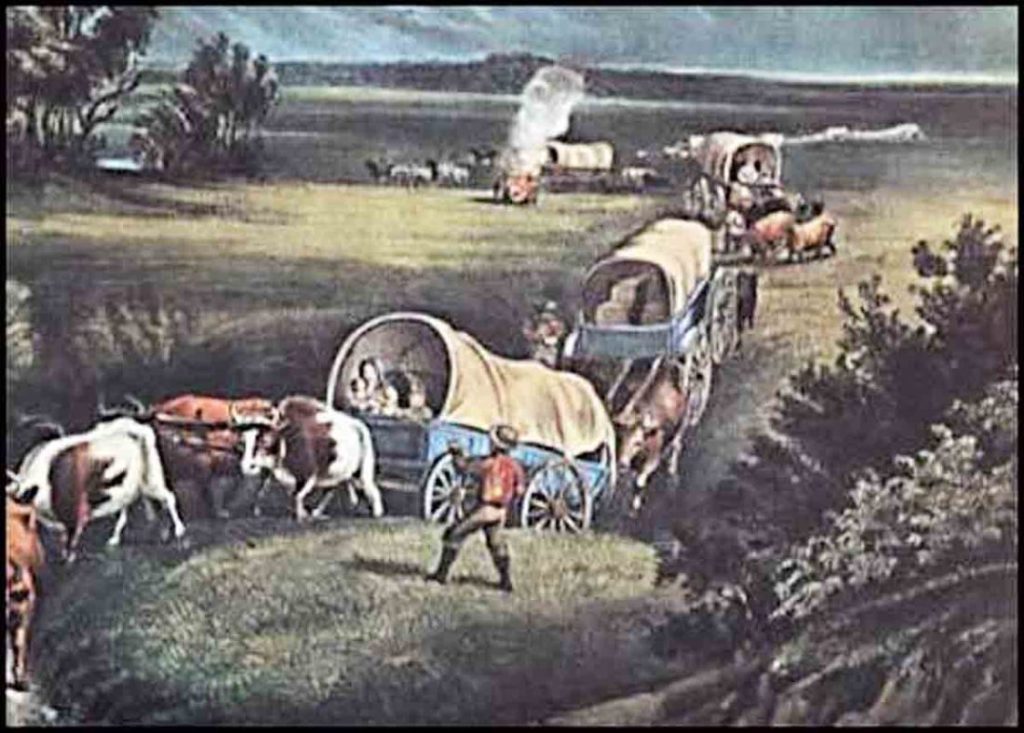
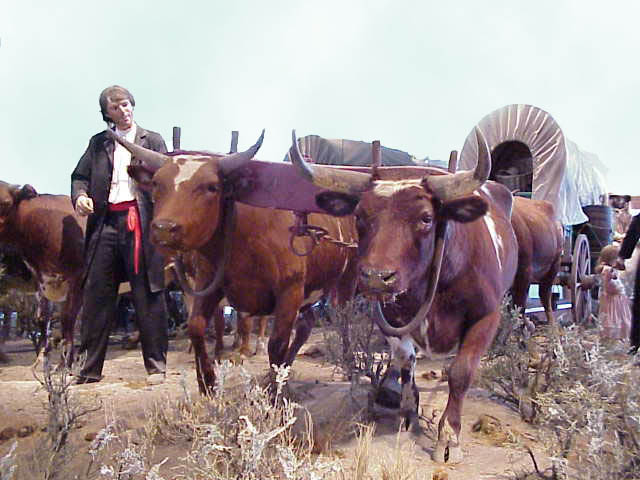
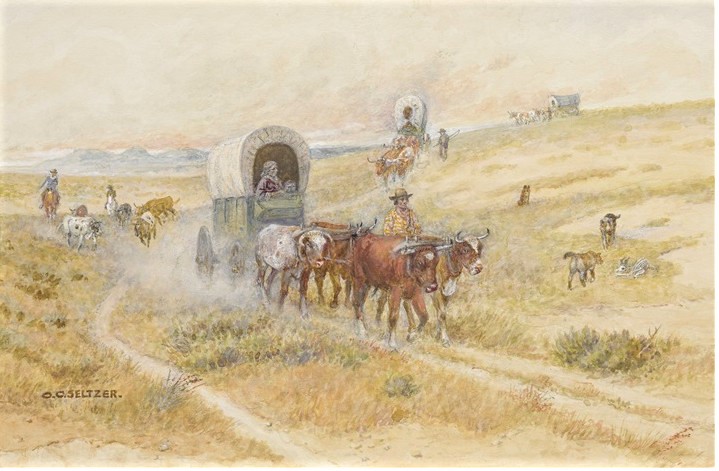
You might be picturing John Bidwell seated on the wagon, driving his oxen, but that was not the way that oxen were driven. They were not guided by reins like horses or mules. The driver walked alongside the lead ox and guided it with a stick. John Bidwell would walk all the way to California.
Sunday, May 23rd: All the oxen were gone this morning excepting nine. There was considerable complaint among the company, some saying at this slow rate of traveling we would have to winter among the Black Hills, and eat our mules etc. We, however, made a start about 9 in the morning, proceeded about nine miles and stopped to wait for Chiles’ wagon which overtook us about 5 P.M.; 14 Pawnees were seen by the wagon, well armed with spears etc. It was supposed they were on an expedition against the Kanzas.
Joseph Chiles was a member of the Western Emigration Society, but a little behind the others in getting started, and had to do some catching up. Once he and the men with him got with the main party, they were probably able to make better time, although the trip was slow going. Fifteen to twenty miles a day was the best they could do. They wouldn’t have to winter in the Black Hills, but the mules were another matter (and another meal).
Saturday, 22nd. Started at six o’clock this morning, traveled about 18 miles, high rolling prairie, encamped on a small stream, shaded by a few willows.
That was an average day. 18 miles was a decent distance. Just moving along over the prairie with nothing much to report.
Friday, 21st. Our oxen left us last night, and it was 9 o’clock before we were all ready to start, passed a considerable stream called Vermillion, a branch of the Kanzas. On its banks were finer timber than we had heretofore seen, hickory, walnut, &c. &c. The country was prairie, hilly and strong; we passed in the forenoon a Kanzas village, entirely deserted on account of the Pawnees, [we] encamped by a scattering grove, having come about 15 miles.
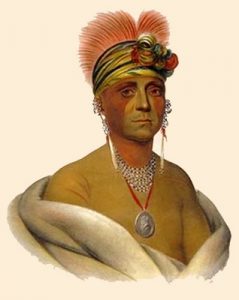
On the 19th the emigrants had met some well-armed Kansas (Kaw or Kanza) Indians. who were expecting an attack by the Pawnees, in retaliation for an attack by the Kansas on a Pawnee village a short time before. The Kaw and the Pawnee were traditional enemies whose hostility had been intensified by pressure from the westward movement of American settlers.
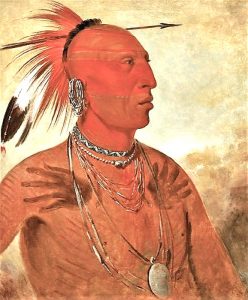
Kanza chief
The fear of meeting hostile Indians was one of the chief concerns of the members of the Bidwell-Bartleson party. Under the guidance of Thomas Fitzpatrick, who was well-acquainted with the Plains Indian tribes, they were able to avoid coming between rival native bands.
Thursday, 20. The day was tolerably pleasant. Our road was interrupted by small streams which crossed our course in every 2 or 3 miles during the day. The land was prairie, except the narrow groves which accompanied every stream — timber principally, burr-oak, black walnut, elm and white hickory. Traveled this day about sixteen miles and encamped in a beautiful grove of timber, through which meandered a small stream.
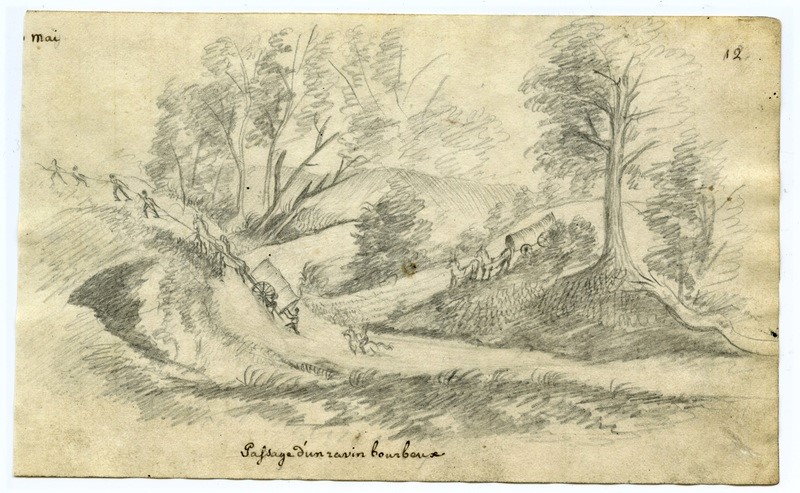
Father Nicholas Point made several pencil sketches along the way. This one, “Passage of a Muddy Ravine,” shows how the wagon train negotiated those narrow groves and stream beds. The Nicholas Point Missionary Drawings Collection can be accessed at the Jesuit Archives.



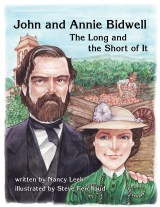
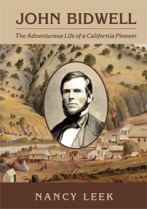
 goldfields