Brother to Brother

John Bidwell 1850

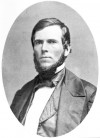
John Bidwell in 1850

John Bidwell spent the summer and fall of 1850 in New York City and Washington, D.C., waiting for Congress to pass the bill that would make California a state of the Union. Once that was accomplished, he took the statehood papers and boarded a steamship to return to California. With him went his younger brother, Thomas. (Unfortunately, I don’t know of any photograph of Thomas.)

Thomas J. Bidwell was twenty-eight years old, two years younger than John. He had been teaching at a school for boys in Westchester, New York, but big brother John persuaded him to come to California. John Bidwell desperately needed a trustworthy man on his ranch, especially since he would be returning to the legislature in San Jose and would not be able to spend much time at Rancho Chico.

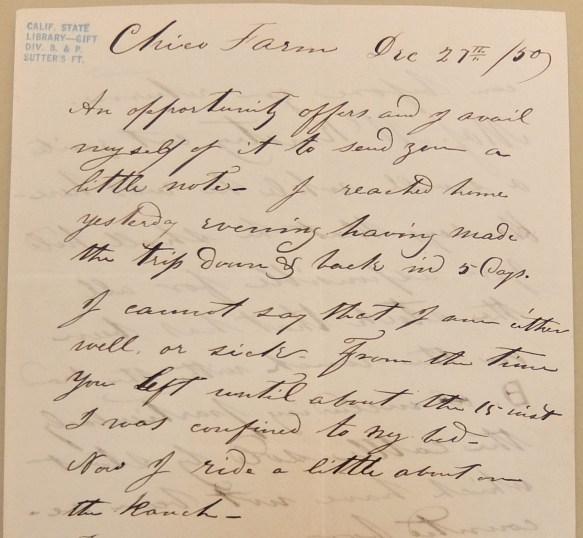
Several letters that Thomas sent to John in December 1850 give a good idea of the difficulties the young man was facing.

Dr. Brother

I have just hired a vaquero so that you need trouble yourself no more about it. I could not do without one. I have no one here now but Charley Haskell.

Yours in haste,  Thos. J. Bidwell

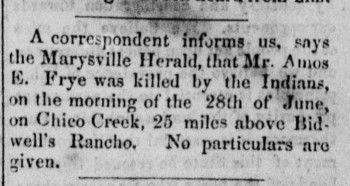
In the following letter Thomas mentions Amos Frye. Frye had crossed the plains in 1841 with the Bidwell-Bartleson Party, and John Bidwell ran into him again when he went back east. Maybe he talked him into coming back to California too. Potter owned land on the south side of Chico Creek that Bidwell would later acquire.

I don’t know who the Alfred family were, but they seem to be bad news.

Sacramento City, Dec. 25, 1850

Dearest Brother

You may be astonished to receive a letter from me dated Sac. etc. but having heard nothing from you since yours by Mr. Frye, I feared lest you might be very sick and in need of me. If ever you were needed at the ranch it is now. Brown has over 2000 head of stock on the ranch which gives us a great deal of trouble. Old Potter is playing the very devil. He has made several rodeos [?] of the wild cattle without notifying me at all and in separating his stock from ours, he has taken all the yearlings and branded them with his iron. I have forbidden him to meddle with the stock again without my knowledge & consent. I have sent away Fenston & the two Robinsons! and hired two first-rate young men. Stout has returned and gone up on the Feather River to mine. Mariano returned with him and staid with me a few days, but I have sent him away and if I had my way not one soul that Stout left would remain. And I believe you will soon have to send the Alfred family off unless you are resigned to let your house become a whore house.

I have bargained for 40 yoke of oxen and shall go after them in about 8 days do come home before that time of you can. We have sown about 20 acres of wheat, am now building a corral. Mr. Frye renders great service to the ranch.

I would come to see you but I hear that you are recovering from your illness. I have much to tell you only come and give me a chance. I can say nothing of our Friends here, for I have seen no one except Grant.

Come, come as soon as you can. I shall leave for home next Thursday.

If possible procure the necessary garden seeds, sweet potatoes, yams, etc. etc.

Yours affectionately,  Thomas J. Bidwell

P.S. McKinstry has sold his interest in the ranch to his brother Maj. Mc, who is now at the ranch. He wishes a division of the land & stock.

In 1850 Bidwell owned half of Rancho Chico and his former partner in business, George McKinstry, owned the other half. George sold his half to his brother Justus McKinstry, who would sell it to Bidwell in 1851.

In the following letter, “boys” refers to the Indian workers on the ranch.

Sac. City Dec. 26th 1850

Dear Brother

I am very sorry to return to the ranch without seeing you, but Mr. Crosby thought I could be of no material service to you even should I come to see you, so that I think it best to “vamos” back to the ranch before it rains again.

The boys are in want of pantaloons and I cannot find any small enough in Sac. City. I have borrowed one hundred dollars of Mr. Tarr & I hope it will neither break your heart nor your fortune. Try and bring home a few hundred dollars with you if you can.

I shall start at 9 o’clock for Nicolaus and hope to reach home in 3 days. I came in 2. – (not in two)  I hope your sickness is not what is called love sickness, if so I should fear much that you would never recover from so severe an attack. O shake it off and live an old bachelor.

My having locked horns with old man Potter may alarm you a little; fear nothing, it has restored something like order to the ranch. All our yearlings, 8 months & six months calves however are now marked & branded with P’s mark and brand. Your band of wild cattle has dwindled down to about 150! I have done nothing more than to put a stop to open theft.

Come & see—

Adieu until we meet again—

Your affectionate bro.,   Thos. J. Bidwell

DSCF8897 (2)


Posted in Uncategorized | Leave a comment

Don Roberto Livermore

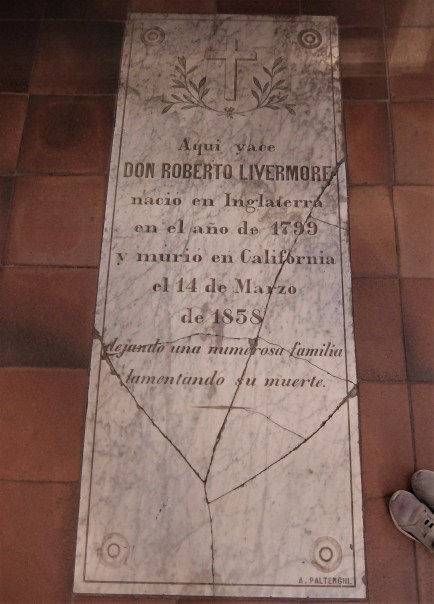
DSCF9192Robert Livermore, Englishman, runaway sailor, Mexican land grantee and early Californian, is buried in old Mission San José.
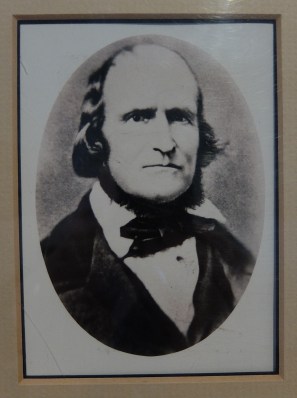
The grave marker was found  when the wooden church that replaced the original adobe building (destroyed in an earthquake in 1868) was torn down in 1981 to make way for the reconstructed Mission San José. It reads:

“Here lies Mr. Robert Livermore, born in England in the year 1799 and died in California March 14, 1858, leaving behind a large family mourning his death.”

My granddaughter and I were surprised and delighted to see his grave, since she lives in Livermore, but had no idea how the city got its name.

What an adventurous life he lived!

DSCF9200Robert Livermore was born in Essex, England in 1799, and at the age of 15 he was apprenticed to a stone mason. He must not have cared for that work, because he ran away to sea the following year. He served in both the U.S. Navy and the British Navy, as well as on a merchant vessel that brought him to California in 1822, where he jumped ship.
He took to life in California with gusto. He worked on various ranchos until he was able to build up a cattle herd and acquire Rancho Las Positas in what is now the Livermore Valley. In 1838 he married Josefa Higuera Molina and built an adobe house on Las Positas creek. During the Gold Rush he prospered by raising and selling beef cattle and accommodating gold seekers on their way to the mines. He seems to have been liked and admired by all who knew him.

Joshua Neal, who worked for Livermore from 1851 until his death in 1858, wrote of him, “Many of the immigrants will remember his kindness of heart and hospitality to all, for he was continually assisting those in need. His orders to his vaqueros were to be on the lookout for coming immigrants, and as soon as discovered, to go up to them and ascertain their needs.”

RIP, Don Roberto.

Posted in Robert Livermore, Uncategorized | 2 Comments

A Visit to Mission San José

Mission San José is not in San José. Probably a lot of you knew that.

I knew that the old Spanish mission in San José is Mission Santa Clara, located on the grounds of Santa Clara University. And I knew that Mission San José was somewhere else in the San Francisco Bay Area, but I was unclear on the location.

DSCF9207 (2)No more! Saturday I took my granddaughter on a field trip and we visited old Mission San José.
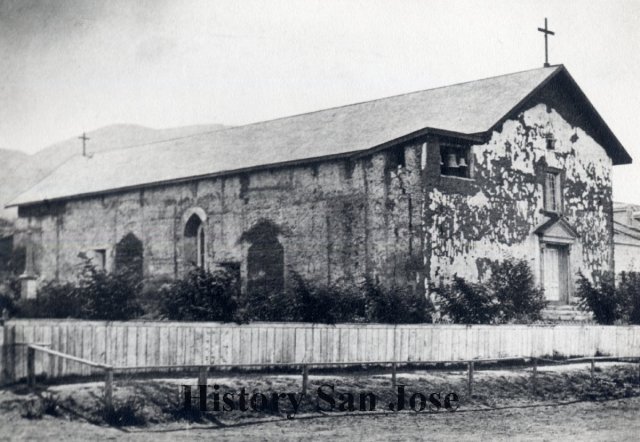
In Fremont. (That’s her on the steps.)

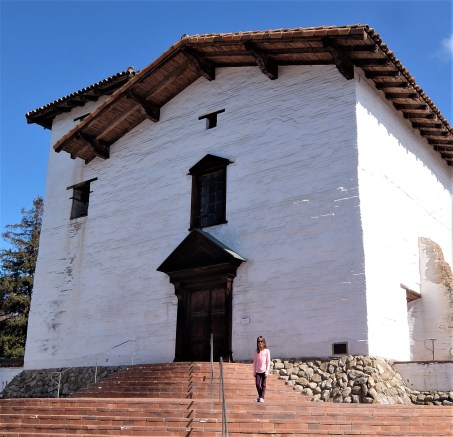
This building is actually a replica of the original adobe church.  The original building was destroyed by an earthquake in 1868. That’s the kind of thing that happens in California.

Here is a picture of the first mission church. The buildings look the same, but the old church was badly in need of a whitewashing.

Mission San José

History San Jose Photographic Collection

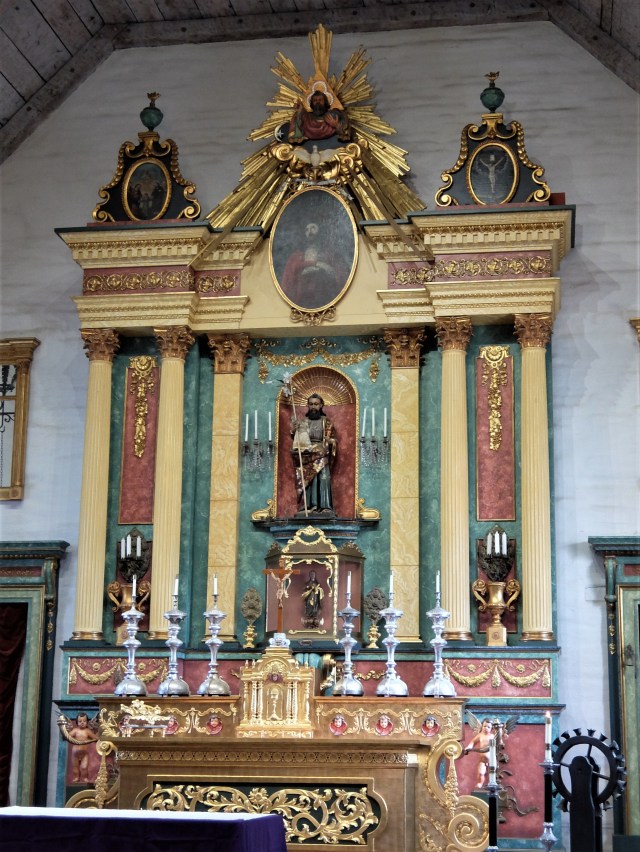
It is a beautiful church inside, restored to look as it did back in the day. Two of the statues are ones that were rescued from the rubble.

DSCF9194

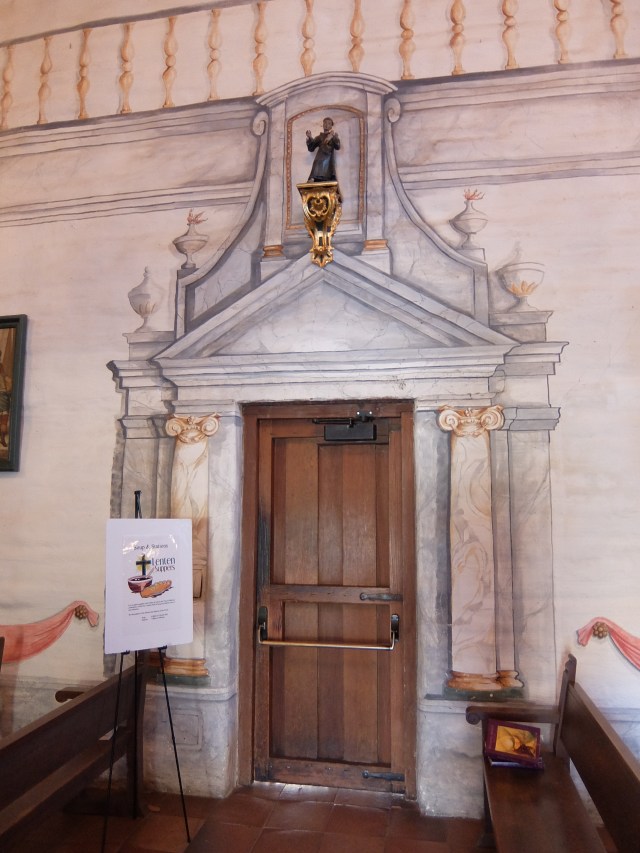
The walls are painted to look like they have marble pillars, door frames, and a balcony. But it is all painted on white plaster over adobe bricks.

DSCF9193

Next time: What prominent Californian is buried under the floor of the Mission San José church?

Posted in Missions, Uncategorized | Leave a comment

A Leap Year Proposal

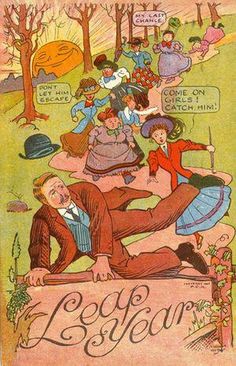
leap2Once upon a time, when the rules of courtship were strict, and a woman could only wait for a man to get a clue and propose marriage, tradition had it that during a leap year a woman could propose to her tardy and reluctant male. According to legend the custom grew up in Ireland, where St. Patrick allowed women this opportunity every four years, after St. Brigid complained to him that the girls were having to wait too long for marriage. Another legend attributes the custom to Scotland, where Queen Margaret decreed that during leap year a maiden could make the first move and snare the man she admired.

There is no evidence for either of these stories, but the tradition of a leap year proposal leap3was a popular legend. It became a humorous trope employed by storytellers, cartoonists (think Al Capp and Sadie Hawkins), and versemakers like Pres Longley. The idea may have faded away in today’s society, but in the 19th and early 20th century it had great currency.
Here is a Leap Year verse from Pres Longley, the Bard of Butte..

THE LAST HOUR OF LEAP YEAR
 A youth and a maiden sat closely together,
And passed off the time in discussing the weather.
It was chilly without, but the grate was aglow—
Thomas mildly remarked that he thought we’d have snow.
Susie quickly opposed him in words that were plain,
And thought it most likely we’d have a small rain;
But she soon changed the subject, in tones that were bland,
And placed on his shoulder her little brown hand.

“You know, my dear Tom, ere an hour hath sped,
That this old year will slumber and sleep with the dead,
And before it recedes from my grasp and my sight,
I wish to assume a small feminine right.
Will you marry me, Thomas?” “I declare that is cool.
No, Susie, I can’t. Do you think I’m a fool?”
“You won’t? You’re a brute!” He arose from his chair,
But left in her grasp quite a handful of hair.
                           Pres Longley, 1873    

         leap4


Posted in Uncategorized | Leave a comment

A Hike to Iron Canyon

I went with an OLLI group on a hike to Iron Canyon today. Not too strenuous, about the right length for me. The weather was perfect, warm with a slight breeze. I wouldn’t recommend this trail in the summertime — it would be hot and there isn’t much shade. But right now is a good time, and pretty soon there will be a good display of wildflowers. (Not a great display though. We have had very little rain this winter.)

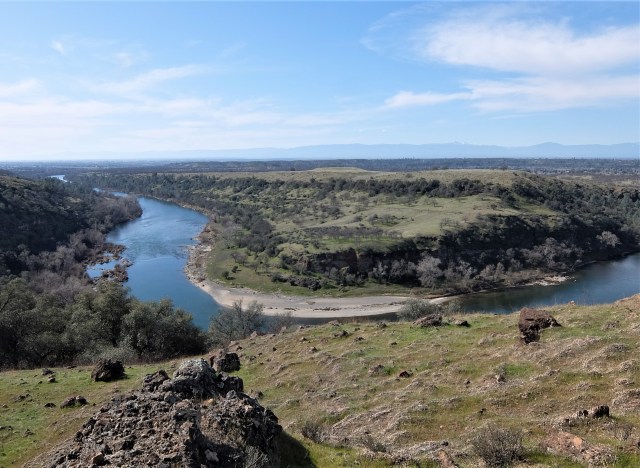
The Iron Canyon Trail is on BLM land and the trailhead is a short drive up Highway 36 east of Red Bluff. The majority of the hike is over fairly level but very rocky terrain, and then you get to this:

DSCF8790 (2)

It’s a gorgeous view and a good place to stop and eat your lunch. The entire trail loop is 3.6 miles. We were out for about three and a half hours — we don’t hurry. Along the way you get nice views of the Coast Range, the Trinity Alps, Lassen Peak and Brokeoff Mountain, and Mount Shasta.

DSCF8789 (2)

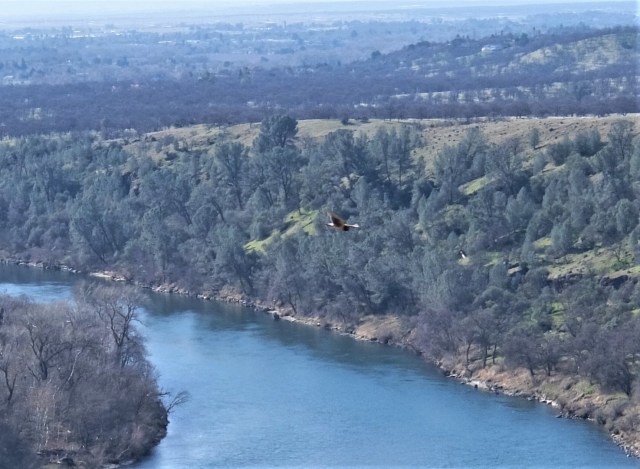
We saw turkey buzzards flying over the river, and one northern harrier (at least, that’s what someone said it was. To me it was some kind of hawk.) See him?

DSCF8797 (3)

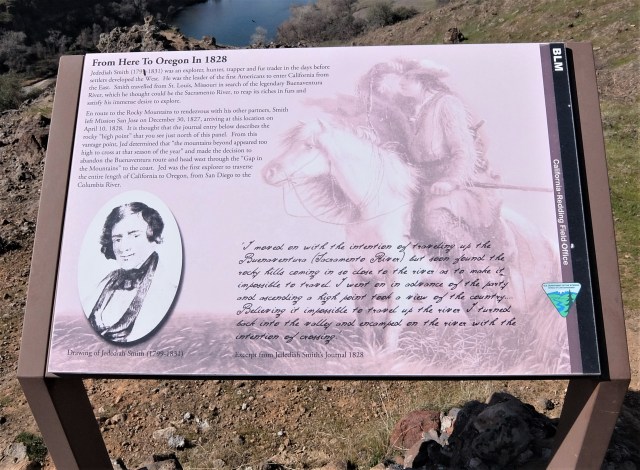
And . .  there is a history connection. The bluff overlooking the bend in the river is known as Smith Point, named for Jedediah Smith, the early fur trapper, frontiersman, and explorer. He came through here in 1828, traveling along what he called the Buenaventura River. He got to this point and found the canyon too rocky and narrow, so he turned back and looked for another way.

Smith was the first American explorer to traverse the length of California. He continued on into Oregon and followed the Columbia back to the Rocky Mountains. After several years of exploring, he died a tragic and too-early death at the age of 33 when he met up with a band of Comanches on the Santa Fe Trail.

DSCF8805 (2)


Posted in Uncategorized | Leave a comment

A Few Last Items About the Crosbys

Just a few last tidbits about Elisha O. Crosby and Maria Crosby, to wrap things up.

Elisha O. Crosby married in Fremont, Nebraska in 1874 and his son was born there in 1875. After having lived in California and Guatemala, the cold Nebraska winters must have been unendurable. It wasn’t long before he decided to return to California. Who can blame him?

In early 1875 he was writing to the Los Angeles Herald, asking for their pamphlet on the wonders of Southern California, and later that year he was living again in the Golden State.

LAH18750508.1.4-2662-4825-800-733-400w

Los Angeles Herald, 8 May 1875

All he had to do was get on a train. But he didn’t go to Los Angeles; he went back to San Francisco, where he had friends and property. And a “wife” in San Jose, who sued him in court as soon as he returned.

DAC18750908.1.1-1912-8855-937-315-468w

Daily Alta California, 8 September 1875

ecrosbThe case, whatever it was, was dismissed by the court.  If they were never married, she couldn’t sue for divorce or accuse him of desertion. Also, he may have had more political pull than she did.

But there is nothing to indicate that she was in poverty. She was probably still living on Hensley property in San Jose. Still, E.O. Crosby seems to have treated her shabbily.

Crosby, with his new wife Frances and their son Edward, settled in Alameda. He was elected as a Justice of the Peace and was later appointed to the office of City Recorder.

Maria L. Crosby continued living in San Jose until her death in 1879. If the newspapers are to be believed, she was well-known and well-liked in the community. The part she played in the admission of California to the United States was celebrated in an Admission Day speech given in 1877 and reported in the San Jose Herald.

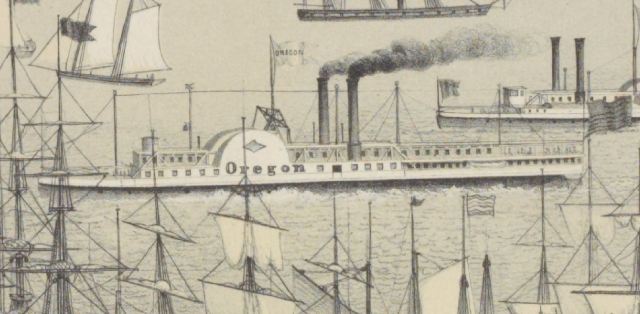
The news of the admission was brought by the steamer “Oregon,” which connected with the steamer “Cherokee” that left New York on the 13th of September. The “Oregon” arrived at San Francisco on the 14th [18th] of October, 1850. On that steamer was General Bidwell, the bearer of the authentic documents of admission, and with him was our beloved (now departed) friend, one of the noblest of the early Pioneers, Major Hensley. On that steamer also was a lady, Mrs. Crosby, now an old and respected resident in our midst, the mother of Mrs. Hensley, who was then coming to California with her young daughter. [Mrs. Crosby, not her daughter, was coming with her young daughter.] (San Jose Herald, 8 September 1877)


Posted in Elisha O. Crosby, Uncategorized | Leave a comment

Rivals for Miss Crosby’s Hand

John Bidwell took a liking to Helen Crosby during the five-week journey back to California, perhaps one reason for giving the admission documents into her care. Young ladies were few on board ship and in California, and he was an eligible young bachelor. But he wasn’t the only one taking an interest in the young lady. Samuel Hensley (and who knows who else) enthusiastically courted her.

Three months after they arrived a friend wrote to Bidwell from San Jose, urging him to seek Miss Helen’s hand before it was too late. “There are strong exertions being made by certain parties – a word enough,” he told him,  but Bidwell did not pursue a closer connection with Helen Crosby.

In the contest for Helen’s affections, Sam Hensley won the prize. She became Mrs. Samuel J. Hensley of San José on April 7, 1851. It would be another fifteen years before John Bidwell found the love of his life.

hensley

Major Samuel J. Hensley

Samuel Hensley was born in Kentucky in 1816 and came to California with the Chiles party in 1843. He was a trapper and hunter, and for a time he worked for John Sutter. He claimed a land grant adjoining John Bidwell’s Rancho Chico, but I don’t think he ever actually lived there. Like Bidwell, he served in the California Battalion during the Mexican War and was afterward known as Major Hensley.

He was a savvy businessman and a founding member of the California Steamship Navigation Company. He may well have looked like the better catch to Miss Helen Crosby — he had built a substantial home in San Jose while John Bidwell was still living in a log cabin on remote Rancho Chico.

maryhelencrosby

Mary Helen Crosby Hensley in 1871.

Unfortunately, there is no young picture (that I know of) of Mary Helen Crosby Hensley.  Here is one 1871, five years after her husband passed away. They had two children, Charles and Mary Helen.


Posted in Elisha O. Crosby, Mary Helen Crosby, Samuel J. Hensley | 2 Comments

The Crosby Puzzle Solved

e_o_crosby-167x211

E. O. Crosby in 1850

So why did Elisha Crosby have a daughter only 14 years younger than himself?

Let’s go back to 1844, when Crosby was a young lawyer in Elmira, New York.

Here is an excerpt from the Reports of Cases Argued and Determined in the Supreme Court, at Special Term for the state of New York, 1845, which can be found on Google Books.

State of New York, county of Orange, ss. Ebenezer Seely of the town of Chester in said county, being duly sworn deposes and says, that he is about to commence a suit in the supreme court of said state, against Elisha O. Crosby, for criminal conversation with Maria Seely the wife of the deponent; . . . that about the month of October, 1844, the said Elisha O. Crosby left the said town of Elmira with the said Maria Seely, and removed to the city of New York, where . . . the said Elisha O. Crosby has ever since resided with the said Maria Seely in adulterous intercourse . . .  (p. 231)

13793.scarlet-letterOh dear. Trouble, with a capital A, and that stands for Adultery.

Mr. Seely wanted Crosby held on bail of $2,500, but the case was dismissed by the court. If anything more came of this, I don’t know what it was. Maria and Elisha continued to live together, but I doubt there was ever any divorce or remarriage.

In 1844, when they ran away to New York City, Crosby would have been 25 years old. Census records and her obituary point to Maria as having been born in 1803, which made her 39 — that’s 16 years older than Elisha! That is a considerable gap. She was certainly old enough to have a young daughter, fathered not by Crosby but by her legal husband.

This is an odd story, but there it is in the legal record and the census. It’s the only solution to the puzzle that I could figure out.

All of this hullabaloo would have made California look like a great place to escape to, especially for 18-year-old Mary Helen, whose household (it would seem) was somewhat irregular. Traveling to San Francisco was the opportunity to start over with a new name and put the past in the past. It reminds me of something Oscar Wilde said:

“It’s an odd thing, but anyone who disappears is said to be seen in San Francisco. It must be a delightful city and possess all the attractions of the next world.”

Did John Bidwell know any of this when he met Mrs. and Miss Crosby in New York City and arranged to escort them to California? It’s doubtful. He was a stranger to the city, and probably not one to pick up gossip. As far as he knew, Mrs. Crosby was a respectable married woman. Did he notice that she looked so much older than her husband? Did Crosby look older than he really was? Because in truth he was only one year older than John Bidwell, and not old enough to have a teen-age daughter.

Next: A Few Odds and Ends about the Crosby Family

Posted in Elisha O. Crosby, Mary Helen Crosby, Uncategorized | Leave a comment

The Crosby Puzzle Continued

InkedDAC18501018.1.5-1884-2928-939-981-469w_LI

Mrs. and Miss Crosby came to California in October 1850 on the same ship that brought the news of statehood. They went to San Jose to be with Elisha O. Crosby, and within a few months Miss Mary Helen Crosby was married to Samuel J. Hensley, who was also on that ship. (You will find him on that passenger list.)

elisha

E.O. Crosby

Elisha O. Crosby moved to San Francisco in 1852 and opened a law office dealing primarily in land grant titles. He specialized in the claims of the Spanish-speaking Californios, who had held the land under Mexico and were supposedly guaranteed their rights by the Treaty of Guadalupe Hidalgo. It was a frustrating  business that occupied him for the rest of the decade. After years of litigation through the Land Commission and the courts, many of the titles were not upheld, and the land was taken over by “speculators and sharpers.” In his memoir he complained:

In God’s name, what sense or right was there on the part of the Government of the U. S. in putting these claimants to the enormous expense of carrying the litigation of their claims to Washington? There was not one in fifty of these claimants who could stand any such expense and the result has been the transfer of these claims to speculators and men of wealth, who took them up for little or nothing and have been fighting them out for what they could get. Thus the most outrageous wrongs were perpetrated on the old California Claimants. (Memoirs of Elisha Oscar Crosby; reminiscences of California and Guatemala from 1849 to 1864. Edited by Charles Albro Barker)

In 1860 Crosby set out for Washington, D.C., but stopped over in Guatemala for a few months, where he made the acquaintance of dictator-President Rafael Carrera. This experience positioned him for his appointment by President Lincoln as ambassador to Guatemala for the next four years.

All this time he makes no mention in his memoir of a wife or family. After his return from Guatemala he went to Philadelphia, and then onward to Fremont, Nebraska. (I have no idea why.) But Nebraska must have been a lively place, because here is where we get a hint of his private life.

Contract of separation from Francis Ann Deer 1872

Handwritten single-page document evidencing the agreement of Crosby and Deer to their separation after living together unmarried for “many years.” Signed by Crosby, Deer, and Deer’s sister, Mary J. Field, as a witness

This is the description of an item in the E.O. Crosby Collection at the University of California, San Diego Special Collections. If you are interested, the link to a detailed finding guide is at the Online Archive of California. 

So, in 1872 he separates from Francis Ann, with whom he has been living for “many years,” then in 1874 he marries another Frances: Frances Alma Crandall, nicknamed Frankie. They have one son, Edward Oscar Crosby, born in February 1875.

On the marriage record, Crosby gave his age as 45, when actually he was about to turn 56. Frankie’s age was either 24 or 27, depending on whether you accept the marriage record or the 1900 census. (It’s surprising — or maybe not — how often people fudged their ages on various documents.)

But what about his wife in California? What became of her in all this activity?

There is a story there as well—–

Next: How Maria Seely became Mrs. Crosby


Posted in Elisha O. Crosby, Uncategorized | 1 Comment

The Puzzling Life of Elisha O. Crosby

I am working on an article about John Bidwell’s activities during the year of 1850. It started with a short narrative I put together for Admission Day last year. During 2019 the Bidwell Mansion Association had a number of special events in honor of the two-hundredth anniversary of Bidwell’s birth, and for Admission Day I wrote up the story of how Bidwell brought the news of statehood to California.

I have written about John Bidwell and Helen Crosby, “the lady with the blue silk umbrella,” here before, but it’s a fun story and worth repeating. (Go take a look.) I wanted to expand that incident and cover Bidwell’s other activities during 1850. I thought I was almost done, and then I decided I should check some basic information for Helen Crosby and her parents. And that’s when I went down the rabbit hole.

rabbit-rabbit-hole-gray-rabbit-hides-rabbit-hole-115679888

e_o_crosby-167x211

E.O. Crosby as a state senator

Elisha O. Crosby was a true Forty-Niner.

He arrived in California via the Panama route in February 1849. He tried his hand at mining, as they all did, but as an attorney he soon saw that going into law and real estate would be much more profitable. He was a delegate to the Constitutional Convention in Monterey, and served in the first and second legislatures of the state as a Senator.

When John Bidwell was asked in 1850 to deliver a block of quartz to Washington, D.C., for the Washington Monument, Crosby asked if Bidwell could do him a favor. Crosby had a wife and a teen-age daughter in New York City. Would Bidwell escort them to California to join him?

It wasn’t unusual for men heading to the goldfields of California to leave a family behind. If things “panned out,” they would either come home with a sack full of gold, or send for the family. That was the situation for Crosby — he was doing well, California was growing and would soon be a state — it was time for the family to be reunited.

Let’s backtrack a little—

Elisha O. Crosby was born on July 18, 1818, the second child of Samuel and Mehitabel Crosby of Tompkins County, New York. The family was not well-to-do, but Elisha got a good education and studied law under his uncle in Buffalo.  In 1841 he was licensed to practice law and opened a practice in Elmira, New York.

image_681x458_from_2945,3889_to_5808,5817

Elmira Gazette 15 Feb. 1844

In 1844 he joined a law firm in New York City. When news came of gold in California, he immediately caught “gold fever” and boarded a ship on Christmas Day, 1848. He left behind his wife and daughter.

Mary Helen Crosby, his daughter, was a young lady of 18 when she boarded the steamship to California two years later, so she was probably born in 1832. She is listed in the California census of 1852 as being 20 years old, which is consistent with a birth year of 1832.

Dad — 1818, daughter — 1832. Something didn’t add up. Was he 14 years old when she was born? Seems unlikely. And I couldn’t find any record of her or her mother before they arrived in California. Who were they?

Do we know anything about Crosby as a husband? Biographical notes on Crosby say little about his family life. The only marriage noted anywhere is:

In 1874, he married Frances Alma Crandall in Lincoln, Nebraska, and settled afterwards in Alameda. They had one son, Edward Oscar Crosby. (Note to the Crosby file at The Society of California Pioneers)

Well, that was puzzling. What about his other wife, the one who came to California in 1850? Had she died? What about his daughter, who married Samuel Hensley soon after arriving?

DAC18510409.1.2-5116-4784-1029-275-514w

Daily Alta California 9 April 1851

The first Mrs. Crosby did not die, at least not that soon. Mrs. Maria L. Crosby died in 1879. Notice that in her obituary she is called the mother of Mrs. M.H. Hensley, but not the wife or widow of E.O. Crosby. There’s a reason for that.

SJH18790301.1.3-782-3352-699-1129-349w

San Jose Herald 1 March 1879

Next: The mystery gets murkier before it clears up


Posted in Elisha O. Crosby, Mary Helen Crosby | Leave a comment