A Few Last Items About the Crosbys

Just a few last tidbits about Elisha O. Crosby and Maria Crosby, to wrap things up.

Elisha O. Crosby married in Fremont, Nebraska in 1874 and his son was born there in 1875. After having lived in California and Guatemala, the cold Nebraska winters must have been unendurable. It wasn’t long before he decided to return to California. Who can blame him?

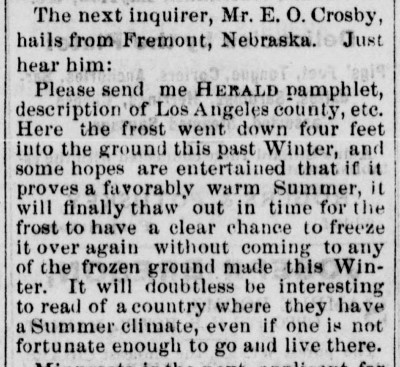
In early 1875 he was writing to the Los Angeles Herald, asking for their pamphlet on the wonders of Southern California, and later that year he was living again in the Golden State.
LAH18750508.1.4-2662-4825-800-733-400w

Los Angeles Herald, 8 May 1875

All he had to do was get on a train. But he didn’t go to Los Angeles; he went back to San Francisco, where he had friends and property. And a “wife” in San Jose, who sued him in court as soon as he returned.

DAC18750908.1.1-1912-8855-937-315-468w

Daily Alta California, 8 September 1875

ecrosbThe case, whatever it was, was dismissed by the court.  If they were never married, she couldn’t sue for divorce or accuse him of desertion. Also, he may have had more political pull than she did.

But there is nothing to indicate that she was in poverty. She was probably still living on Hensley property in San Jose. Still, E.O. Crosby seems to have treated her shabbily.

Crosby, with his new wife Frances and their son Edward, settled in Alameda. He was elected as a Justice of the Peace and was later appointed to the office of City Recorder.

Maria L. Crosby continued living in San Jose until her death in 1879. If the newspapers are to be believed, she was well-known and well-liked in the community. The part she played in the admission of California to the United States was celebrated in an Admission Day speech given in 1877 and reported in the San Jose Herald.

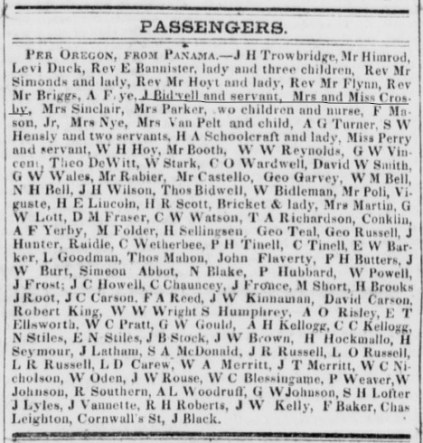
The news of the admission was brought by the steamer “Oregon,” which connected with the steamer “Cherokee” that left New York on the 13th of September. The “Oregon” arrived at San Francisco on the 14th [18th] of October, 1850. On that steamer was General Bidwell, the bearer of the authentic documents of admission, and with him was our beloved (now departed) friend, one of the noblest of the early Pioneers, Major Hensley. On that steamer also was a lady, Mrs. Crosby, now an old and respected resident in our midst, the mother of Mrs. Hensley, who was then coming to California with her young daughter. [Mrs. Crosby, not her daughter, was coming with her young daughter.] (San Jose Herald, 8 September 1877)

 

Posted in Elisha O. Crosby, Uncategorized | Leave a comment

Rivals for Miss Crosby’s Hand

John Bidwell took a liking to Helen Crosby during the five-week journey back to California, perhaps one reason for giving the admission documents into her care. Young ladies were few on board ship and in California, and he was an eligible young bachelor. But he wasn’t the only one taking an interest in the young lady. Samuel Hensley (and who knows who else) enthusiastically courted her.

Three months after they arrived a friend wrote to Bidwell from San Jose, urging him to seek Miss Helen’s hand before it was too late. “There are strong exertions being made by certain parties – a word enough,” he told him,  but Bidwell did not pursue a closer connection with Helen Crosby.

In the contest for Helen’s affections, Sam Hensley won the prize. She became Mrs. Samuel J. Hensley of San José on April 7, 1851. It would be another fifteen years before John Bidwell found the love of his life.

hensley

Major Samuel J. Hensley

Samuel Hensley was born in Kentucky in 1816 and came to California with the Chiles party in 1843. He was a trapper and hunter, and for a time he worked for John Sutter. He claimed a land grant adjoining John Bidwell’s Rancho Chico, but I don’t think he ever actually lived there. Like Bidwell, he served in the California Battalion during the Mexican War and was afterward known as Major Hensley.

He was a savvy businessman and a founding member of the California Steamship Navigation Company. He may well have looked like the better catch to Miss Helen Crosby — he had built a substantial home in San Jose while John Bidwell was still living in a log cabin on remote Rancho Chico.

maryhelencrosby

Mary Helen Crosby Hensley in 1871.

Unfortunately, there is no young picture (that I know of) of Mary Helen Crosby Hensley.  Here is one 1871, five years after her husband passed away. They had two children, Charles and Mary Helen.


Posted in Elisha O. Crosby, Mary Helen Crosby, Samuel J. Hensley | 2 Comments

The Crosby Puzzle Solved

e_o_crosby-167x211

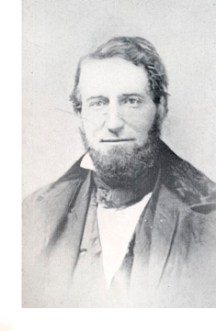
E. O. Crosby in 1850

So why did Elisha Crosby have a daughter only 14 years younger than himself?

Let’s go back to 1844, when Crosby was a young lawyer in Elmira, New York.

Here is an excerpt from the Reports of Cases Argued and Determined in the Supreme Court, at Special Term for the state of New York, 1845, which can be found on Google Books.

State of New York, county of Orange, ss. Ebenezer Seely of the town of Chester in said county, being duly sworn deposes and says, that he is about to commence a suit in the supreme court of said state, against Elisha O. Crosby, for criminal conversation with Maria Seely the wife of the deponent; . . . that about the month of October, 1844, the said Elisha O. Crosby left the said town of Elmira with the said Maria Seely, and removed to the city of New York, where . . . the said Elisha O. Crosby has ever since resided with the said Maria Seely in adulterous intercourse . . .  (p. 231)

13793.scarlet-letterOh dear. Trouble, with a capital A, and that stands for Adultery.
Mr. Seely wanted Crosby held on bail of $2,500, but the case was dismissed by the court. If anything more came of this, I don’t know what it was. Maria and Elisha continued to live together, but I doubt there was ever any divorce or remarriage.

In 1844, when they ran away to New York City, Crosby would have been 25 years old. Census records and her obituary point to Maria as having been born in 1803, which made her 39 — that’s 16 years older than Elisha! That is a considerable gap. She was certainly old enough to have a young daughter, fathered not by Crosby but by her legal husband.

This is an odd story, but there it is in the legal record and the census. It’s the only solution to the puzzle that I could figure out.

All of this hullabaloo would have made California look like a great place to escape to, especially for 18-year-old Mary Helen, whose household (it would seem) was somewhat irregular. Traveling to San Francisco was the opportunity to start over with a new name and put the past in the past. It reminds me of something Oscar Wilde said:

“It’s an odd thing, but anyone who disappears is said to be seen in San Francisco. It must be a delightful city and possess all the attractions of the next world.”

Did John Bidwell know any of this when he met Mrs. and Miss Crosby in New York City and arranged to escort them to California? It’s doubtful. He was a stranger to the city, and probably not one to pick up gossip. As far as he knew, Mrs. Crosby was a respectable married woman. Did he notice that she looked so much older than her husband? Did Crosby look older than he really was? Because in truth he was only one year older than John Bidwell, and not old enough to have a teen-age daughter.

Next: A Few Odds and Ends about the Crosby Family

Posted in Elisha O. Crosby, Mary Helen Crosby, Uncategorized | Leave a comment

The Crosby Puzzle Continued

InkedDAC18501018.1.5-1884-2928-939-981-469w_LI

Mrs. and Miss Crosby came to California in October 1850 on the same ship that brought the news of statehood. They went to San Jose to be with Elisha O. Crosby, and within a few months Miss Mary Helen Crosby was married to Samuel J. Hensley, who was also on that ship. (You will find him on that passenger list.)

elisha

E.O. Crosby

Elisha O. Crosby moved to San Francisco in 1852 and opened a law office dealing primarily in land grant titles. He specialized in the claims of the Spanish-speaking Californios, who had held the land under Mexico and were supposedly guaranteed their rights by the Treaty of Guadalupe Hidalgo. It was a frustrating  business that occupied him for the rest of the decade. After years of litigation through the Land Commission and the courts, many of the titles were not upheld, and the land was taken over by “speculators and sharpers.” In his memoir he complained:

In God’s name, what sense or right was there on the part of the Government of the U. S. in putting these claimants to the enormous expense of carrying the litigation of their claims to Washington? There was not one in fifty of these claimants who could stand any such expense and the result has been the transfer of these claims to speculators and men of wealth, who took them up for little or nothing and have been fighting them out for what they could get. Thus the most outrageous wrongs were perpetrated on the old California Claimants. (Memoirs of Elisha Oscar Crosby; reminiscences of California and Guatemala from 1849 to 1864. Edited by Charles Albro Barker)

In 1860 Crosby set out for Washington, D.C., but stopped over in Guatemala for a few months, where he made the acquaintance of dictator-President Rafael Carrera. This experience positioned him for his appointment by President Lincoln as ambassador to Guatemala for the next four years.

All this time he makes no mention in his memoir of a wife or family. After his return from Guatemala he went to Philadelphia, and then onward to Fremont, Nebraska. (I have no idea why.) But Nebraska must have been a lively place, because here is where we get a hint of his private life.

Contract of separation from Francis Ann Deer 1872

Handwritten single-page document evidencing the agreement of Crosby and Deer to their separation after living together unmarried for “many years.” Signed by Crosby, Deer, and Deer’s sister, Mary J. Field, as a witness

This is the description of an item in the E.O. Crosby Collection at the University of California, San Diego Special Collections. If you are interested, the link to a detailed finding guide is at the Online Archive of California. 

So, in 1872 he separates from Francis Ann, with whom he has been living for “many years,” then in 1874 he marries another Frances: Frances Alma Crandall, nicknamed Frankie. They have one son, Edward Oscar Crosby, born in February 1875.

On the marriage record, Crosby gave his age as 45, when actually he was about to turn 56. Frankie’s age was either 24 or 27, depending on whether you accept the marriage record or the 1900 census. (It’s surprising — or maybe not — how often people fudged their ages on various documents.)

But what about his wife in California? What became of her in all this activity?

There is a story there as well—–

Next: How Maria Seely became Mrs. Crosby


Posted in Elisha O. Crosby, Uncategorized | 1 Comment

The Puzzling Life of Elisha O. Crosby

I am working on an article about John Bidwell’s activities during the year of 1850. It started with a short narrative I put together for Admission Day last year. During 2019 the Bidwell Mansion Association had a number of special events in honor of the two-hundredth anniversary of Bidwell’s birth, and for Admission Day I wrote up the story of how Bidwell brought the news of statehood to California.

I have written about John Bidwell and Helen Crosby, “the lady with the blue silk umbrella,” here before, but it’s a fun story and worth repeating. (Go take a look.) I wanted to expand that incident and cover Bidwell’s other activities during 1850. I thought I was almost done, and then I decided I should check some basic information for Helen Crosby and her parents. And that’s when I went down the rabbit hole.

rabbit-rabbit-hole-gray-rabbit-hides-rabbit-hole-115679888

e_o_crosby-167x211

E.O. Crosby as a state senator

Elisha O. Crosby was a true Forty-Niner.

He arrived in California via the Panama route in February 1849. He tried his hand at mining, as they all did, but as an attorney he soon saw that going into law and real estate would be much more profitable. He was a delegate to the Constitutional Convention in Monterey, and served in the first and second legislatures of the state as a Senator.

When John Bidwell was asked in 1850 to deliver a block of quartz to Washington, D.C., for the Washington Monument, Crosby asked if Bidwell could do him a favor. Crosby had a wife and a teen-age daughter in New York City. Would Bidwell escort them to California to join him?

It wasn’t unusual for men heading to the goldfields of California to leave a family behind. If things “panned out,” they would either come home with a sack full of gold, or send for the family. That was the situation for Crosby — he was doing well, California was growing and would soon be a state — it was time for the family to be reunited.

Let’s backtrack a little—

Elisha O. Crosby was born on July 18, 1818, the second child of Samuel and Mehitabel Crosby of Tompkins County, New York. The family was not well-to-do, but Elisha got a good education and studied law under his uncle in Buffalo.  In 1841 he was licensed to practice law and opened a practice in Elmira, New York.

image_681x458_from_2945,3889_to_5808,5817

Elmira Gazette 15 Feb. 1844

In 1844 he joined a law firm in New York City. When news came of gold in California, he immediately caught “gold fever” and boarded a ship on Christmas Day, 1848. He left behind his wife and daughter.

Mary Helen Crosby, his daughter, was a young lady of 18 when she boarded the steamship to California two years later, so she was probably born in 1832. She is listed in the California census of 1852 as being 20 years old, which is consistent with a birth year of 1832.

Dad — 1818, daughter — 1832. Something didn’t add up. Was he 14 years old when she was born? Seems unlikely. And I couldn’t find any record of her or her mother before they arrived in California. Who were they?

Do we know anything about Crosby as a husband? Biographical notes on Crosby say little about his family life. The only marriage noted anywhere is:

In 1874, he married Frances Alma Crandall in Lincoln, Nebraska, and settled afterwards in Alameda. They had one son, Edward Oscar Crosby. (Note to the Crosby file at The Society of California Pioneers)

Well, that was puzzling. What about his other wife, the one who came to California in 1850? Had she died? What about his daughter, who married Samuel Hensley soon after arriving?

DAC18510409.1.2-5116-4784-1029-275-514w

Daily Alta California 9 April 1851

The first Mrs. Crosby did not die, at least not that soon. Mrs. Maria L. Crosby died in 1879. Notice that in her obituary she is called the mother of Mrs. M.H. Hensley, but not the wife or widow of E.O. Crosby. There’s a reason for that.

SJH18790301.1.3-782-3352-699-1129-349w

San Jose Herald 1 March 1879

Next: The mystery gets murkier before it clears up


Posted in Elisha O. Crosby, Mary Helen Crosby | Leave a comment

“Yours for Equal Justice”

Susan_B_Anthony.tif“Yours for Equal Justice” was Susan B. Anthony’s signature line, and this year it is the theme of the Bidwell Mansion Association’s Annual Meeting.
Please join us next Sunday, Jan. 26 to celebrate women’s suffrage and to mark the 100th anniversary of the Nineteenth Amendment, State Parks Seasonal Park Aide Sondra Murphy will present a program on Annie Bidwell and the Women’s Suffrage Movement.

John and Annie Bidwell were both supporters of women’s suffrage and the mansion served to host leaders of the movement. The Bidwells’ trend-setting relationship is examined in Sondra’s presentation, “Yours for Equal Justice.” Learn who Annie’s influences and John’s contemporaries were in this special presentation celebrating the many voices in the fight to pass the 19th Amendment.

Come to Bidwell Mansion’s Visitors Center  at 5:30 p.m. for light refreshments, a short business meeting, and a fascinating program.

Click on the link to see a flyer for the event.

bma annual meeting 2020

Posted in Uncategorized | Leave a comment

Nikolai and Conchita in Literature

Any romance novelists out there reading this? It is high time that Conchita Arguello and Nikolai Rezanov were brought to life on the pages of a romantic novel. Such a great love story deserves a new treatment. No happy ending of reunited lovers, unfortunately, but all the passion and longing you could possibly want.

rezanov.jpgSurely someone has done it already?

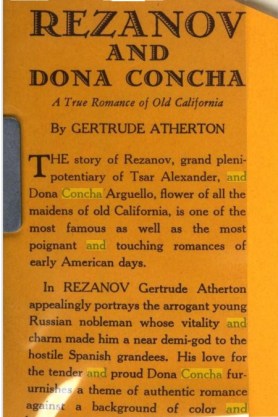
Yes, but it could do with an update. Gertrude Atherton, a popular turn-of-the-century California novelist, wrote Rezanov and Doña Concha: A True Romance of Old California in 1907. A few (very few) libraries still have the book, but it is forgotten and out of print these many years.

If you want to read it though, you can find it on Google Books.

Bret Harte wrote a poem based on the story, called Concepcion de Arguello. You can find it at the Poemhunter website. The poem tells the story of “Count von Resanoff, the Russian, envoy of the mighty Czar” and how

He from grave provincial magnates oft had turned to talk apart
With the Commandante’s daughter on the questions of the heart.

The lovers part, and forty years later an English baronet comes to Monterey. At a dinner given in his honor someone speaks of Conchita’s Russian lover:

Quickly then cried Sir George Simpson: ‘Speak no ill of him, I pray!
He is dead. He died, poor fellow, forty years ago this day,–

‘Died while speeding home to Russia, falling from a fractious horse.
Left a sweetheart, too, they tell me. Married, I suppose, of course!

‘Lives she yet?’ A deathlike silence fell on banquet, guests, and hall,
And a trembling figure rising fixed the awestruck gaze of all.

Two black eyes in darkened orbits gleamed beneath the nun’s white hood;
Black serge hid the wasted figure, bowed and stricken where it stood.

‘Lives she yet?’ Sir George repeated. All were hushed as Concha drew
Closer yet her nun’s attire. ‘Senor, pardon, she died, too!’

conchitatombl


Posted in Nikolai Rezanov, Uncategorized | 2 Comments

Nikolai and Conchita: The Opera

I was just thinking that a revival in popular culture of the love story of Conchita Arguello and Nikolai Rezanov was long overdue, when I found out from my lovely daughter-in-law that the Russians have already taken care of the matter.

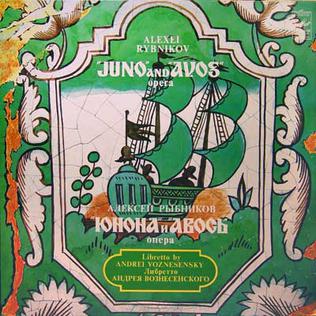
JunoAndAvosThe newest incarnation of Nikolai and Conchita is not in a book, but in an opera: a Russian-language rock-opera. The opera’s title, Juno and Avos, comes from the names of the two Russian ships that sailed from Alaska to California. (Juno was the Roman goddess of marriage and wife of Jupiter, Avos is a Russian expression of hope or trusting in luck.)

Juno and Avos is a rock opera with music by Alexey Rybnikov and poetry by Andrei Voznesensky. It was first performed in 1981 in Moscow and has been performed a few times in the West. Here is the final duet, a beautiful lament by the separated lovers.

I must say, nobody knows how to write beautiful, heart-felt music like the Russians.

Posted in Nikolai Rezanov, Uncategorized | Leave a comment

Nikolai and Conchita Separated

Nikolai Rezanov left San Francisco Bay on May 11, 1806. By June 7 the Juno was back at Sitka, where he found the colony about to go under from a combination of starvation and the threat of an attack by Tlingit warriors. The provisions and reinforcements he brought from California were the salvation of the Russian colony in Alaska.

Rezanov spent the next month or so in Alaska, supervising the revival of the colony and writing lengthy dispatches to the directors of the Russian-American Company and the Tsar. In his dispatches he revealed his intention to marry Conchita, but couched the news in terms of business and politics to make it palatable to his superiors.

At the end of July he set sail for Okhotsk, on the eastern shore of Russia. Arriving in late August, he started off on the trip across Siberia. He fell ill at Irkutsk (by Lake Baikal) and spent three months there, then resumed his travels, only to relapse again at the trading post of Krasnoyarsk, halfway to Moscow. He would never leave it. He died of fever and exhaustion in Krasnoyarsk on March 8, 1807.

Rezomb

The tomb of Nikolai Rezanov in Krasnoyarsk, destroyed by Bolsheviks in 1932.

Conchita waited, and it was not until 1808 that she heard rumors, brought by Russian otter hunters, that Rezanov had died on his way to St. Petersburg. Still she hoped, but as the years went by she must have known that he would never return. She moved with her family to Santa Barbara, and later to Monterey, when her father became governor of California in 1814. By 1818, 10 years after she first heard rumors of her fiance’s death, she was living in Mexico. As a young woman of good family and renowned beauty, she received many offers of marriage, but she refused them all.

Without exception, the men who sought my hand were worthy and honorable. After much deliberation and prayer I concluded that I could not and would not be joined in marriage to one whom I did not love . . . I felt that a certain lasting loyalty was demanded of me by a Higher Power–a loyalty to Nikolai and myself.

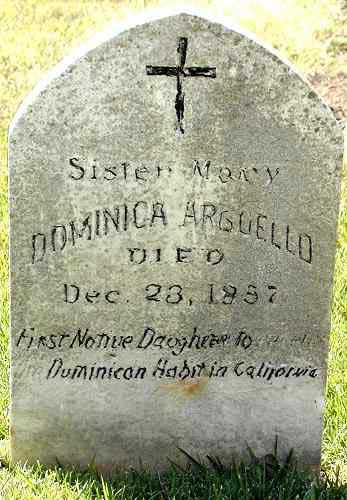
After the death of her parents, Conchita returned to California in 1829 and became a Franciscan lay sister. When a Dominican convent was established in Monterey in 1851, Conchita joined as a novice, and as Sister Maria Dominga, became California’s first native-born nun. She befriended a 13-year-old novice, and it was to this young friend, Sister Vincentia, that she confided the story of her romance with the courtly Russian. Decades later Sister Vincentia related the story to a priest, who wrote down her recollections of Conchita.

Although she never doubted as to his (Nikolai’s) deep loyalty and intense sincerity in her regard, she told me that from the evening he sailed away out through the Golden Gate she had somehow a deep, hidden, eerie feeling that stayed with her night and day.

conchitatombl

The tombstone of Conchita in the nuns’ cemetery in Benicia.

Maria de Concepcion Arguello died at the convent in Benicia on December 23, 1854.

The legend of Nikolai and Conchita, a compound of Spanish gaiety and passion and Russian melancholy and ardor, lives on in novels, poetry, and opera.

Next: The Love Story in Music and on the Stage

Posted in Nikolai Rezanov, Uncategorized | Leave a comment

Nikolai and Conchita

200px-Rezanov_np

N.P. Rezanov

Nikolai Rezanov must have looked quite impressive in his dress uniform, with the diamond Order of St. Anne on his breast and a laced bicorne hat under his arm. He went out of his way to be charming and courteous, distributing presents to one and all. He was aware of the need to “hide from the Spaniards our distress and needfulness,” so no mention was made of just how bad conditions were at the Russian colony in Alaska, or the real reason that they had come to California. He assured the Spaniards that Russia had no interest in extending their colonies southward.

Conchita was smitten with this courtly, handsome gentleman, resplendent in his uniform. She had never met anyone like him; he was an emissary from another world, the world of glittering courts and grand balls. He danced with her; together they explored the wooded hills of Yerba Buena; he told her stories of his travels in Europe, Asia, and the isles of the Pacific. She had never been farther from home than Monterey, and here was a man who had sailed around the world. In spite of her position as the daughter of the comandante of the presidio, she was leading a humdrum life in a small town in a cultural backwater. She was eager for a new life and Rezanov was the only chance she was ever likely to meet to change her fortune.

concept

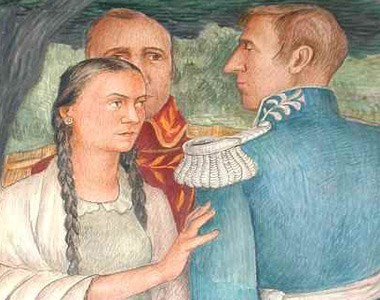
Concepcion Arguello and Nikolai Rezanov as depicted on a mural in the Presidio Interfaith Chapel.

After only two weeks in California, Nikolai made a proposal of marriage to Conchita, and she accepted. Conchita began to dream of travel to Europe, of wearing beautiful dresses and meeting the noble and great. But what would her parents think?

Her parents were shocked and appalled. How could their daughter think of marrying a foreigner? He wasn’t even a Roman Catholic. It was impossible.

But Rezanov was not an expert diplomat for nothing, and a mere difference in religion was not going to stop him. If the marriage required a dispensation from the Pope, then he would see to it. He assured Conchita’s parents that once he was back in St. Petersburg, the Tsar would appoint him ambassador to Spain. He would make every necessary arrangement to bring about the marriage and return via Mexico to claim his bride. He was willing to make another trip around the world for love. And so her parents consented to a betrothal.

Many years later, Conchita told a friend how “Nikolai Rezanov came bounding into her life. How she loved him and how they planned for a life of love and happiness in far-off Russia.” Such were her dreams.


Posted in Nikolai Rezanov, Uncategorized | Leave a comment