Politics in Nineteenth Century California

header-fall-30th-2036px_0

I am working on a presentation for an OLLI class on Local History. (OLLI is the Osher Lifelong Learning Institute — basically retirees teaching other retirees whatever they feel like teaching. It’s a fun and easy way to keep your brain ticking.) I have done other presentations in this class over the last couple of years. So far, they have let me come back.

I decided to talk about John Bidwell in California politics this time. It’s a topic that has always interested me, although I do not have a background in political science. But I thought it might be entertaining to get away from the turmoils of the present day and see what they were up to way back when.

My opening question will be “With what political party did John Bidwell affiliate?” He was active in politics, so what party did he belong to?

It all depends on which decade you are asking about. That is what makes it interesting, and what makes Bidwell a portrait of the changing trends in California politics.

1840–1860: “I was in those years an incorrigible Democrat.”

1860–mid-1870s: Republican or Union Party

1875–mid-1880s: People’s Independent Party (Anti-Monopolist)

1885-1900: Prohibition Partyprohibition button

That looks simple, if changeable, but it gets more complicated the deeper you dig. Come with me on a ride through the quickly changing landscape of 19th-century politics.


Posted in Uncategorized | Leave a comment

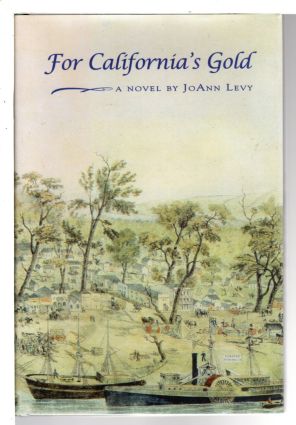
For California’s Gold

I enjoy reading historical fiction, but only if I know it is as authentic as possible. Nothing makes me more testy than to have an anachronism intrude into a good story.  I remember one where two young men arrived by ship in California in 1849 — and got on a train to go to the mines! They were enjoying the view from the railroad car and I was shouting, “But there was no railroad in California until at least 1855!”

levyYou will never experience that emotion reading JoAnn Levy’s For California’s Gold (University Press of Colorado, 2000). As the author of They Saw the Elephant: Women in the California Gold Rush, JoAnn knows the pioneer experience better than anyone.

For California’s Gold is the story of Sarah Daniels of Illinois, whose husband is seized by gold fever. Reluctant to leave her home and concerned for the welfare of her four children, she only goes along because of her husband’s insistence. The overland journey confirms all her worst fears: bad weather, disease, poor food, a desperate struggle to cross the 40-mile desert, and worst of all, fatal accidents.

Once in California, Sarah’s only goal is to earn enough money to get back to the safety of Illinois. But her efforts are plagued by flood and fire. Only gradually does she learn to love her new home and her new friends.

Sarah is a composite of many women who came to California and who shared their experiences in letters and diaries. JoAnn Levy seamlessly weaves together incidents and reflections from the lives of many women to make one unforgettable heroine. I recognized several incidents from the life of Luzena Stanley Wilson, but JoAnn never simply copies. Instead she transforms .

Gracefully written, with beautiful descriptions and exciting incidents, this is a novel that puts all other attempts at pioneer historical romances in the shade. I only wish it was easier to come by. I found my copy in a used bookstore. Your best bet may be inter-library loan. If you have any interest at all in the women of the westward movement, it will be worth it.


Posted in Book Reviews, Uncategorized | Leave a comment

Ghosts of Gold Mountain

godl mountainGhosts of Gold Mountain, by Gordon H. Chang, is “the epic story of the Chinese who built the transcontinental railroad,” a book that combines faultless scholarship with compelling storytelling. (published by Houghton, Mifflin, Harcourt, 2019; available at your public library.)

Chinese men came to “Gold Mountain” in the 1850s to escape war and poverty in China and seek their fortunes in the goldfields. Thousands more arrived in the 1860s to labor on the monumental task of building the Central Pacific Rail Road from its western terminus in Sacramento to its meeting point with the Union Pacific in Utah. The challenges and hardships were beyond description — no words can adequately convey the blistering summers, the bone-chilling winters, and the back-breaking labor needed to conquer the Sierra Nevada range.

No diaries or letters survive from these men, although many of them were literate. Reconstructing their story takes deep digging in newspapers, payroll sheets, archeological digs, historical photography, and the business letters and speeches of men like Crocker and Stanford. The picture that emerges is one of men who were strong, intelligent, resilient, disciplined, and well-organized.

In a tunneling contest with Cornish miners, thought to be the best miners in the world, the Chinese team outstripped the men of Cornwall, and Charles Crocker reported that compared to white men, the Chinese showed “greater reliability and steadiness” with a tremendous “aptitude and capacity for hard work.” (p. 142) Nevertheless, Chinese laborers were always paid less than their white equivalents, and their lives were considered of little account. The number who died is unknown and all but a handful of their names are lost.

For anyone interested in California history, railroad history, or the Chinese presence in the United States, this is a must-read, the compelling story of the men who built the railroad. Too long forgotten, or hidden behind stereotypes, the “Railroad Chinese” finally get their due in Chang’s ground-breaking book.

Posted in Book Reviews, Uncategorized | Leave a comment

I’m Back!

And you probably didn’t even know I was gone.

scotland-2019 (962)

Edinburgh Castle and me with a blue backpack

I’ve been silent here for the last couple of weeks because I was on vacation. My husband and I went on a trip to Scotland, to see the land of my mother’s ancestors. We spent time in Edinburgh and went on a tour of the Isle of Skye. All in all, we had a wonderful time.

DSCF8149 (2)

Here’s looking at you, kid.

And now I’ll get back to blogging. I have a couple of books to review, and a presentation to write about John Bidwell and politics, some of which I will share here.


Posted in Uncategorized | Leave a comment

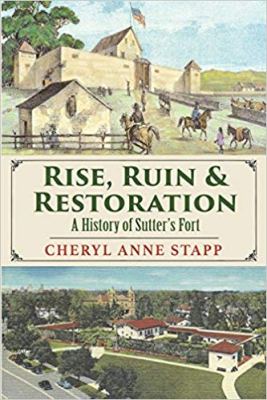
Rise, Ruin & Restoration: A Review

Sutter’s Fort stands at the center of California history. Here its biography, telling the  story of that iconic fort from the day John Sutter arrived at the spot in August 1839, through its building and its decline, to the State Park we know today in the heart of Sacramento.

riseruinCheryl Anne Stapp has given John Sutter and his iconic Fort their due regard in Rise, Ruin & Restoration: A History of Sutter’s Fort.  In this brief but detailed book she traces the history of the fort and the people who built it, lived in it, and restored it.

What was it made of? Who had the skill to build such an edifice in the wilderness? Are there eye-witness accounts of its early days? What happened to the fort during and after the gold rush? How did it rise from ruin? The author answers all those questions and more.

Names familiar and unfamiliar in California history are here, because everybody went to Sutter’s. John Bidwell, Nancy and Ben Kelsey, P.B. Reading, Lansford Hastings, John C. Fremont, Eliza Gregson, Sam Brannan, and many more — they all saw it and many of them wrote about it.

sutters fort old

Sutter’s Fort in decline — a pencil drawing by W. Tyrrell done in 1855

I knew something about the fort’s early history, but what happened to it after Sutter left, and how it was restored, has seldom been touched on. The fort lay in ruins for many years, until the adobe walls melted back into the earth. Then in 1889 the city board of trustees decided to extend 27th Street from K to L Streets.

The cut-through would necessitate the destruction of the decaying Central Building, the only standing remnant of Sutter’s Fort. Within days of the trustees’ announcement, a patriotic and well-known Sacramentan named James G. Martine sent an open letter to the Sacramento Union addressed “To the Pioneers of the Pacific Coast.”  (p. 104)

The movement to restore the fort to its former glory was led by The Native Sons of the Golden West. But what did the original look like? Where exactly were the walls and the bastions? Old pioneers like John Bidwell were consulted, but the resulting restoration actually turned out to be a third smaller than the original.

Not until the Kunzel Map was rediscovered in 1958 did the restorers have an authentic ground plan for Sutter’s Fort. Published in an obscure German pamphlet in 1848 and filed away in the Bancroft Library ever since, the Kunzel Map is a ground plan sent by John Sutter himself to Dr. Heinrich Kunzel to promote German emigration to California. At last we have an accurate diagram of the fort and its attendant buildings.


Posted in Book Reviews, Sutter's Fort | Leave a comment

Kit Carson

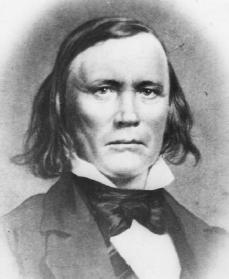
uewb_03_img0149I have enjoyed riches and suffered the pangs of poverty. I saw General Grant when he was little known. I baked bread for General Fremont and talked to Kit Carson. Nancy Kelsey

When Nancy Kelsey was remembering her adventurous life, three famous Americans were top on her list of celebrities: Grant, Fremont, and Kit Carson, the celebrated scout, trapper, and frontiersman.

Last week I made a visit to Taos, New Mexico. It’s a lovely town to visit, especially if you like window-shopping among art galleries, which Taos is chock-full of. I didn’t have time for that, but for history buffs Taos has the Kit Carson Home and Museum.

(It also has Taos Pueblo, a UNESCO World Heritage Site, well worth a visit.)

DSCF7858

Hard to get a good picture with our tour bus parked right in front of the museum.

dscf7857-e1568686613375.jpg

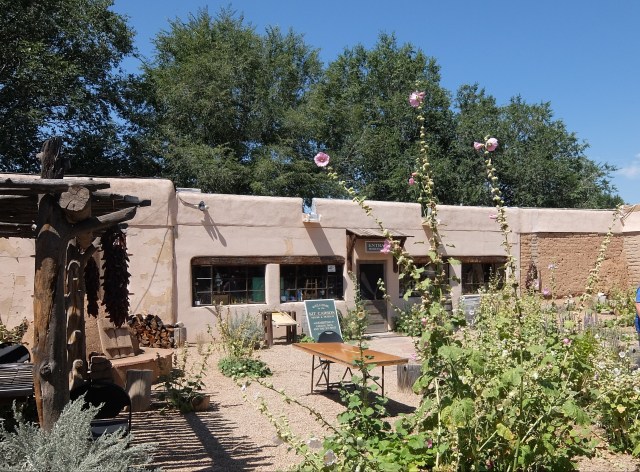
The courtyard of the Kit Carson Home.

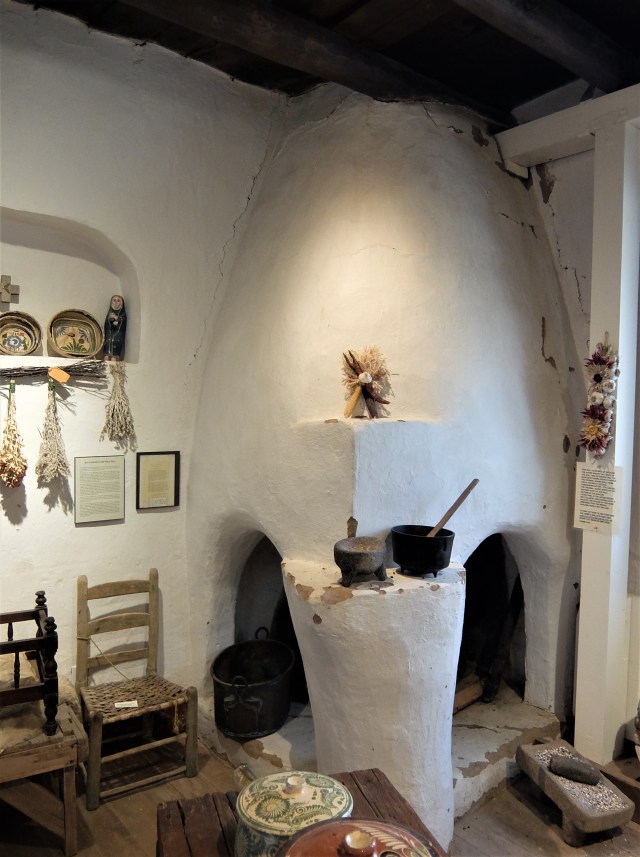
The house is a typical Southwestern-style one-story adobe structure surrounding a courtyard, with a flat roof and small connected rooms. The large cooking and heating adobe stove is two-sided, for versatility.

DSCF7854

The museum consists of four rooms of Carson’s home, full of family photographs and artifacts, plus a gift shop. Carson was a devoted family man, in spite of his many journeys away, and he was never happier than when he was home with his wife Josefa and their lively bunch of children.

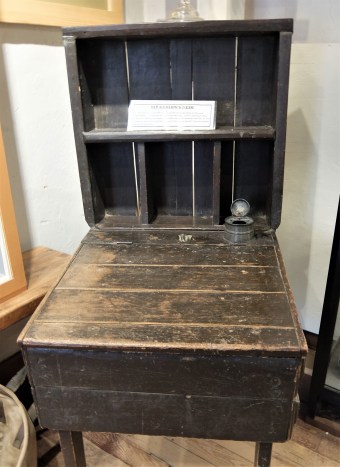
DSCF7856Kit’s writing desk. I don’t know how much writing he did, since I am told that he was illiterate. He did learn to sign his name. Nevertheless, he had a writing desk.

Since Carson’s home was in Taos, what is his connection to California? Well, it was considerable. Maybe someday I’ll write about it.

The museum director asked our group, “What do you know about Kit Carson?” I said, “I know he was with John C. Fremont in California.”

The director said, “It might be more accurate to say that Fremont was with Kit Carson in California,” and he was right. Without Carson’s knowledge and quiet leadership, Fremont probably never would have made it.

So if you ever get to Taos, say hello to Kit and Josefa from all of us in California.

Posted in Kit Carson, Uncategorized | Leave a comment

A Russian in California

800px-SudzilovskySan Francisco, Sacramento, Soapweed — the travels of a Russian in California.

Nikolai Konstantinovich Sudzilovsky came to California in 1891, but not under that name. When he left Russia, he adopted the English-sounding name Nicholas John Russel, the surname being a nod to his homeland. His description of his travels in California, written in Russian for a Russian audience, was never published in his lifetime — indeed, he never completed it. It languished among his papers in a Moscow archive until discovered and translated by Terence Emmons.

Around California in 1891 was published by the Stanford Alumni Association in 1991. I picked the book up in a used book store, another one of those serendipitous finds.

Russel (I’ll call his that, since it is easier to type and the name he used most often) was born in Belarus in 1850. He studied medicine at Kiev University, where he also got deep into revolutionary politics. When the political situation became too heated for the young rebel, he left for Bucharest, where he completed his medical education and continued his activities in left-wing politics. Expelled from Romania, he bounced around Europe until 1887, when he emigrated to the United States. Wherever he went he wrote travel articles for Russian magazines that were published under pseudonyms.

In 1887 he came to California and for a few years practiced medicine in San Francisco. In 1891 he decides to go to the mountains for a summer vacation. He begins his account with these words:

Surely, one of the unique features of American life worthy of imitation is the widespread practice of spending summer vacation in the wilderness camping or wandering. . . .  “Camping,” “tramping,” and “roughing it” as the Americans call this custom of summer traveling, will not lose their poetic charm and will continue to be the inexpensive and popular source of a multitude of healthy and varied pleasure.

And here we are, over 100 years later, still taking our family camping trips and enjoying the wilderness.

The business man and the “aristocrat,” though, will not be found enjoying the summer in the rural isolation. Americans, according to Russel, are obsessed with getting rich, and the man of business does not have time for leisurely vacations.

As he travels, he remarks on the ubiquity of advertising, “whether on the railroad, ferry boat, or country lane, it flies into your ears and nose like mosquitoes in the swamp or woods.” He doesn’t forget his socialist roots — he is sensitive to the excesses of American business and “the predators of capitalist feudalism.” But to be fair, it was the Gilded Age of the robber barons and the “Big Four.” There was plenty to criticize.

Russel starts his travels in San Francisco, takes the ferry to Oakland and then the train to Sacramento, describing all the sights, sounds, and smells along the way. His object is the mountains — he plans to spend the summer among the pines. To this end he had put an advertisement in the papers, looking for a place where he and his traveling companion could stay for the summer and do some hiking and fishing.

He ends up with a Mrs. Golden, who “offered us, for a reasonable price, room and board in a comfortable apartment with a small family at the elevation of 3,000 feet, in a forested, healthful area covered with mountain streams.” Sounds inviting!

The rest of his unfinished account is a description of their summer at Soapweed. There is no town of Soapweed now (if there ever was), but there is a Soapweed Creek, about 16 miles from Placerville in the El Dorado National Forest, and that is where he enjoyed California country life.

Russel never completed the book. After a dispute with the Russian Orthodox bishop of San Francisco (thoroughly covered in the book in an article by Terence Emmons), he went to Hawaii, where he became the first president of the Hawaiian Senate, under the name Kauka Lukini!

Never one to settle anywhere, he traveled to Japan, and then to China, where he died in 1930. His papers eventually made their way back to Moscow.

The book is too brief to tell us much about life California in 1891, but it gives an idea of how the Golden State looked to the eyes of a revolutionary Russian.

 

Posted in Nicholas Russel | Leave a comment

Tehama County Jubilee!

IMG_20190914_084814399 (2)

Look at that! Top billing at the Tehama County Museum’s 38th Annual Jubilee.

If you like a good old-fashioned fair, not too big but with plenty to do for old and young, then the Jubilee was the place to be today.

I was their featured author, and I had a table inside the air-conditioned annex (lucky me!) where I talked to local folks and sold and signed books.

You can tell from this array of signs that there was plenty going on, and that wasn’t the half of it. I was sitting next to the Fiber Arts ladies, who were spinning away on their spinning wheels, making yarn to craft a shawl.

There were craft booths, a pancake breakfast, a picnic lunch, vintage trucks and tractors, raffle prizes, an art show from Corning High School, and plenty of toe-tapping music. Something for everyone!

Here are a few pictures:


IMG_20190914_084739529

The Tehama County Museum, in the town of Tehama, just over the Sacramento River from Los Molinos. I hope you all know where Tehama County is. (I have to admit that I didn’t until I moved to Northern California.)

IMG_20190914_084602119

Every county needs a jail.

IMG_20190914_084616254

IMG_20190914_111423064

Ladies, start your spinning wheels!

IMG_20190914_084351801

Look at those beauties! Vintage trucks on display.

History comes alive at the Tehama County Museum!


Posted in Tehama County | Leave a comment

California Admission Day

Admission-Day-Bear-1850-1024x676

Courtesy of the Society of California Pioneers

Here’s Cuffy in a cartoon from 1850, reading the news of California’s admission into the Union.  The drawing comes from the Society of California Pioneers, but I don’t know anything else about the source of this picture. The SCP has a treasure trove of California items.

In September 1889 — 39 years after the event — John Bidwell wrote to his friend E. Nelson Blake:

Your memory is good — true, 39 years ago we brought the news of California’s admission into the Union. Where are those who were our fellow passengers? Except for yourself, I cannot recall the name of one living! We ought to be thankful that our lives have been spared to behold the wonderful march of events of this prolific age!

Unfortunately, Blake’s letter to Bidwell recalling the great day does not survive. Blake had a very good memory for his California days — I wish we had his recollections.

Bidwell and Blake were both passengers on the steamship Oregon, arriving on October 18, 1850 with the news that California had become the 31st state. Bidwell was traveling in a first class cabin, while Blake, a farm boy on his way to the goldfields, was in steerage.

Bidwell carried with him the statehood documents, but fearing their loss to unknown men who opposed the admission of California as a free state, he gave the document into the keeping of Mrs. Elisha Crosby and her daughter Helen. Miss Helen slept with the packet of papers under her pillow and hid them in her blue silk umbrella as the crossed the Isthmus of Panama.

You can celebrate Admission Day with the Bidwell Mansion Association at Bidwell Mansion on Sunday, September 8th at 4 p.m. and hear the whole story of how John Bidwell brought the news and the documents safely to San Francisco.

California-Admission-Day-12


Posted in Uncategorized | Leave a comment

A Visit to the Haggin Museum

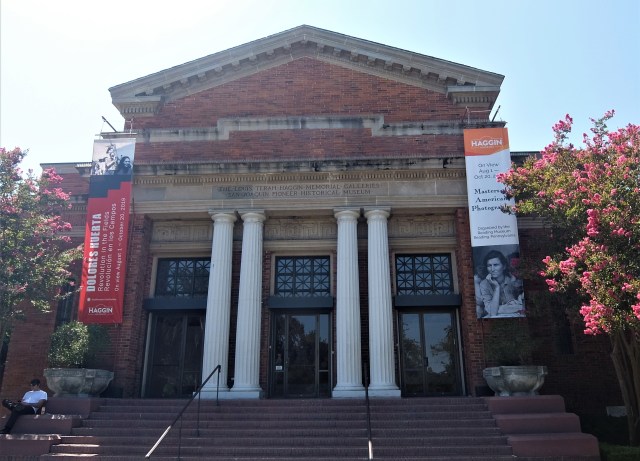
I travel quite often from our home in Chico to our son’s home in Livermore (because that’s where the grandchildren are). Traveling down I-5 we pass through Stockton. I have never had any reason to stop in Stockton, until I found out about the Haggin Museum.

DSCF7721

What a gem! Stockton is very lucky to have such a fine museum. And luck has played a significant role in the creation of the Haggin Museum. According to Wikipedia:

The San Joaquin Pioneer and Historical Society wanted to build a history museum, but was unable to raise sufficient funds to do so. Robert McKee offered the group $30,000 in honor of his wife, Eila Haggin McKee, if the museum would be named for her father Louis Terah Haggin and if they added a wing to house his art collection. The museum opened its doors to the public on 14 June 1931, Flag Day.

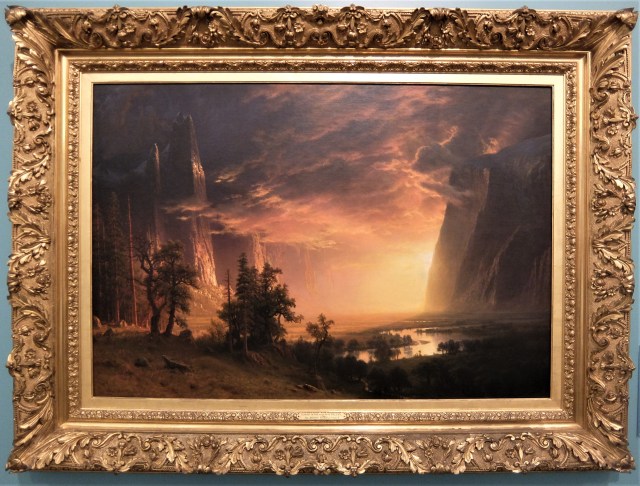
So Mr. Haggin never lived in Stockton, but his fine collection of 19th century European and American does reside there. It’s an especially good place to see paintings by Albert Bierstadt.

DSCF7712

Sunset in Yosemite Valley, by Albert Bierstadt

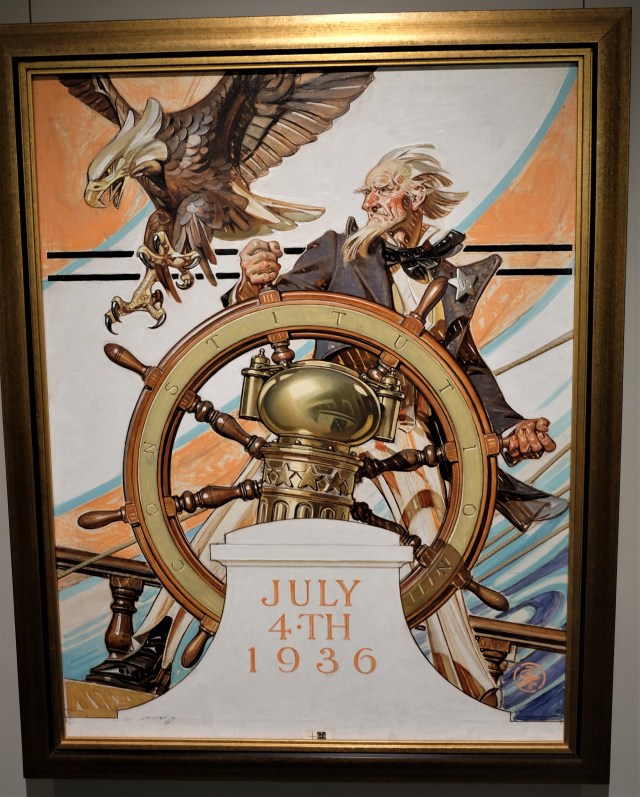
The museum also has an extensive collection of the works of the American “Golden Age” illustrator, J.C. Leyendecker, which also came to them by luck. Leyendecker never lived in Stockton either, but his sister did, and she left her collection to the museum. If 19th century French art is not your thing, then go to the upstairs gallery to see Saturday Evening Post covers and advertising art for Kellogg’s cereals and Arrow shirts.

dscf7720.jpg

J.C. Leyendecker — Is it any wonder that we all eat cereal for breakfast now?

DSCF7714

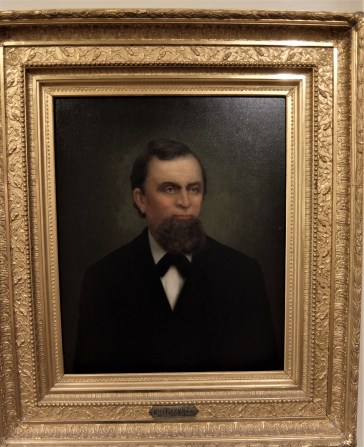
Charles Weber, member of the Bidwell-Bartleson Party and founder of Stockton

And then there is local and California history, farm machinery, boats, old fire engines, a World War II Jeep (one of 275 bought by the students and teachers of Stockton High), and traveling exhibits. Something for everyone!

The museum is easy to get to — close to I-5 on Pershing Ave. Directions and hours are here.  Put it on your list of places to visit soon.

The museum is set in a city park so you can have a picnic or run some energy off the kids. There is also a lovely rose garden.


livermore-aug26 (27)

A Saturday Evening Post cover by J.C. Leyendecker 

Posted in Uncategorized | 2 Comments