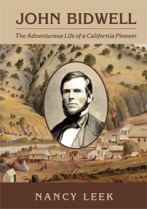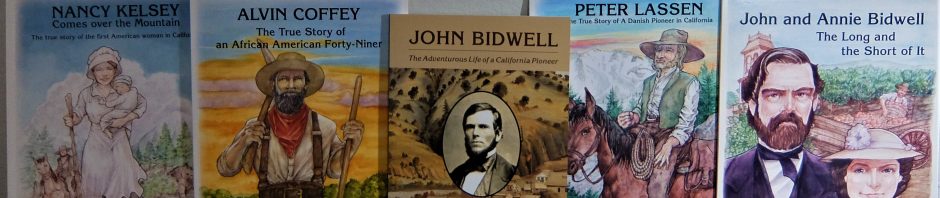
More Bicentennial Birthdays

bicentennielNot only does the year 2019 mark the 200th birthday of John Bidwell, but he shares his bicentennial year with some notable figures.
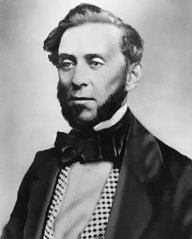
Here are some other folks who turn 200 this year.

Two royals: Queen Victoria (May 24) and Prince Albert (August 28). Queen Vicky and her Prince Consort were born in the same year, and she was actually three months older than he.

Two famous American authors: Walt Whitman (May 31) and Herman Melville (August 1). Maybe this year is a good year to pick up Leaves of Grass or reread Moby Dick.

A great British novelist: George Eliot, born Mary Ann Evans (November 22). One of these days I am going to reread Middlemarch. I keep telling myself that.

The author of The Battle Hymn of the Republic: Julia Ward Howe (May 27). Glory, glory, hallelujah!

Another Howe, inventor of the sewing machine: Elias Howe (July 9). He was not the first to try to invent a machine for sewing, but he came up with the lockstitch method that is still the basis for modern machines. Seamstresses (or sewists, as they are called now) everywhere than you!

The foremost American detective: Allan Pinkerton (August 25).

sam brannanAnd last but not least, that other California pioneer: Samuel Brannan (March 2). (I knew I shared a birthday with Dr. Seuss, but Sam Brannan too? I am not an admirer.)

Brannan was an opportunist and a scoundrel, but he has an important place in California history.

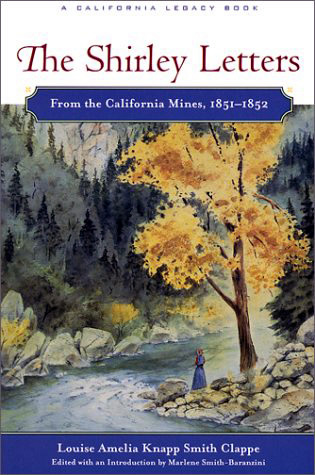
Very soon I will tell you about my favorite Bicentennialist (other than John Bidwell) , a California writer we should all celebrate.

Posted in Uncategorized | Leave a comment

Bidwell Bicentennial Birthday Bash

It’s John Bidwell’s 200th birthday and you are all invited to a free event at Bidwell Mansion on Sunday, August 4th from 4 to 6 p.m. Fun for all!

Come for free Shubert’s ice cream, birthday cake, games, music by the Chico Community Band, and vignettes in the Mansion. Also, burgers for purchase from the Madison Bear Gardens grill.

BidwellBirthday2019 facebook event-outline

The birthday boy doesn’t look a day over 50, does he? Happy Birthday, General!


Posted in Uncategorized | 3 Comments

Gold Rush Stories

GRUS2.inddGary Noy has done it again. A few years ago I read and reviewed his book Sierra Stories. Now he has a new book: Gold Rush Stories: 49 Tales of Seekers, Scoundrels, Loss, and Luck, published by Heyday Books. It came out in 2017 and I wish I had gotten it sooner. Whether you are new to reading about the California gold rush, or an old hand, you will find and enjoy stories that you never heard before.

A few of the characters are old familiars, like James Marshall, Emperor Norton, and Joaquin Murieta, but even then Gary finds something new in their lives. A few of these stories I have written about myself: the fate of Sutter’s Fort or the adventures of Luzena Stanley Wilson.

Many more of them were new to me, and what an invitation to explore further! Who wouldn’t want to know more about Lt. George Horatio Derby, who wrote under the pen name the “Veritable Squibob,” or Alfred Doten, whose alcohol-fueled journal of fifty years reveals the seamier side of life in the camps?

The forty-nine (what else?) chapters are short but packed with careful research and entertaining details. Gary has dug deep into the vast collection of journals, letters, and memoirs that came out of the gold rush. Along with the stories of individual “seekers and scoundrels,” he gives us a look at special groups — the tribulations of the Californios (and how the Peralta family was swindled out of their land holdings), the commercial success and family life of Jewish immigrants, and the struggle of African-Americans against prejudice. He has chapters on catastrophes, gambling, “dissipation” (drunkenness), hangings, and grizzly bears.

John Bidwell even makes an appearance, in the story of the explosion of the steamboat Belle on the Sacramento River.

Really, you can’t go wrong with this collection. There is excitement, surprise, and revelation in every chapter. This is the California Gold Rush in all its splendor and squalor. What Bayard Taylor said of the California Constitutional Convention can be applied to the entire experience: “So wonderful, so dangerous, so magnificent a chaos!”

Posted in Book Reviews | Leave a comment

“Dear Charlie” — Horace Goes Home

Boston, June 19, 1855

Dear Charlie:

As you have been informed, Snow has arrived in America.  . .  I landed in New York the 6th day of June and from that time to this I haven’t seen a moment’s leisure time . . . How I came to return so suddenly, and thousands of other little things, I must omit until I see you  . . .

md1260381293After twenty-one months mining in California, Horace came home to “America.” as he called the eastern United States. Why he came home “suddenly” isn’t known. Maybe he was getting homesick for the comforts of home, in spite of his success as a gold miner.

A few months later he wrote another letter to Charlie (who was in New Hampshire) telling him he had changed his plans to return to California and was still in Boston.

But return to California he did, eventually. Though not until after the Civil War.

According to the “Civil War Veterans Project” of the Orange County California Genealogical Society, Horace Snow “enlisted 10 February 1862 at Dubuque, Iowa in Company H, 13th Infantry, mustered out 31 August 1864. Commissioned 7 September 1864 in Company D, U.S. Colored Troops 45th Infantry, Mustering Officer at Philadelphia, Pennsylvania, mustered out 4 November 1865.” It would be interesting to know about his experiences as an officer with a colored troop, but I don’t have any information about that.

After the war he married Margaret (Maggie) Fox Butcher and took his bride back to California. His brother Hiram was still here. Horace and Maggie had five children, all of them born in California. After a few years in Solano County and Powellton, Butte County (he is on the 1872 Butte County Great Register of Voters), he settled in Eureka, Humboldt County.

He was a dry goods merchant, in business with his brother Hiram, as Snow & Co.

8722415_117407309048In later years he moved to Southern California, and lived in Tustin, Orange County, where he died in 1895.

For more information about Horace Snow, check out the complete record at the OCCGS Civil War Veterans Project.

Posted in Uncategorized | Leave a comment

“Dear Charlie” — Prices

Horace Snow wrote his old friend Charlie in September 1854 and included a list of grocery staples that they bought to lay up for the coming winter. Many miners moved down out of the hills to the cities like Stockton or Sacramento during the winter, but Agua Frio must have been comfortable enough to stay year-round.

Dear Charlie:

Seated on my three-legged stool before the old rustic table, I am happy to have health, materials, time and a mind to give you a few more details of my experience in California. . . . .

We are now laying in our winter’s provisions and getting up our winter’s wood. We can purchase provisions cheaper now than any other time and also cheaper by the quantity. In doing this we capture two birds and come a “Yankee game,” as the Southerners say. Twenty dollars is worth saving if your relatives are well off! — say two thousand miles off! I will tell you our kinds with prices and quantity annexed, just for a novelty.50 lbs. butter @ .40 (cents per pound)
2 bbls. (barrels) flour @ $18.00
1 bbl. crackers @ $10.00
50 lbs. sugar @ .20
12 lbs. chocolate @ .36 (they drank chocolate as a breakfast drink)
1 doz. boxes yeast powder $5.00
15 lbs. candles @ .40
30 lbs. lard @ .20
50 lbs. of beans @ .10
and about $20.00 for extras, making a little bill of $122.00. This we calculate will last us until sunny spring begins to dawn and then we hope our pockets will look agreeable.

MDH18530902.1.4-2474-5484-763-871-381w

A typical ad for provisions, from the Marysville Daily Herald, 2 September 1853

These prices may look low to us, but to Charlie they would have seemed high. Back in Massachusetts he could buy a barrel of flour for half the price that Horace paid in California. Sugar was 8 cents a pound, not 20 cents. He could get fresh butter for 25 cents a pound, not only cheaper but better quality than the rancid butter that came round the Horn to California.

You can get a pretty good idea of what the three men ate from this list. Lots of beans, and bread they baked themselves. Meat they would have either hunted or gotten from a butcher. Did they ever have fresh vegetables or fruit? I don’t know, but I hope so. Otherwise they’d be coming down with scurvy, as many miners did.


Posted in Horace Snow, Uncategorized | Leave a comment

“Dear Charlie” — A Gold Panning Contest

californiagoldrush1Horace Snow tells of a competition he and his brother took on, just to liven things up in the summer of 1854. They decided to take turns washing out pans of gold to see which one of them could wash the most gold out of a single pan. He says they did this for several days without there being much difference in the amounts they each washed out, “the biggest pan being $5.00.”

But then—

This day when we came to the ledge my brother began to pick around — it being his turn — and accidentally struck a place which looked nearly yellow with gold!! He jumped for the pan and began to fill it and I looked on. I saw by the dirt that he would take the palm from my honored head and began to remonstrate against his selecting the dirt in such a way and also for rounding up his pan so. But this was no use!

Perhaps he was complaining that his brother was overfilling his pan with dirt.

Finally I offered him a dollar to let me wash the pan. He was bound to wash the pan and away he went. He returned in a few moments and how much do you guess he obtained. Only $19.75!

Now chum Snow wasn’t idle by no means while he was gone and accidentally discovered him a place but when he saw his brother’s gold he thought ’twas no use, for $19.75 was a tremendous pan. However, Snow kept on picking and in a short time got him a pan. Our competition had become very great, so much so, that my brother had to go and see me wash it, for fear that I should come some game upon him. The pan when washed, the gold dried and weighed and, Charlie, how much do you reckon I had? Only the pitiable sum of $48.50!! Wasn’t I tickled!

Then went on to wash out one more pan and got $23.75, “making in all $92.00 in three pan, and all in one day!”

$92.00 for maybe an hour’s work was a magnificent return on their labor — several thousand dollars in today’s money.  No wonder Snow was so tickled. Not every day was so rewarding, but they were doing well. In this same letter of October, 22, 1854, Horace Snow expresses his contentment with his lot:

Charlie, you cannot think of how well we are situated. We have the best cabin, the best table, the best bunks, the best dishes, the most books and more conveniences than any other cabin in Agua Frio Camp. Sometimes I think that I could spend my days here, only give me plenty of [news]papers and enough to read.

Sounds good to me!


Posted in Horace Snow, Uncategorized | Leave a comment

“Dear Charlie” — Three Cheers for Snow

California-Gold-Miners

Nearly every account of any man who came to California to get rich mining for gold will say that after a few months, or weeks, or days in the goldfields the fellow gave up the attempt and turned to “mining the miners” as a storekeeper, lawyer, doctor, teamster, or just about anything else that didn’t involve standing in an ice-cold creek or shoveling dirt all day. But some miners did stick to it, and some made money at it, and not all of them lost their gold to card sharps and loose women.

Horace Snow was one of those men, along with his brother Hiram and their partner Charles Spear. Horace rejoiced in telling his friend Charlie about his financial progress. He had come to California owing money to his brother and to a Mr. Plympton who had loaned him the money to attend the Normal School in Massachusetts. He owed these and other men $267 when he came to California: “Wasn’t that a pretty little sum to accompany a poor, unsophisticated person into such a dissipative country as this?”

But after a year and half he could boast that he had cleared all his debts. Moreover, he had sent

$50 to Father, $12.50 to Sister, and furthermore, have got $100 at interest, besides owning one half of a good Cabin and cooking utensils, one half of three claims, the same interest in a good stock of mining tools . . . Now Charlie, I don’t wish to be boisterous or ungentlemanly, but let us throw off a little of our superfluous hilarity and give three cheers for Snow. Therenow, HURRAH! HURRAH!! HURRAH!!!

As a basis for comparing how much he had gained by his labor, $100 then would be worth at least $3320 today. Measuring Worth has a variety of answers, depending on what you are trying to measure. It get complicated. The relative worth of that $100 could be  $3,320.00, or as labor value $25,400.00 (using the unskilled wage) or $52,600.00 (using production worker compensation) or an income value of $56,400.00. No wonder Horace was chuffed.

Even that little $12.50 he sent to his sister was worth at least $415.


Posted in Uncategorized | Leave a comment

“Dear Charlie” — A Day in the Life

Horace Snow spent most of his almost two years in the California goldfields in Agua Frio, a little mining camp in Mariposa County. On October 9th, 1854 he wrote to Charlie Fitz to “tell you of one day in our lives.”

minersten2

Vignette from The Pioneer Ten Commandments, Courtesy of UC Berkeley, Bancroft Library

[This] morning I awoke very early and was thinking about — well, I have forgotten what — when all at once a big rat who was running along the logs missed his calculations and fell smack into my stationary box. This aroused me from my calm content and in less than one minute I was up, had a candle lit and after him with a sharp stick — for I always keep one beside me expressly for this purpose. I hunted him around the flour barrel, the dutch oven, the pile of wood, but at last he got away from me, “knowing better the ropes” and made good his escape.

Not having violated the 13th Commandment [does anybody know what that was? –ed.], I now built a fire and began to prepare breakfast. I first put some water on to heat to wash the dishes with, for just as we were done with supper last night, our nearest neighbor made us a a call and so we deferred until morning, though this was against one of our regulations. As soon as the water was hot, I put the chocolate on and washed the dishes.

I had not need to cook this morning as we had beans yesterday and they were not all gone. Bread we always bake night beforehand. Therefore, before the first rays of sun peeped over the hills, I had breakfast all ready, which frugal meal consisted as follows: beans, boiled ham, bread, butter, cheese, chocolate, cold water, boiled rice, sugar, with pepper, vinegar and salt. And true to say, I was the only person up to enjoy the warm breakfast and morning air. However, by relieving them of a few blankets, I soon had them before the fire!

Breakfast being over, we put the unconsumed food in the cupboard, which, by the way, is a Natick shoe box,* turned our plates the other side up, changed out woolen shirts and went to work, which time was about sun half hour high. We picked and shovelled until noon — our guide being the shade of a tree — when my brother brought a pail of water. I built a fire and Spear set the table. Dinner the same as breakfast, tea substituting for chocolate.

Afternoon the same as forenoon and when night came my brother made the bread, Spear washed the dishes, and I boiled the rice. We had rice and molasses for supper, with a sprinkling of biscuit and butter. As we have no milk, we use molasses in its stead. The day passes this way and all for a little Money!

They were industrious and sober Yankees, and they were doing quite well at finding gold and saving money.

*Natick, Massachusetts was a center of shoe-making, especially the heavy boots and brogans worn by miners and other laborers.


Posted in Horace Snow | Leave a comment

“Dear Charlie” — Jury Duty

Gold miners were no more eager to serve on a jury in 1854 than most citizens are today, although they rarely had to show up for more than one day. Horace Snow writes:

April 4th: Tomorrow I am obliged to go to Mariposa, having been summoned as a juror. I endeavored to avoid being called upon but the sheriff caught me and there is no doing otherwise. The miners are determined not to go if they can possibly help it, as they get nothing for pay. As soon as they see an officers coming, the shovels drop very quick and such running and skulking would beat the Indians.

8c97923a27bdcc140f71c9a07b3533ee

“The man with a red shirt,” a colored photograph of a forty-niner

You see there were four of us in a store when the Sheriff rode up and we all made for the back door but he was right after us. I got within about four feet of a large hole when he saw me and screams, “Your name, Sir, the man with a red shirt,” and kept right on after the others, but he only caught two of us, two running around one side of the store and two the other.

He got caught again later that year.

December 4th:  Yesterday, while picking away in my claim, a gentleman appeared before me and says, “Your name, Sir?” “What?” says I. “Please give me your name?” By this time I knew what was up and says my name is Snow.

“Your first name, if you please,” says he, “and be quick, for the other boys are all running and I want to catch them.” “Horace C. Snow, sir” says I. Then says he, “Mr. Snow, I warn you to appear at Mariposa tomorrow morning at ten o’clock to serve as a Grand Jurorman, whereof fail not, or suffer the penalty of the law.” –and away he ran to catch some of the other boys who had, unintentionally, of course, gone in search of something. The boys were too sharp for him and he only got two of seven.

Miners, as a general thing, are much averse to sitting upon a jury. They get no pay, (not enough to bear expenses), besides losing their time and disarranging their work. You would laugh to see the miners take to the bushes when the Sheriff makes his appearance on the creek.


Posted in Horace Snow | Leave a comment

“Dear Charlie” — What’s for Dinner?

Young men of the 19th century  were not accustomed to doing their own cooking. They had mothers, wives, or boarding house landladies to take care of that. But in the goldfields and mining camps, men had to fend for themselves. Horace Snow took delight in describing his prowess at the cookstove.

1999-0032_000105402cook

He especially took pride in his baked beans, a New England staple:

By the way, when I commenced this epistle, I commenced cooking some beans and now I have them parboiled and pork in, all ready for baking; therefore, I shall not be disturbed for a short time. You see, I am learning several lessons that you will not get at the Traveller Office [where Charlie worked]. Only think of working all day, going home at night, rolling up your sleeves, making biscuits, doughnuts, flap jacks, frying pork or ham, washing dishes, and all such things as pertain to domestic duties!  . . . What an accomplished young man I shall be when I return.

Horace is learning what life was like for a working woman!

The next day he writes:

My bake beans are splendid. Would that you were here to eat some. Eat some out of a tin plate, with an iron spoon. How much better they would relish then eaten from nice china ware and from a table loaded down with the edibles, the fragrance, all of which rush upon the olfactory nerves, thus destroying the flavor of “my good bake bread!” Think of me when you eat bake beans.

c0cfbf48fd02a9416d8f6dbcbe939f89-800

Posted in Horace Snow | 3 Comments