Sarah Pellet, Lady Reformer

I haven’t been able to find a picture of Sarah Pellet. I wish I had one to show you, because I wonder what she looked like. Newspaper reports sometimes refer to her as “fair” (as in “the fair lecturer”), but that was a convention.

The Daily Alta California said she was “small and neat-looking, and wearing spectacles” and another editor called her “angular.” She was 30 years old when she first came to California. Her passport application of 1858 gives a description that includes height of 5 feet 2 and 3/4 inches, a dark complexion, black hair and eyes, a Grecian nose and a mouth “rather large.”
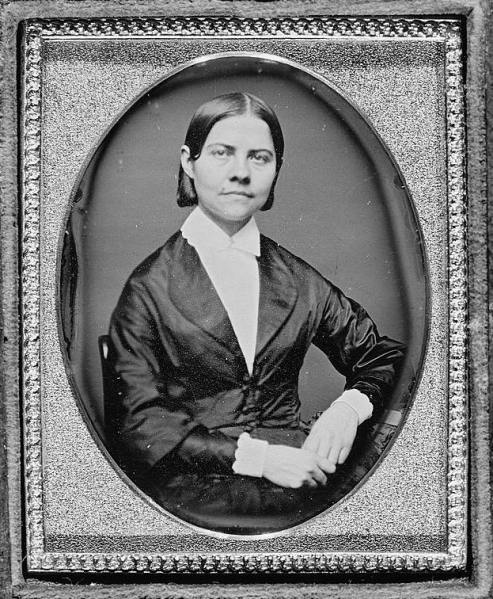
lucy_stone

Lucy Stone

Sarah Pellet was born in North Brookfield, Massachusetts in 1824. A neighbor of Lucy Stone, she became friends with that women’s rights activist, and like her attended Oberlin College, graduating in 1851. Following her graduation, she returned to Massachusetts and became active in the cause of women’s rights. Later she went on to gain a medical degree. She was certainly an intelligent and determined woman.

Inspired by Lucy Stone’s lecturing tour of the “western states” (what we would call “midwestern”, i.e. Ohio, Indiana and Illinois) in 1853, Sarah decided to go even further west, to California, in 1854-55. A letter to Sarah from Susan B. Anthony in August 1854 encouraged her to take up lecturing to spread the word of women’s rights.

Dear Sarah

I had long been asking my self where is Sarah Pellet & what is she busy about, for busy she must be
What say you Sarah— here is a chance for you, (under the auspices of our State Committee) to make yourself thoroughly at home in the Lecture room—  If you ever intend to make Lecturing your business, you surely need just such a discipline—one cannot have a reputation as speaker, until they have won it, & simply giving a few Lectures to small audiences in large places will not win a name to one’s self—
 
bloomercostume-7

Susan B. Anthony was asking Sarah to campaign around the Northeast, but Sarah decided to go further afield. In the fall of 1854 she boarded a steamship for California, and drew a considerable amount of humorous comment, dressed as she was in “brown linen bloomers.”

Bloomers were practical, especially for a woman who would have to ride a mule across the Isthmus of Panama, but they were considered outlandish and dirisible. Did she continue to wear the bloomers while touring and lecturing throughout California? I wonder.  

Next: Sarah Pellet in California  
Posted in Uncategorized | 3 Comments

Duel in Downieville, and the Woman Who Caused It

But not for the reason you might think.

Miss Sarah Pellet came to California in the autumn of 1854 to lecture on temperance, women’s rights, and political reform. A female lecturer was a rarity anywhere, but especially in California, and Miss Pellet attracted crowds wherever she went.

Some years later, Calvin B. McDonald, who had been the editor of the Sierra Citizen in Downieville when Miss Pellet came to town, told the story of her visit and the subsequent duel. Her lectures to the men of Downieville had an effect that must have gratified the lady reformer. Wrote Mr. McDonald:

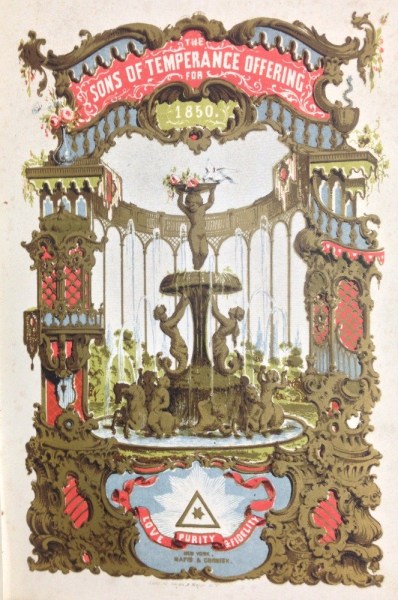
Sonsof-TemperanceThrough her exertions a large and flourishing division of the Sons of Temperance was there established, and all the respectable young men temporarily stopped drinking and became enthusiastic advocates of total abstinence. A temperance Fourth of July celebration was projected, and we nominated our friend, Miss Pellet, to make the oration, and notwithstanding a strong prejudice against women orators, succeeded in procuring her the coveted invitation.
Unfortunately, an up-and-coming young politician named Robert Tevis had planned on making the oration. He was given the job of reading the Declaration of Independence instead. His lengthy remarks following the reading drew the ire of the crowd, who set about firing anvils and making a racket to drown him out. Mr. McDonald continues the story:

The event made a great deal of talk, and brought the ambitious young man into very unpleasant notoriety instead of fame. The Democratic Party had procured the use of two columns of the local paper, and had appointed as editor the Hon. Charles E. Lippincott, State Senator from Yuba County. Lippincott had a keen appreciation of the ludicrous, and as Tevis was a Know-Nothing, he took occasion to roast the unfortunate young man in the Democratic corner of the paper, and it created a great deal of fun in the town. The next day Mr. Tevis came to me–I had no jurisdiction in the Democratic side of the paper–and demanded the publication of a card which pronounced the author of Lippincott’s article “a liar and a slanderer.” He was white with rage, and trembling, and would not be reasoned with. Knowing the nature of his antagonist and his deadly skill with arms, I tried to dissuade Tevis from the rash and dangerous publication, and dwelt on the inevitable consequence. But he would hear nothing; he wanted to fight, he said, and would fight, in the street or otherwise.

A location for the duel outside of town was selected and the weapons agreed on — double-barreled shotguns at forty yards. When the time came, the sheriff arrived to intervene (for dueling was actually illegal in California), so the duel was moved over the county line into Yuba County.

Charles Lippincott was an expert marksman. According to McDonald, “He declared he did not wish to kill his adversary, to whom he had never spoken in person, did not want to fight if it could be avoided, but the nature of the public insult and the customs of the time compelled him to send the challenge.” Once an insulting “card” was published in a newspaper, a duel was bound to follow.

The combatants took their places, forty yards apart; the ground was a little sloping, and the highest situation fell to the lot of Tevis. As his second walked away he turned toward Tevis and laid his finger on his own breast, as an indication where to aim, and Lippincott observed the gesture and fixed his eyes on the same place. The word was given; both guns cracked at the same instant. Tevis sank down, shot directly through the heart, and a lock of hair fell from near Lippincott’s ear. The fallen man had not made the necessary allowance for descending ground, and his murderous lead had passed directly over his adversary’s left shoulder, grazing his face.

Lippincott left for Nevada, but later returned to Downieville for a time, but after completion of his term in the State Senate, he went back to his home state of Illinois.

And what of Miss Sarah Pellet?

Miss Pellet, regarding herself as the innocent cause of the duel, stood courageously by her friend [Lippincott], visited him in his exile, exerted all her personal influence to reconcile public opinion to the survivor, and behaved altogether like a brave, true-hearted woman, as she was and still is, in her fancied mission of reform. . . .

Her temperance division at Downieville has melted away; some of her cold-water converts are dead; [and] others have been separated from their families by the foul fiend whom she almost drove from the place.

More on Sarah Pellet and her career in California next time.

Posted in Sarah Pellet | Leave a comment

Bear Story

Issue Date DECEMBER 23 1854 page 1

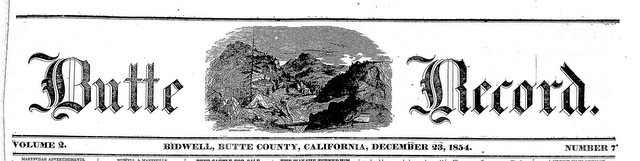
While searching old newspapers online looking for something else (isn’t that always the way), I came across this entertaining story in the Butte Record of December 23, 1854.

Bear Story

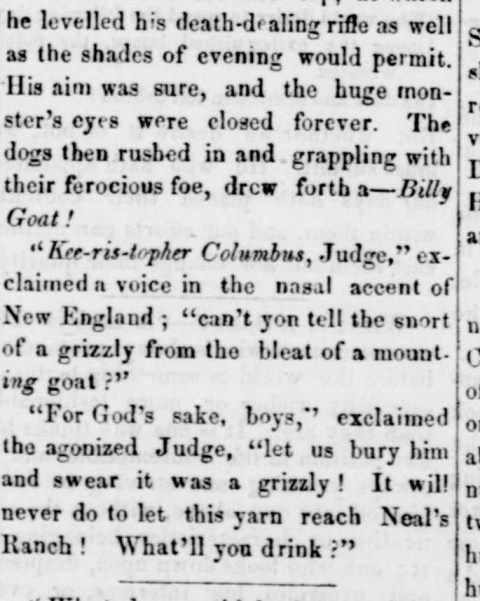
The little town of Hamilton, a few evenings since, was visited by a Bruin of the grizzly species. The first intimation the peaceful inhabitants had of his presence, was given by their lowing and frightened herds, coming tearing into town as fast as their trembling limbs could carry them.  The inhabitants were soon aroused, and discovered his bearship in the rear of the flying cattle. Judge W., from the upper country, happened to be in Hamilton, and the inhabitants arming themselves, and letting loose their dogs, followed the warlike Judge to the bushy field. They soon succeeded in corraling his bearship in the top of a fallen tree, which was soon surrounded by dogs, and armed and silent but excited citizens.

A hideous noise issuing from the tree top, warned all to be on their guard, and convinced the Judge, to whom the sound was perfectly familiar, that they had a regular grizzly to deal with. The utmost caution was now used. One person who was perched upon a high log, soon discovered a pair of fierce burning eyes, in the wreck of the tree top, at which he levelled his death-dealing rifle as well as the shades of evening would permit. His aim was sure, and the huge monster’s eyes were closed forever. The dogs then rushed in and grappling with their ferocious foe, drew forth a – Billy Goat!

Kee-ris-topher Columbus, Judge,” exclaimed a voice in the nasal accent of New England; “ can’t you tell the snort of a grizzly from the bleat of a mounting goat?”

“For God’s sake, boys,” exclaimed the agonized Judge, “let’s bury him and swear it was a grizzly! It will never do to let this yarn reach Neal’s Ranch! What’ll you drink?”

Issue Date DECEMBER 23 1854 page 2 bear story2I don’t know whether this is a true story, or just a tall tale to fill a page. There were certainly still grizzly bears in Butte County in 1854, so it could have happened.
Why not?

Posted in Uncategorized | Leave a comment

More Shameless Book Promotion


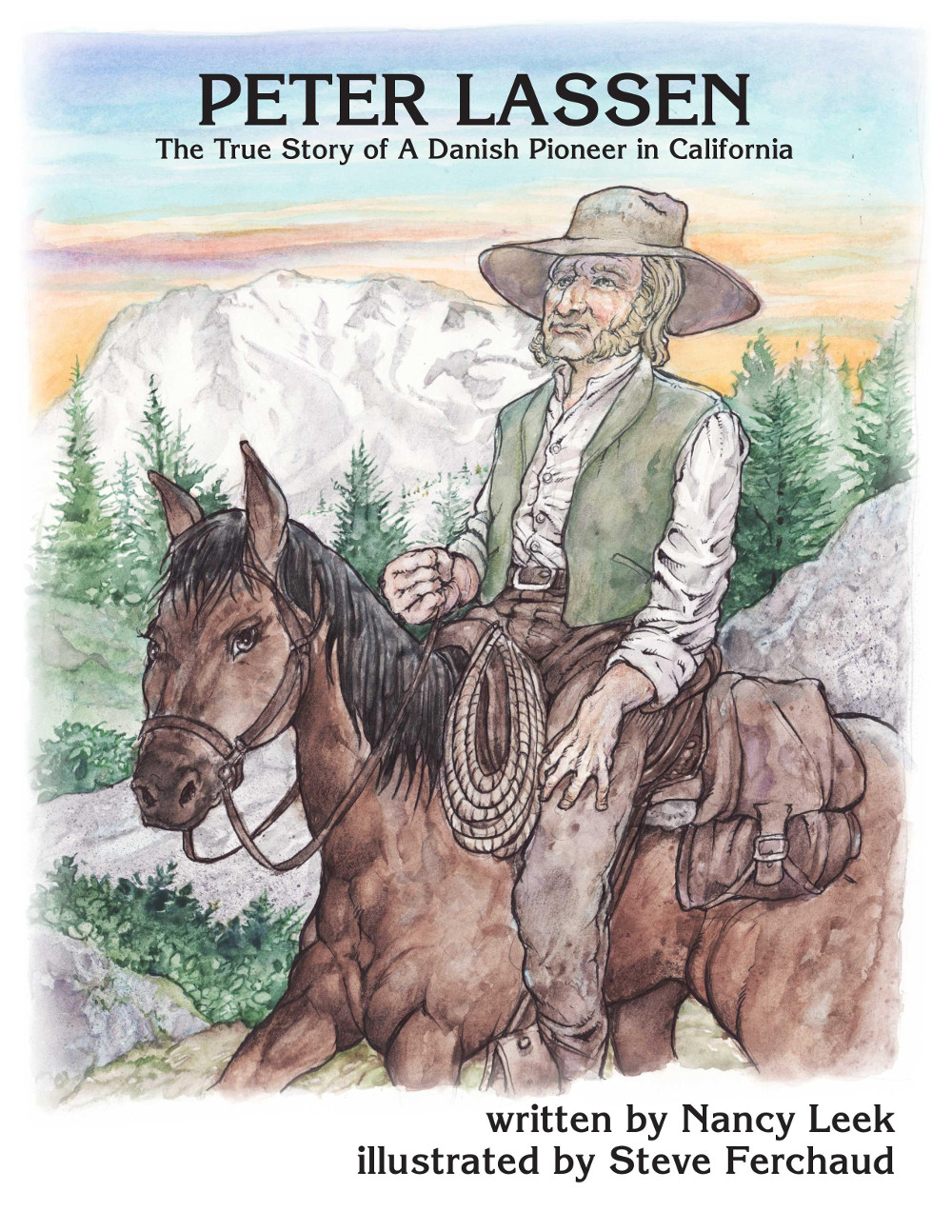
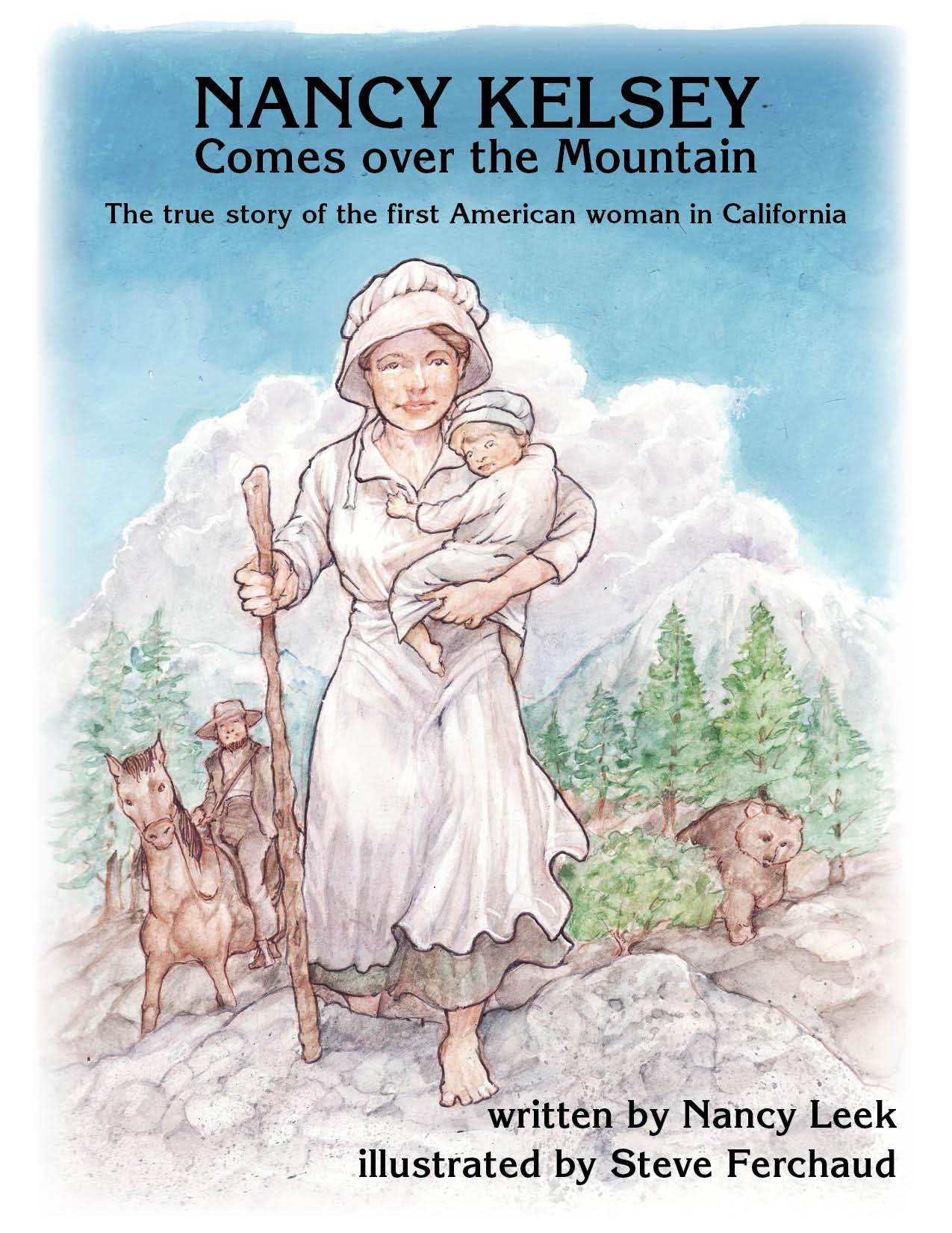
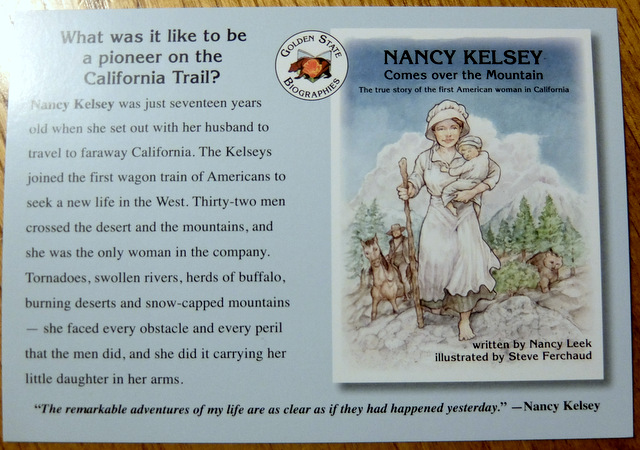
My picture book biographies, Nancy Kelsey Comes over the Mountain and John and Annie Bidwell: The Long and the Short of It, are both available on Amazon. But I need to some reviews! If you have bought or read the books (available at a library near you, I hope) then you could post a review.

DSCF4730

I have started sending out postcards to schools, museums, and libraries advertising my latest book. If they go to Amazon to look at the book, I think it would encourage them to buy it if it had some good reviews. I hope you think so too, and can help me out.

Gary Kurutz, who is curator emeritus of the  California State Library and executive director, California State Library Foundation (and a very nice person) said of the Nancy Kelsey book:

“Nancy Leek is a master story-teller and has brought to life the heroic 1841 overland trek of Nancy Kelsey. Her book proves that women could handle just about any obstacle thrown their way.”

You can order the book here at Goldfields Books or you can order from Amazon or you can buy it locally, but whichever you do, I hope you will post a review.

DSCF4720


Posted in Uncategorized | Leave a comment

This Date in California History

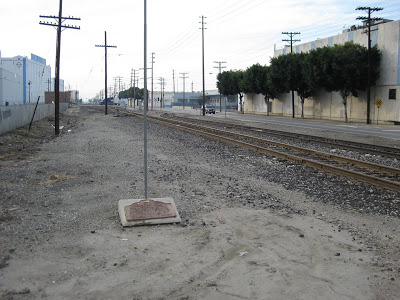
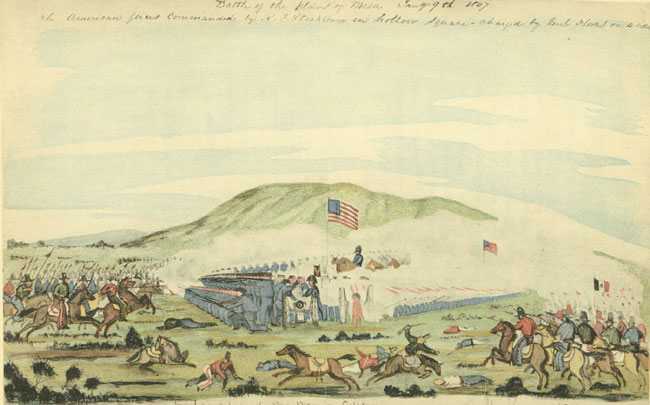
Today, January 9th, is the date of the final battle of the California Campaign of the Mexican-American War. The Battle of La Mesa occurred one day after the Battle of Rio San Gabriel and brought an end to hostilities between American forces and the Californios.

The site of the battle was on a plain between the Los Angeles River and the San Gabriel River. The city of Vernon, just south of downtown Los Angeles, now occupies the site.

The two sides looked to be evenly matched: 300 Mexican Californians under Jose Maria Flores faced 300 American troops under Commodore Robert Stockton and General Stephen Watts Kearny. But the Americans were armed with rifles, while the Californios were armed only with lances.

LaMesa battle

Battle of La Mesa

Marching toward Los Angeles, the American troops encountered the Californios on horseback, who extended their line to surround the Americans. The cavalry charged the American troops, but were cut down by relentless rifle fire and forced to retreat. Losses during this and the precious day’s battle consisted of three dead on each side and several wounded.

The conquest of California was settled with the signing of the Treaty of Cahuenga by Lieutenant-Colonel John C. Frémont and Californio General Andrés Pico four days later, on January 13, 1847.

LaMesa2

Plaque marking the battle in Vernon California — California Historical Landmark #167

Posted in Uncategorized | Leave a comment

Entrepreneurs of the Gold Rush

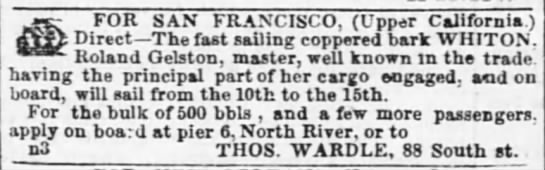
What would a canny ship owner do as soon as he heard about gold in California in 1848? He would load up a ship with goods and passengers, and set sail for the Pacific.

whiton

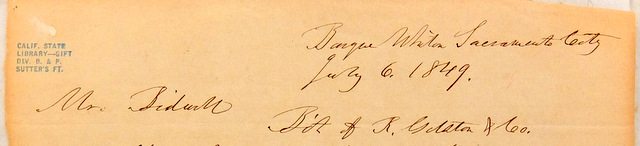
Among the many fascinating items to be found among the Bidwell Papers at the California State Library are a series of receipts from a shopping trip John Bidwell took to Sacramento in 1849 where he purchased goods to supply a trading post at Bidwell Bar. Over a two day period he visited at least ten merchants, buying whatever they had.

One of the stores he visited was not in a building or a tent, but on a ship. According to Mark A. Eifler in Gold Rush Capitalists (University of New Mexico Press, 2002), Roland Gelston, captain of the bark Whiton, was the first to bring a shipload of merchandise from the East Coast directly to Sacramento. He left New York in November of 1848 and sailed around Cape Horn with cargo and passengers. Arriving in May 1849, he “immediately threw open his ship’s hold to sell merchandise to expectant miners.”


He was still selling when John Bidwell bought from him on July 6, 1849.

DSCF4531

Among the items he bought were two kegs of molasses, shelled almonds, dried apples, two tin kettles, and a shot pouch (also useful for gold dust). The handwriting is not very clear, and I can’t read some of the other things he bought. But he spent $229.45 with R. Gelston & Co.

Posted in Uncategorized | Leave a comment

Happy New Year!

happy-new-year-clipart-15Best wishes for a happy and prosperous New Year from Goldfields Books. I hope 2018 is filled with wonderful discoveries and joyful events for you and yours.
This past year I worked on two publishing projects: my own book on Nancy Kelsey and ANCHR’s compilation of Northern California oral histories.

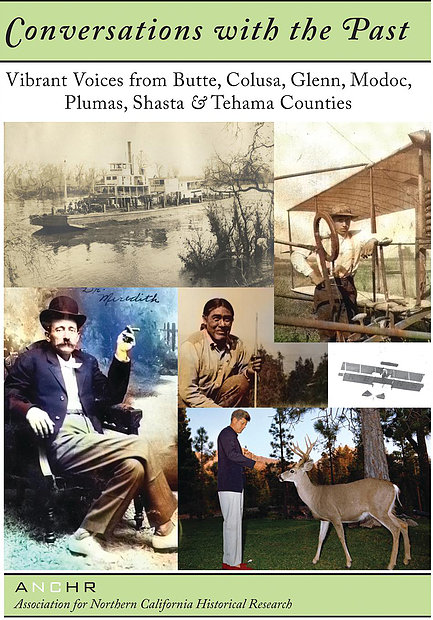
Conversationswith the PastIf you have not yet seen ANCHR’s new book you need to check it out — Conversations with the Past: Vibrant Voices from Butte, Colusa, Glenn, Modoc, Plumas, Shasta & Tehama Counties. This book truly has something for every history buff’s interest.
In the 1970s, members of the Association of Northern California Records and Research (ANCHR’s predecessor) spent several years collecting and transcribing oral histories. These histories have languished in storage files for decades. We rediscovered them this year and decided these voices and their stories needed to be heard.

These personal accounts provide a priceless window to a past long gone. But they also show that people did back then what we do now — live their lives.

These memories range from personal accounts about the Bidwells, family cattle drives, early days in Paradise and Chico, hitching canoe rides on riverboat barges, Chico’s first teenage aviator, the discovery of Ishi in Oroville, western Colusa County Indian life and John Bidwell’s explorations, herding geese (it’s not what you might think it is), pioneer life in Orland and Newville including feuding Civil War veterans, memories of Modoc County, the town of Prattville and Big Meadows before Lake Almanor flooded the areas, railroad torpedoes, and President Kennedy’s visit to Lassen Volcanic National Park in 1963.

 NKfrontcoverThe book costs $16.95 and is available at The Bookstore on Main St. in Chico, ABC Books, Discount Books in Oroville, My Girlfriend’s Closet in Paradise, and various museums and historical societies in Northern California. You can also order online at anchr.org.
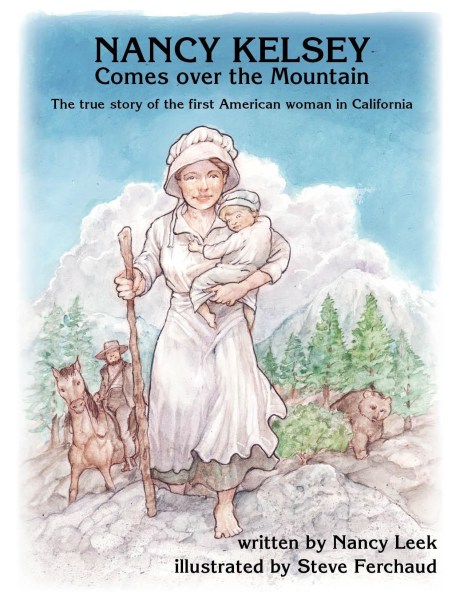
Nancy Kelsey Comes over the Mountain is also available from the ANCHR website, and from me right here, and from Amazon.com. The book was a joy to research and to write. If you would like to hear Steve Ferchaud and me talk about our work on this book, you can hear us on a Nancy’s Bookshelf podcast.
And . . . if you would like to hear either the ANCHR team of editors, or me, talk about our books, please contact me at goldfieldsbooksca@gmail.com. We are available to speak to groups throughout the North State.

DSCF4389

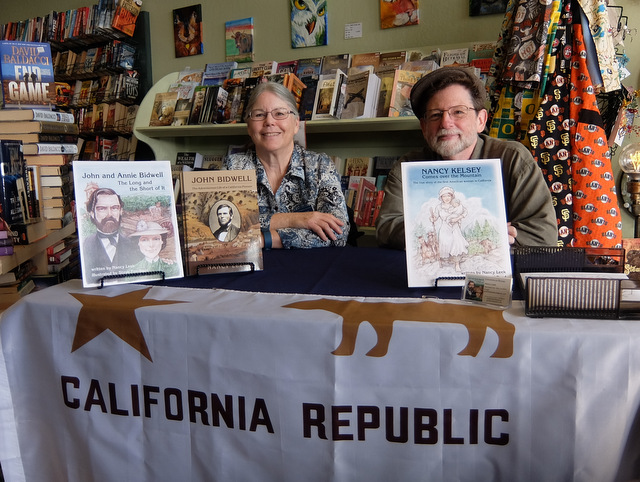
Steve and I peddling our books at ABC Books on Mangrove in Chico.


Posted in Uncategorized | 1 Comment

Bidwell’s Winepress

I spent the day at the History Room of the California State Library in Sacramento, looking at papers in the Sutter’s Fort Pioneer Collection. Among other things, this collection contains two boxes of papers pulled from the Bidwell Papers, consisting primarily of business letters, contracts and receipts. It’s full of interesting items that I had never seen before.

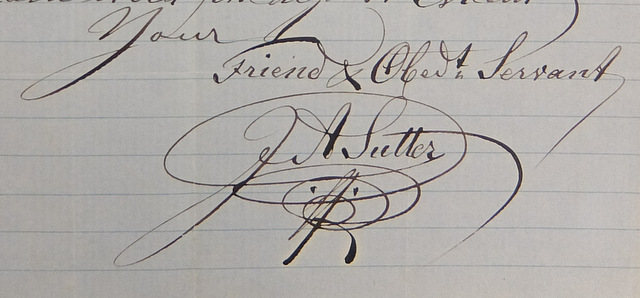
Here is one little tidbit, a letter from John Sutter to Bidwell, concerning a screw for his winepress.

            My Dear Sir,

The screw for your winepress will be ready at the Marysville foundry at the same time when mine, the price of them they could not tell me when I ordered them, but will know it on Wednesday when I will be there and will write you a few lines.

The carpenter will be ready with my work in a few days and then he will go up to your establishment, he understand likewise to make the wine.

I remain with the highest Esteem

Your Friend and Obedt. Servant  J. A. Sutter

DSCF4391

The date is missing from the top of the letter, so I don’t know when it was written. According to the History Of Yuba And Sutter Counties, the first foundry in Marysville was established in 1852, so it can’t be any earlier than that. It was probably written sometime in the mid-1850s.

Just a glimpse of John Bidwell before he met Annie!


Posted in Uncategorized | Leave a comment

Rancho Rio de los Molinos

This Week in California History (an ever-useful site, maintained by Jim Silverman) tells me that December 20th, 1844, is the date on which

Rancho Rio de los Molinos, a 22,172-acre Mexican land grant in present day Tehama County was deeded. It extended along the east side of the Sacramento River from Dye Creek to Toomes Creek, including present day Los Molinos.

So here is a little more about Rancho Rio de los Molinos:

Albert G. Toomes, a native of Missouri, came into California with the Rowland-Workman party by way of the southern route. They arrived in California on November 10, 1841, just a few days after the Bidwell-Bartleson Party arrived at Marsh’s Ranch near Mt. Diablo.

Toomes worked in Monterey as a carpenter with Robert H. Thomes, who had come with the Bidwell group. Together they built a house for Manuel Jimeno Casarin, secretary of state and sometimes acting governor under Governors Alvarado and Micheltorena, This turned out to be to their advantage, for as Toomes said:

“The house we built at Monterey for Governor Jimeno in 1845 was one of the best jobs we ever did in our lives, for the old gentleman not only paid us well, but got us our farms without any of the trouble others had.”

RanchoMolinos

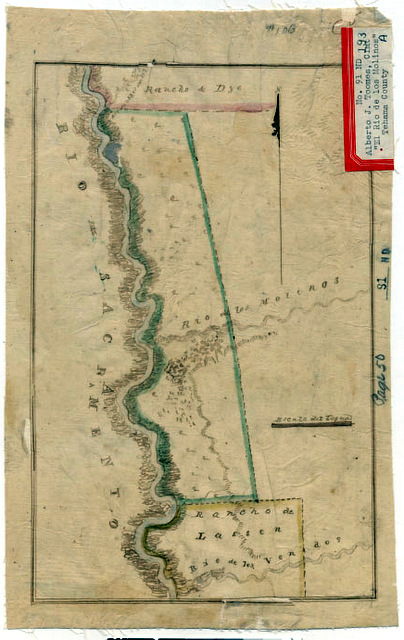
Diseño for Rancho Rio de los Molinos

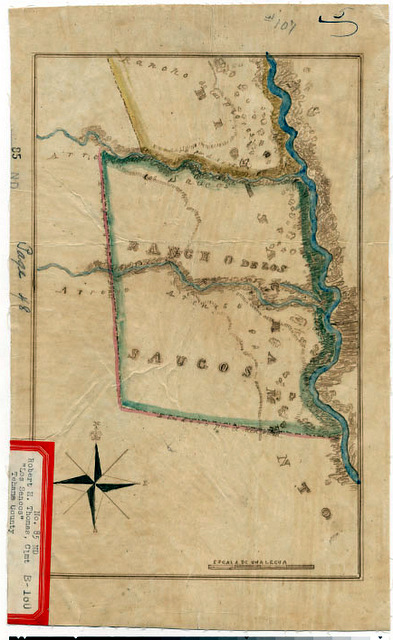
On December 20th, 1844, five square leagues (22,177 acres) were granted to Albert G. Toomes by Manuel Micheltorena, between Dye Creek and Toomes Creek with Mill Creek in about the center, on the east side of the Sacramento River. Robert H. Thomes received a matching land grant, Rancho Saucos, on the west side of the river.

John Bidwell had named Mill Creek (in Spanish, Rio de los Molinos) because it looked like a good stream for a mill. He also drew the diseño for the rancho.

You can see on the diseño that Job Dye’s ranch (Rancho de Dye) is to the north, and Peter Lassen’s ranch is to the south.


RanchoSaucos

Diseño for Rancho Saucos

Posted in Albert G. Toomes, Robert Thomes, Uncategorized | 4 Comments

Bidwellville, Anyone?

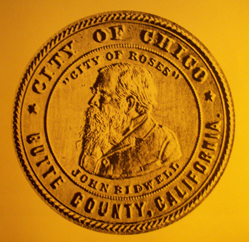
chico sealNot long ago a friend of mine asked me why John Bidwell did not name the town he founded after himself. He could name it anything he wanted. Why Chico? Why not Bidwellville, or Bidwellton, or Bidwell City?
It used to be pretty common to name a town after its founder, or someone the founder wanted to honor. Gridley is named for founder George W. Gridley. Redding is named for railroad man Benjamin Redding (or maybe pioneer Pierson B. Reading, who owned the rancho Redding was built on). Weed is named for founder Abner Weed, and not for  tumbleweeds or any other plant. Susanville is named after Susan Roop, the daughter of founder Isaac Roop (before that it was Rooptown) and Marysville is named after Mary Murphy Covillaud, a survivor of the Donner Party and wife of Charles Covillaud, who bought Theodor Cordua’s ranch. Cordua called the community he founded New Mecklenburg.

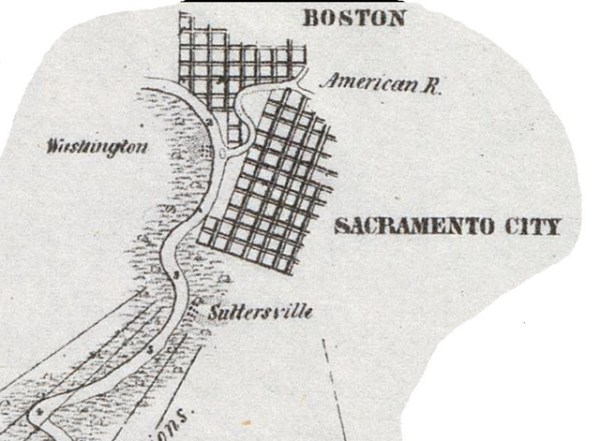
1848_sutterville-sacramento_cityJohn Bidwell had been employed by John Sutter to survey the prospective town of Sutterville, just south of Sacramento. Even though it was laid out on higher ground than Sacramento (which was prone to flooding), it never took off, and Bidwell’s lots in the town were worthless. Maybe that was not a good omen.
Bidwell was never much for naming things after himself. As a state senator, he had a hand in naming the counties. He named Sutter County after John Sutter, whose Hock Farm was located there. Perhaps he could have named Butte County after himself, but he didn’t.

In 1849 Bidwell bought Rancho del Arroyo Chico. I don’t know who named it that, but Chico Creek (Arroyo Chico — Small Creek) seems to have had that name when he got here. He sometimes referred to his place as Rio Chico, or Chico Farm. It must have seemed natural then to name the town Chico.

What we called Bidwell Park was named by the city. He and Annie never called it that — they called the area Vallombrosa. There is Bidwell Junior High School in Chico, and two Bidwell Elementary Schools, one in Red Bluff and one in Sacramento. But no town of Bidwell.

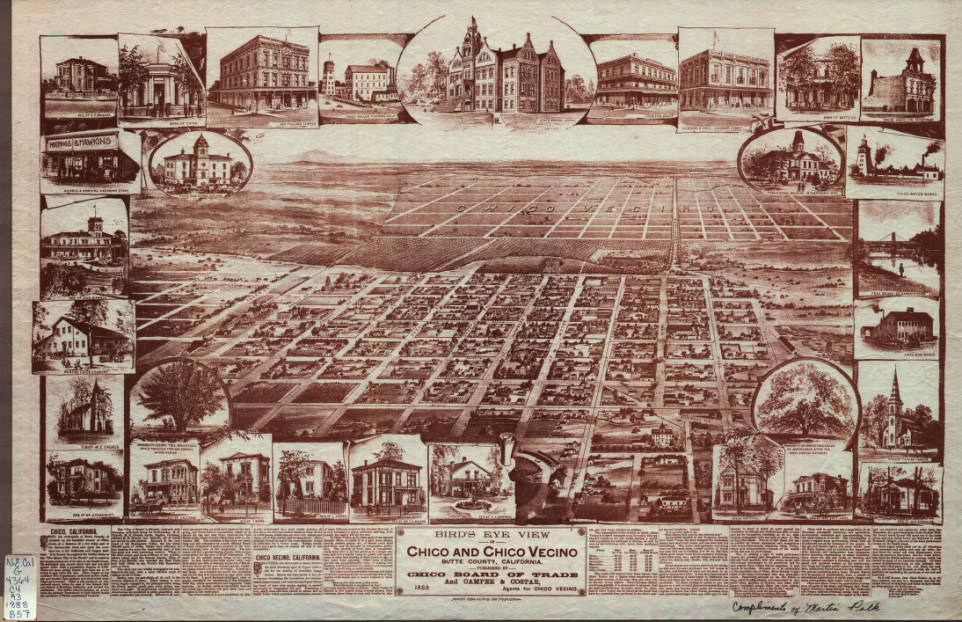
Birds_eye_view_of_Chico_and_Chico_Vecino_Butte_County_CaliforniaThere is a Bidwell Avenue in Chico, which runs along Big Chico Creek west of Nord Ave. Two other streets that were named after John Bidwell have disappeared. I wrote about one of them here. John Gallardo recently informed me that another Bidwell Street shows up on an 1888 bird’s-eye map of Chico. I think it was what is now 12th Street. It is right at the bottom of this map. You can get a closer look at the map at the Chico State Historical Map Collection.


Posted in Uncategorized | 1 Comment