The Sensational Saga of Talbot H. Green (and Sarah Montgomery) — Part 5

Sarah Armstrong Montgomery was eighteen years old when she came to California. She married Allen Montgomery, a gunsmith, in Missouri in 1843. In 1844 they set out with the Stephens-Murphy Party for California. This was the first group of pioneers to bring (with great difficulty) wagons over the Sierra Nevada.

Allen Montgomery went to work for John Sutter and the young couple settled in a cabin near Sutter’s Fort. When the Bear Flaggers began their insurrection in the summer of 1846, Allen joined the California Battalion. So far, it was a typical life for young California pioneers before the gold rush.

In 1847 Allen Montgomery set sail for Hawaii, reason unknown. Allen was never heard from again. There was no sign of him when news of the gold discovery brought men from around the world to California. Sarah assumed she was a widow.

Talbot Green moved to San Francisco in January 1849 and soon made the acquaintance of Mrs. Montgomery. Since she had no official notice of her husband’s death, she was still legally married to Montgomery, but that detail did not stand in the way of their marriage. Green and Sarah Montgomery were quietly married at the home of his old comrade, Grove C. Cook, in San Jose on October 25, 1849.

His situation was, as we know, even sketchier than hers. But nobody knew about his past crimes or his wife in Pennsylvania. He continued to live comfortably in San Francisco with his new wife for a year before the rumors began to circulate. A son was born to them on July 3, 1851, but by then Talbot Green had been gone for two and a half months.

He later told Thomas O. Larkin that his resolve in going to San Francisco was to earn enough money to pay back the bank and redeem himself in the eyes of his family, (although he made no attempt to communicate with them in ten years).

I hoped to make a fortune for them & pay the bank and perhaps would have succeeded had not the fondness for company & drink drowned all my secret resolves and finally smothered conscience entirely. I found & seen that I was fast going to destruction and would soon be lost had I not something to cling to present.

I then by some fatality, although against my reason & judgement, began really and truly to love the woman I married. I studied her character well and was convinced that she had a much stronger mind than my own. I then thought if I married her I might be saved & in a few years pay up & provide for all, which was my full intention, and if I had not been recognized I should have done so before this.

This is a convoluted pack of excuses and self-justification, but he did really seem to love Sarah. In his letters to Larkin his concern for her welfare is second only to his concern for his own. Before leaving San Francisco he had arranged for her to be given $450 a month. He repeatedly asks after her and maintains “I loved that woman and still love her.”

But Sarah was moving on. Larkin wrote to Green in January 1854, enclosing Sarah’s application for a divorce. Green wrote back:

I loved that woman and I still love her, but as she has taken that course I know her so well that she will not stop; but I wish you to go to her and tell her from me never to marry again until I see her. Even if she persists in getting the divorce, as much as I love her & thought she loved me, I cannot blame her as I have done so wrong to her.

If he thought that she might wait until he returned and could work his charm on her, he was wrong. Sarah knew her own mind, and she had her pick of men in San Francisco. In July 1854, she married Joseph S. Wallis, and up-and-coming young lawyer who would later serve as a judge and a State senator. He adopted her son by Green, whose name became Talbot H. Wallis. Sarah was 29 years old as she started on her third marriage, the one that would last. Green wrote plaintively from Tennessee,

It is my sincere prayer that she may be happy in her choice, but I fear for her unless her husband is of a mild and conciliating disposition. . . I wish you to see her and tell her I have heard of her marriage and hope she will be happy, and tell her to take care of our boy, and if I ever come into possession of my own I will do what is right and just toward him.
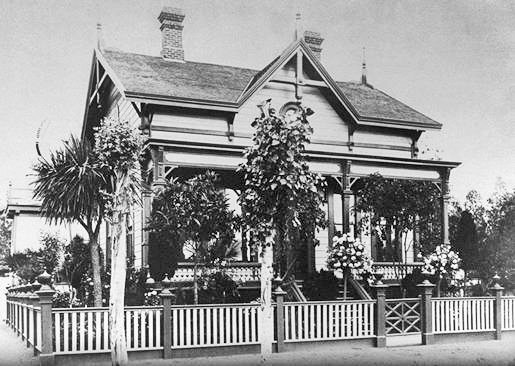
wallishome

The Wallis home at Mayfield (now part of Palo Alto)

The couple moved to Mayfield, in Santa Clara County, where they had a large estate. They became the parents of four children, in addition to Sarah’s son by Green. Sarah was active in the social and economic life of her community. She and her husband were strong supporters of women’s rights. Her husband Joseph Wallis died in 1898, and Sarah lived until 1905. She had lived a long, busy, and quintessentially Californian life.
 

Posted in Sarah Montgomery Green Wallis, Talbot H. Green | Leave a comment

The Sensational Saga of Talbot H. Green — Part 4

Talbot H. Green had two valuable assets that he brought to California in 1841. One was his lump of “lead.” Whatever it was, however much it was worth, and however he managed to turn it into spendable currency, it helped to set him up in business.

His other asset was his experience as a storekeeper. He had no trouble finding work with Thomas O. Larkin, the foremost American merchant in Monterey. Men who knew how to handle merchandise, how to buy and sell and negotiate, who knew how to keep accounts and keep up friendly business relationships were in very short supply in Alta California. The only handicap that Green discovered in himself was that he couldn’t speak Spanish.

That was a drawback that was remedied over time, as Green learned the language and customs of California. Larkin soon grew to trust and rely on his new clerk. He sent him on business trips to Los Angeles and Mazatlan. By January 1846, when Green had been in California four years, he was able to contract with Larkin to run his mercantile business for a period of three years for one-third of the profits.

Green’s popularity increased along with his experience. Walter Colton, the alcalde at Monterey, said that Green “enjoys a wide reputation for business habits and sterling integrity of character.” No one had anything detrimental to say about him.

Green was a busy man in the 1840s. As Larkin’s agent, he sold goods to Capt. John C. Fremont and the rest of the U.S. military and naval forces. He voyaged to Mazatlan for supplies from Mexico, he sold goods and bought lots in San Francisco, and when the gold discovery took off, he visited the gold mines. He could see opportunities everywhere, and he moved his base of operations from Monterey to San Francisco.

In January 1849 he joined the prominent trading firm of Mellus, Howard, & Co. Now he had truly arrived. The Mellus brothers soon sold their interest and it became the firm of Howard & Green, buying, selling, trading, and providing office space in San Francisco. He was also active in political life, serving on the San Francisco city council.

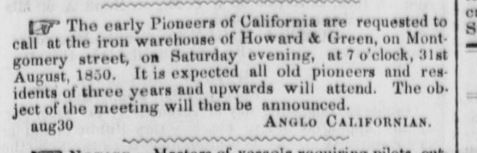
In August 1850 the following advertisement appeared in the Daily Alta California.

DAC18500831.2.11.1-a1-503w

It was the beginning of the Society of California Pioneers. Six men, including Talbot Green, Sam Brannan, and W.D.M. Howard, met to form a social club for emigrants who had arrived in California before the rush. The three-year requirement barred any forty-niners, and made it a very exclusive club indeed, although eventually they settled on January 1, 1850 as the cut-off arrival date for membership. Five men from the Bidwell-Bartleson Party of 1841 were among the first members: Green, John Bidwell, Grove Cook, Josiah Belden and Francis Henry Huber. Talbot Green was the society’s first treasurer.

Green was not only active in business, civic, and social life of San Francisco, but in the fall of 1849 he became a married man. A twice-married man, but nobody knew about his wife in Pennsylvania.

Stay tuned for the tale of Talbot Green and the redoubtable widow, Mrs. Montgomery.

Posted in Society of California Pioneers, Talbot H. Green | 3 Comments

The Sensational Saga of Talbot H. Green — Part 3

Paul Geddes left Pennsylvania and made his way to New Orleans, probably by ship from New York City. From New Orleans, he took a steamboat up the Mississippi. He was getting as far away from the scene of his crime as he could. On board the boat he met an Englishman, Talbot Henry Green, and when the man died, he appropriated his name.

He continued from St. Louis up the Missouri River until he reached Westport, that jumping off place for the western plains. An emigration party was forming to journey to California. He couldn’t get any farther away from the States than California; he signed up. It was May, 1841.
He made a good impression on the other men. Nicholas “Cheyenne” Dawson recalled him as “a young man of evident culture and very pleasing address.” When the company gathered to organize and elect officers, Green was elected president. This was not a position with much responsibility. The Company had a captain, John Bartleson, and a trail guide, Thomas Fitzpatrick, who was the true leader, at least until the California-bound company parted from the larger group. But Green’s election was testimony to his instant likability. Many years later, “Cheyenne” Dawson wrote:

Among my overland comrades of ’41, the most to my liking and with whom I became most friendly was Talbot H. Green. Gentlemanly, kindly, genial, generous, he was a favorite with all. Before starting the trip he had provided himself with a case of medicines, and from his attention to the sick, he soon won the title of doctor. After we reached California, Green and I were separated, but I took great interest in him, and although I wondered somewhat at his and Grove Cook’s sudden affluence, no suspicion entered my mind, and for some years Green was, to me, just about the all-around best man I had ever known.

Dawson noticed that Green’s “most important possession seemed to be a quantity of lead that he was taking with him.” In the Utah desert the company had to abandon their wagons, but Green clung to his packet of lead. By the time they reached the Sierra Nevada the two men were sharing one mule, taking turns riding “Monte.”

It was in the Sierras that the lead-covered lump became too heavy for Green to carry. Dawson recalled that, “Green, whose pack of lead which he clung to most solicitously, had been growing heavier for his weakened animal, took Grove Cook with him, and going off into some gulch secreted or cached it.” After they reached the rancho of John Marsh, Green and Cook hired an Indian guide and went back for the “lead.”

We can only assume that the lump of “lead” was gold coin, covered over with a coating of lead. Perhaps the coin was in a leather bag and the bag was wrapped in lead sheets. Whatever its exact nature, it was Talbot H. Green’s grubstake in California. When Dawson met Green again after a year in California, he found that Green was thriving.

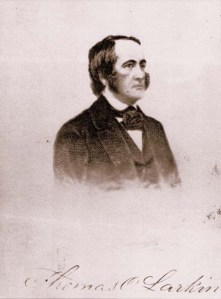
HPF-20-T.-O.-Larkin-Portrait-1

Thomas O. Larkin

I found T. H. Green in Monterey, clerking for T. O. Larkin. It was from his recommendation that I was now at Dye’s. Green was finely dressed, and apparently very prosperous. Soon after my arrival, he set up a store of his own out at a ranch near the redwoods. “Where did he get the money?” I queried of Larkin. “Oh, Green has plenty of money,” was the answer.

Dawson may have had his curiosity about Green’s special package, but he couldn’t guess how he had come by it.

Posted in Talbot H. Green | Leave a comment

The Sensational Saga of Talbot H. Green — Part 2

No extant portrait of Talbot H. Green exists. In a day when forty-niners right and left were having their likenesses made, he avoided the camera. He is absent from a group photograph of Thomas O. Larkin and his business associates. Those who knew him described him as a short, square-built man, with plain but kindly features. He was well-known and well-liked.

hensleylarkinetal

Talbot H. Green, conspicuous by his absence. His business associates, left to right and top to bottom: Samuel J. Hensley, Samuel Brannan, Jacob Leese, Thomas O. Larkin, W.D.M. Howard.

White’s account of a woman recognizing Paul Geddes in the Admission Day parade was only one version of the unmasking of Talbot H. Green. Others said that it was a lawyer from Philadelphia who recognized him, or a woman at a ball. However it happened, Green steadily denied the accusation. At the same time, he withdrew his name from the mayoral race. His friends loyally stood beside him, but the rumors grew and spread. Green, once so prosperous and popular, was under suspicion.

His denials did nothing to allay the rumors, so Green offered to return to the East to clear his name. The day before his departure in April 1851 on the steamship Panama his friends gathered at a tavern and toasted his success. As reported in the Alta California, his old business partner and mentor, Thomas O. Larkin, climbed upon a table, lifted a glass, and proclaimed, “The health and prosperity of our friend and fellow citizen, Talbot H. Green; may the best among us be as worthy as we believe him to be.” In response Green thanked them for their faith in him and promised to return quickly with proof of his good reputation.

Still, the doubt lingered in his friends’ minds that perhaps Green really was Geddes. Their doubt only grew when he failed to return or to write. Two years went by before Larkin finally received a letter from Green that confirmed all their doubts.

Green had not returned to Pennsylvania as he had promised; he was somewhere in Tennessee, hiding out. He never would have written at all, except that he had lost $3200, (so he said) stolen out of his trunk, and he was now penniless. He asked Larkin to obtain his share of investments in San Francisco and send him a draft for the money as soon as possible. He was destitute and he wrote of “the bitter tears I have shed since I left you.” But he didn’t explain his misdeeds, not yet.

Talbot H. Green told his story to Larkin in one of his later letters. He said he was born Paul Geddes in Lewisburg, Pennsylvania in 1810. In 1832 he married Henrietta Frederick, and they had had four children. By 1840 he was a store owner and a trusted man of business. (The spelling in the following quotation is his own.)

In the Spring of 1840 I went on to Philadelphia to buy goods. I made my purchase and had a large quantity of wheat consigned to a house in Philadepha. When I was about to return home I went & drew 3,000$ on acct. and had it about my person and intended to start home next morn’g but was induced to go out with some acquaintances and drank to much and my money was taken from me, but on the same afternoon the cashir of the Farmers & Mechanics Bank of Philadelpa sent for me and asked me to carry money to the Northumberland bank. I told them I would do so. They got a carpet bag and put up 105,000$ in it in my presence and sent a porter with me to the Hotel. I put it in my trunk and went out.

On my return I found that I had been robbed of my money. I was under the excitement of liquor—no excuse—and was in fact not at myself. I opened the carpet bag and took out nearly 8,000$ and done the parcel up again. I then went to bed. In the morning I ten thought of what I had done—the first bad act I had ever done in money matters but it was done. I then took the carpet bag to a merchant & told him what it containd and wished him to keep it until the next day. Next day I went and paid a good many of my debts with the money and sent 3,000$ to my partner to pay notes we owed in bank and that night I left Philadelpia with 375$ determined that my people should never here of me again. I went west and fell in with the emigration for Californa. I joined it with 11$ and a gold watch which I gave for my passage out.

That was his story. Was it true? No doubt he spinned it to put himself in the best light possible. But $105,000 in 1840 dollars! In a carpetbag! The laxity is astonishing.

And as we shall see in the next episode, he had more with him on his journey west than $11.


Posted in Uncategorized | Leave a comment

The Sensational Saga of Talbot H. Green

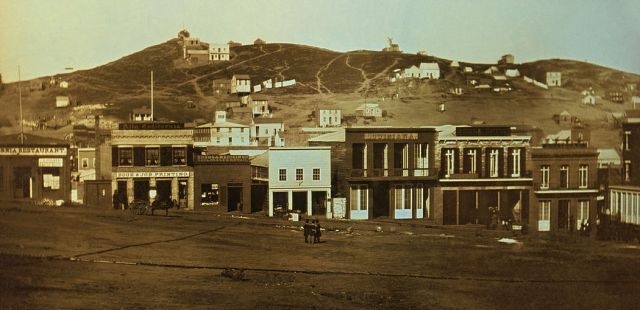
SanFrancisco1851a

San Francisco in 1851, showing a commercial district near Portsmouth Square. Image from the Library of Congress.

San Francisco in 1851 was a booming, bustling place. Fortunes were made and lost daily. Men who had come to California with hardly a penny in their pockets rose to prominence, while others who had struck it rich in the mines and spent freely sank into poverty.

Talbot H. Green had seen nothing but success ever since he came to California in 1841. He had begun by clerking for Thomas O. Larkin in Monterey and gone on to become his trusted business partner. Moving to San Francisco, he cashed in on the gold rush demand for all kinds of goods. By 1849 he was a partner in the foremost mercantile firm of Mellus, Howard & Company. He was a founding member of the Society of California Pioneers and a member of San Francisco’s first city council. In 1849, he married the widow Sarah Montgomery. In 1850, he decided to run for mayor of the city. It would be the pinnacle of his successful 10-year career in California.

Then the scandal broke.

When San Francisco celebrated its admission to the Union in October 1850, Green took a prominent place in the parade. According to W. F. White, a friend of Green’s and the author of A Picture of Pioneer Times in California:

As the procession was breaking up and dispersing on the Plaza, a lady walked forward to Green, and in an excited, astonished way, reached out her hand, saying, “Oh! Mr. Geddes, can it be possible that you are here in California?” Green, in apparent surprise, took her hand and said with perfect coolness: “You must be mistaken, madam, in the person. My name is Green—Talbot H. Green.”

The lady drew back, abashed, but said: “Why, certainly I am not mistaken. I cannot be mistaken. I knew you all my life. I know your wife, your sister, and your children.” A gentleman who stood by said that Green turned pale, and that a tremor shook his frame, but with a forced smile he again denied his identity with Geddes.

But he was Geddes, Paul Geddes, of Lewisburg, Pennsylvania. And Paul Geddes was a store owner who had absconded with the bank’s money and disappeared, leaving behind a wife and four children.

What was his story? How had he come to California? How did he deal with his sudden unmasking?

Stay tuned for more in the Sensational Saga of Talbot H. Green.


Posted in Talbot H. Green | Leave a comment

Sunday Morning in the Mines

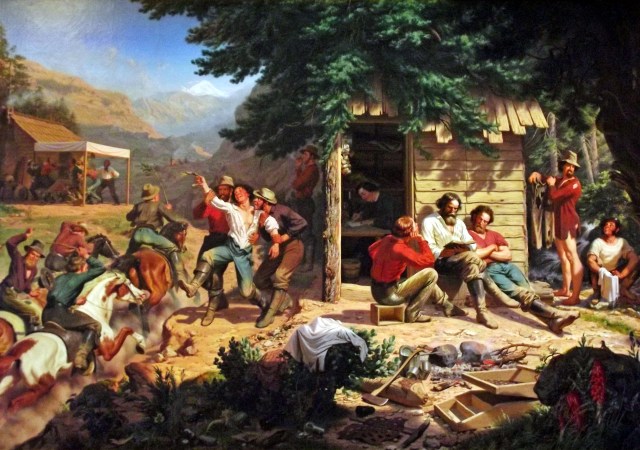
This being a Sunday morning, I’d like to share one of my favorite paintings with you: Sunday Morning in the Mines, by Charles Christian Nahl. It was painted in 1872, but harks back to the “Days of ’49.” The painting is in the Crocker Art Museum in Sacramento. The museum has a number of paintings by Nahl and other California artists.

Nahl_1872,_Sunday_Morning_in_the_Mines

Sunday Morning in the Mines, by Charles Christian Nahl, from Wikimedia Commons

This painting is a moral allegory — laid out before the viewer are the good and evil choices made by men who are far away from civilization. The two worlds are strictly set apart by the pine tree that bisects the painting. Even the foreground is divided between dark and light. On the left in the foreground among the dark plants are discarded bottles and other trash. On the right, the sun shines and the workman’s tools are set aside for the day.

On the left side of the painting are scenes of riotous living: a wild horse race, a drunken young man being set upon by thieves, an idle smoker, and in the background, a brawl at a gambler’s cabin. The young man’s face is flushed, his out-flung arm clutches his poke, from which the gold dust spills. All is confusion and contention. Even the little scene at the cabin is divided in two — on the left, in shadow, two men are at each other’s throats and the man on the far left fires a pistol, while on the right the three men in the light are trying to break up the fight.

The scene on the right shows peaceable acts of the Sabbath.  The men rest from their labors in the goldfields. The central figure reads from the Bible to his two attentive companions, while inside the cabin a man is writing a letter. The two men on the far right are cheerfully doing their laundry, because cleanliness is next to godliness.

Charles Christian Nahl came to California from Germany in 1851, and for a while sought his fortune in gold-mining.  But he had trained as an artist in Europe and he soon found a better fortune in illustrating and painting, with a studio first in Sacramento and then in San Francisco. He became the most popular artist of 19th century California. The bear on the California flag is based on his painting of a grizzly bear.

If you would like to see some closeups of Sunday Morning in the Mines, go to this website.


Posted in Uncategorized | 2 Comments

A Piece of California History

Who doesn’t like to see and hold in their hands a genuine piece of California history?

Cane and cover

The cane and its sheath

Today I was lucky enough to see and admire the gold-headed walking stick that belonged to Joseph B. Chiles, one of the earliest American pioneers in California.

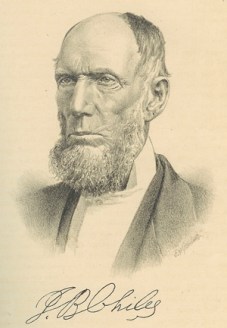
chiles2I made this connection through this blog, because some time ago I wrote a post called “Whatever Happened to Joseph B. Chiles?” and if you read it, you will know what happened to that member of the Bidwell-Bartleson Party after he arrived in 1841. He participated in the Mexican War and had a long and successful career as a rancher, farmer, and mill-owner.

Recently I was contacted by Sandy Shepard, a friend of a long-time Chico teacher named Peggy Chiles, the great-granddaughter of Joe B. She is trying to determine who gave this cane to Chiles. It may have been Governor J. Neely Johnson around 1856, but so far we don’t know for sure.

The cane is an admirable piece of craftsmanship and in excellent condition. These sticks for gentlemen were very popular in the 19th century, and a man who had lived and prospered in California would, of course, want a such an accessory.  I am very grateful to Sandy and her friend Harold for letting me show you these photographs.

As you can see from the photos, a beveled piece of gold-veined quartz is embedded in the gold head of the cane. It is inscribed with the name of “J.B. Chiles.” It looks like a presentation piece, but there is no date on it, and no name of the giver.

Do you know anything about Joseph B. Chiles that might contribute to the provenance of this item? If so, please let us know!

By the way, today was a librarian and history buff’s dream for me. Not only did I enjoy meeting with Sandy and Harold and seeing the cane, but after that I got to have lunch with the head researcher at Jeopardy!, my favorite TV show. We talked trivia and research and Chico history and Alex Trebek. So much fun!

Posted in Joseph B. Chiles | 3 Comments

Eureka!

No, I haven’t struck gold. But I found something I’ve been looking for — an old episode of Death Valley Days.

A year ago or so I found out that John Bidwell featured in the episode The Lady With the Blue Silk Umbrella, broadcast on television on January 9, 1953. I looked for it, but at that time very few episodes were available for viewing. Now there is a pile of them on YouTube.

Stories on Death Valley Days were taken from true events, and this one is based in fact. Sort of. It’s full of errors, the worst being that Bidwell in 1850 was not a fifty-year-old general in the U.S. Army.  He was much closer to the (fictional) young and handsome Lt. Hastings. However, the outline of the story is factual, and it’s fun to travel back in time — to 1953 — and see what was on TV.

So enjoy!

Posted in Uncategorized | Leave a comment

The Mysterious Death of Peter Lassen — Part 3

Whodunit?

Lemericus Wyatt was quick to blame the Paiute Indians. The natives always made  convenient and believable scapegoats. A man named Fred Kingsbury, whose father had been Peter Lassen’s partner, later pointed out that:

When Indians kill they want something for it. They take anything and everything in sight. Nothing was disturbed, not even the food in camp, or Peter’s pocketbook, containing his money. It wasn’t an Indian job.

Left behind were two sacks of flour, plenty of dried meat, and a keg of whiskey. Why pass that up?

Young Chief Winnemucca denied involvement, and was quoted as complaining “that he was accused of killing Pete Lassen, who had been one of the best men he had ever known and with whom he had slept in the same blanket.” His cousin Sarah Winnemucca said that the Indian agent, Major Dodge, also did not think the Paiutes had killed Lassen. Dodge suspected Mormons.

The Mormons, it seems, were second only to Indians when it came to convenient scapegoats. There was no indication that Mormons had anything to do with it.

Captain Weatherlow suggested Pit River Indians. Weatherlow was in the other group that left two days before Lassen’s party to go prospecting in the Black Rock Hills. The settlers had had clashes with the Pit Rivers, and possibly they took revenge on Lassen. Again, there is no proof, and nothing was taken from the campsite. But Weatherlow didn’t want to think it could be a white man.

Three years later two two other men, James Bailey and William Cook, were attacked by Indians in the same region of Nevada. The camp was looted. Captain Weatherlow was in the group of ten men who set out in pursuit of the attackers. They found a camp of nine Indians (tribe not indicated) and killed them. By one of the corpses they found the gun Peter Lassen was carrying when he met his death. It was the only thing taken from Lassen’s campsite.

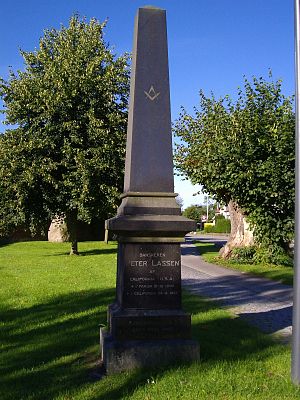
300px-Peter_Lassen_mindesten

Memorial to Peter Lassen in his home town of Farum, Denmark.

How did the gun get there?

Ken Johnston, in his book Legendary Truths, has some suggestions:

Did the Indians kill Lassen and take his rifle? (But why didn’t they take anything else?)

Did the Indians take the rifle from Bailey and Cook? (If so, how did those two get it?)

Did Weatherlow plant the rifle on the dead Indian? (But how could he have arranged that?)

Or was Lassen not the target at all? Perhaps someone was after Clapper, and Lassen just happened to be in the way.

I can’t tell you the answer. The Death of Peter Lassen remains a mystery, never solved. If someone (not me!) wants to write a series of historical mysteries set in 19th century northern California, here’s one you can start with.

By the way, I used the name Lemericus Wyatt because that is a version that shows up in newspaper reports. But the only name that comes close in census records is Lemarcus Wiatt. I imagine that’s the same man. In the 1852 California census he was a 49-year-old Kentuckian living in Sonoma. In 1870 he is married, a carpenter, and living in Petaluma. But in between he must have gone to the Honey Lake Valley, met up with Peter Lassen, and then . . .  the mystery.

plaque

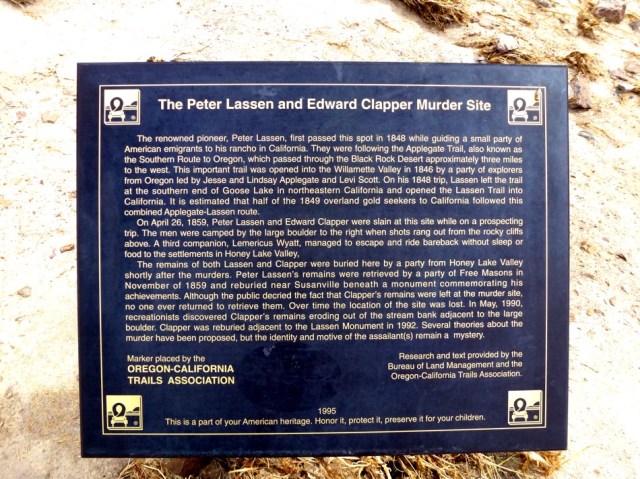
Trail marker installed at the site of the murders by the Oregon-California Trail Association.

Posted in Peter Lassen, Uncategorized | 5 Comments

The Mysterious Death of Peter Lassen — Part 2

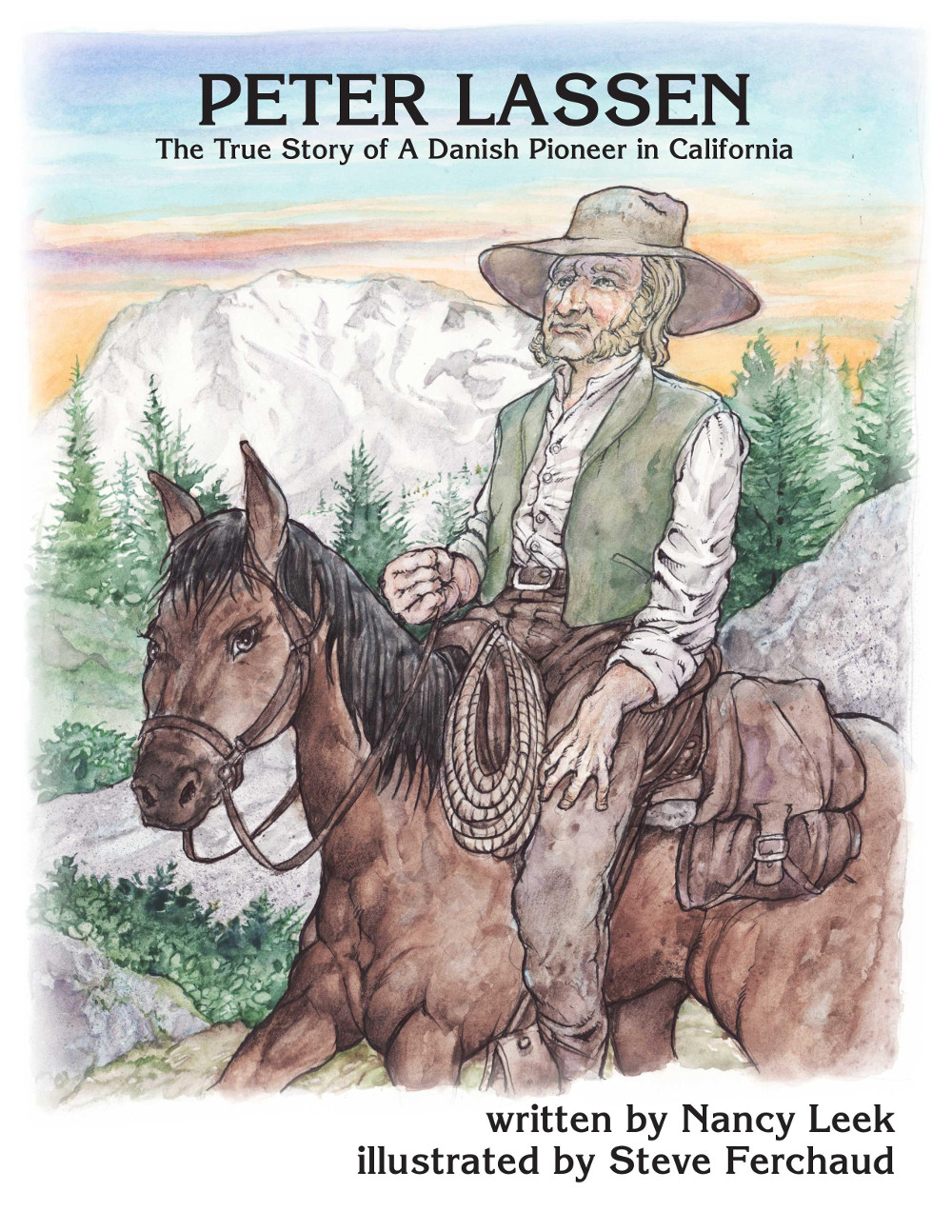
Peter Lassen (or Larsen, since his father’s name was Lars) was born near Copenhagen in 1800.  He became a blacksmith. In 1830 he applied to the king for permission to immigrate, probably because the depressed European economy made it hard to find sufficient work. Or maybe he was just restless.

He arrived in Boston, and later moved to St. Louis, Missouri. In 1839 he joined an emigrant party to Oregon. From Oregon he took ship down the coast and got off at Bodega Bay and traveled overland to Sutter’s settlement, where he easily found work as a blacksmith.

So by the time of his death in 1859 he had been in California nearly 20 years and was well-known and respected. For now I’ll skip over his subsequent peripatetic career in California. By the late 1850s he had lost his Rancho Bosquejo (at Vina) and had relocated to Honey Lake Valley near Susanville. (See my Ever Been to Nataqua? post for more information.)

In the winter of 1858 Lassen and friends heard about a silver strike in the Black Rock Desert of Nevada, which at that time was part of the Utah Territory. It was a region that Lassen was familiar with from the days when he guided emigrants along the Lassen Cutoff of the California Trail. Peter Lassen, Edward Clapper, and Lamericus Wyatt* set out to do some prospecting on April 19, 1859. The plan was to rendezvous with another group of prospectors at Black Rock Springs. When Lassen’s group got there, they didn’t meet the other group, so they set up camp to wait.

canyont

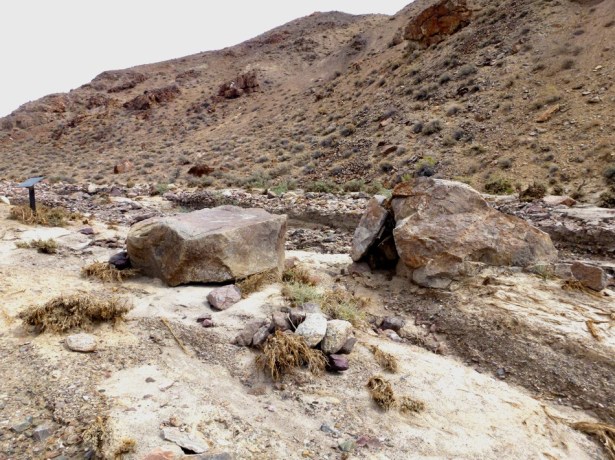
This photo, from the Black Rock Explorers Society website, shows the canyon where the deaths took place.

Just at daylight on April 26th gunshots rang out and Wyatt and Lassen sprang to their feet. Going to rouse Clapper, Wyatt found him already dead, shot through the temple. According to Wyatt, who was the only survivor, Lassen said he would stand lookout while Wyatt gathered up their things and got the horses. A moment later, Lassen was shot and fell, gasping, “They have killed me.”**

Taking nothing but his rifle, Wyatt sprang onto his horse and rode without food or rest for 48 hours (so he claimed) until he arrived back at Susanville and reported the deaths. Twenty men immediately set out for the camp to recover any horses and property, and to assess the situation.

Wyatt blamed the ambush on Paiute Indians. He claimed that a Paiute had come to the camp the evening before, asking for ammunition for his muzzle-loading rifle. Over the objections of Wyatt and Clapper, Peter Lassen gave the man bullets and powder, remarking that he had always been friendly with the Paiutes, they knew old Uncle Pete, and no harm would come of it.

If that really happened, then it made it easy for Wyatt to pin the blame on Indians, and by extension, Peter Lassen himself, who had so foolishly supplied the Indian with the ammo to kill him the next day. But other people questioned this scenario. If Indians did the deed, why did they not loot the camp, as they typically did? When the posse arrived, nothing had been taken from the camp.

bigrock

Site of the camp, again from the Black Rock Explorers Society website. Note the historical marker on the left.

So if not Paiute Indians, then who? Let’s explore that in the next episode.

*Wyatt’s first name also shows up as Americus, LaMarcus, and similar variations.

** As reported in the Downieville Mountain Messenger, and quoted in History of Lassen County. See Ken Johnston, Legendary Truths: Peter Lassen and His Gold Rush Trail in Fact and Fable, p. 287, which is the source of most of my information.

Posted in Peter Lassen, Uncategorized | Leave a comment