What Next?

So now we have gotten John Bidwell to California in November of 1841. On the 1st they arrived on the Central Valley floor, where they found an abundance of game–good eating at last!–and by November 4th the company was at John Marsh’s rancho, near Mt. Diablo, eating pork and beef. Things were looking up for the Bidwell-Bartleson Party.

If you are interested in following these intrepid emigrants for the entire journey, you may wish to revisit my blog posts from May to November 2011, when I traced their progress day by day from Missouri to California. For now I am going to leave them at Marsh’s adobe house and take a look at some other aspects of the history surrounding John Bidwell.

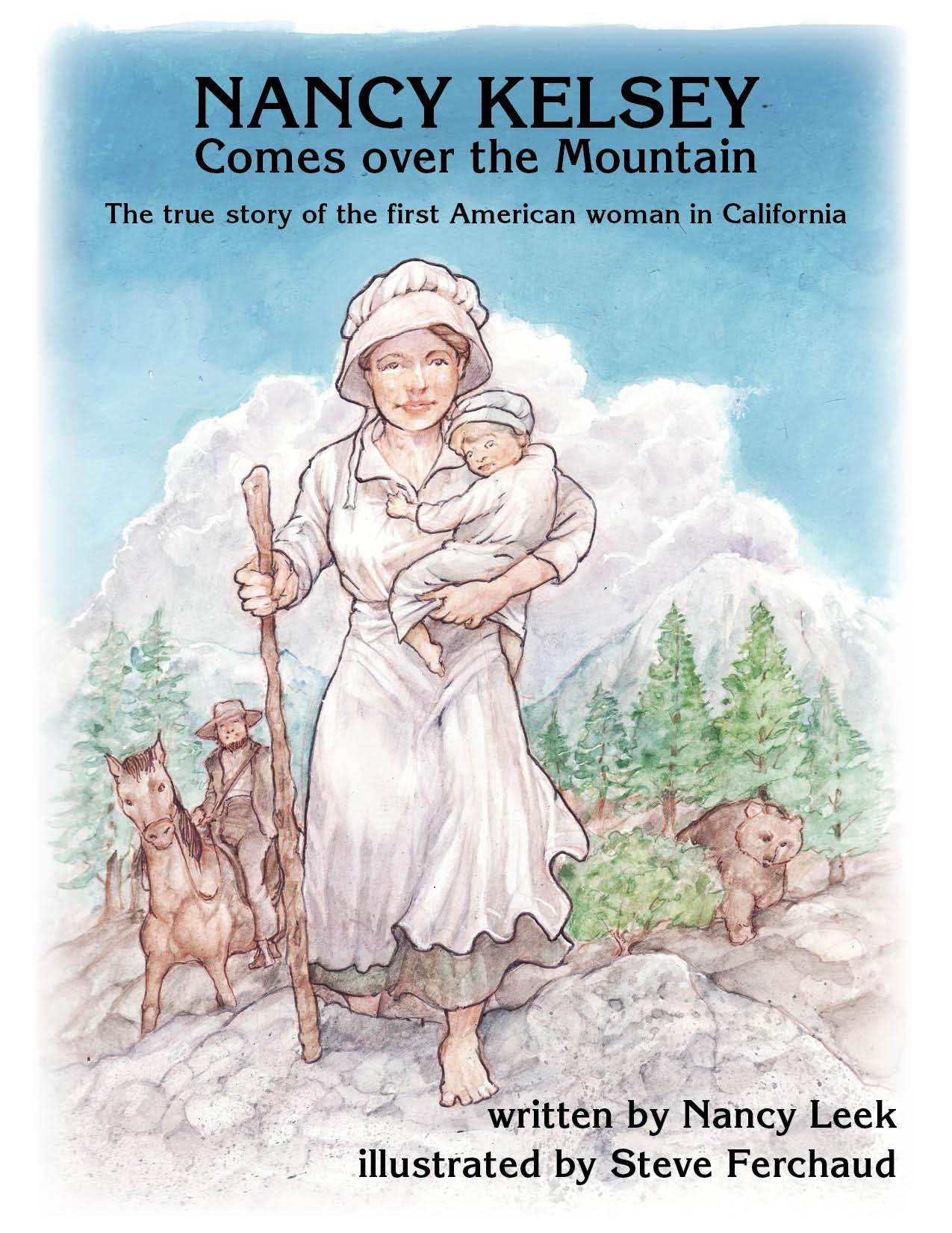
In upcoming posts I’ll be looking at some of Bidwell’s companions on the journey and what became of them. Who found success in California and who returned to the United States?  Did any of them (other than Bidwell) become prominent in their new home? What became of Nancy Kelsey, the lone woman in the company?

So stay tuned for more news from old Northern California, and thanks for  visiting.

Posted in Uncategorized | Leave a comment

California At Last!

From John Bidwell’s trail journal:

November. Monday, 1st. The Company tarried to kill game; an abundance of wild fowl and 13 deer and antelopes were brought in. My breakfast, this morning, formed a striking contrast with that of yesterday which was the lights of a wolf .

In other recollections Bidwell says he had a coyote windpipe for breakfast on the morning of the 31st. Another member of the party had shot the coyote, but by the time Bidwell caught up with them, the only thing left to eat was the lungs (lights) and the windpipe.

Got to be about the worst breakfast ever!

But on the afternoon of the 31st they sighted the valley, “joyful sight to us poor famished wretches!!!” Antelope! Elk! Wild ducks and geese! Their situation changed literally overnight.

Bidwell tells it this way in his 1877 Dictation:

The eve of the next day found us surrounded by abundance. . . . It was about the first of November, and there was no time to delay if we were going to reach California that fall. Most of the party were ready and anxious to press forward. Captain Bartleson and his men though otherwise. They said we hadn’t yet reached California, we probably still had a long distance to travel, that such a place as we were in could not be found everywhere and they were going to stop and lay in meat for the balance of the journey.

Leaving them in camp and crossing the Stanislaus River, we proceeded down the north side of the same and camped. Early the next day the news came that the Indians in the night had attacked them and stolen all their horses. We remained till they came up, carrying on their backs such things as they were able.

John Bidwell never did get on with Captain Bartleson, and I think there is a note of satisfaction here that once again, Bartleson was wrong and got what he deserved.

Posted in Uncategorized | Leave a comment

Almost There! (But They Don’t Know It)

From John Bidwell’s trail journal:

Friday, 29th. Last night, the Indians stole a couple of our horses. About noon we passed along by several huts, but they were deserted as soon as we come in sight, the Indians running in great consternation into the woods. At one place the bones of a horse were roasting in a fire; they were undoubtedly the bones of the horses we had lost. Travelled no less than 9 miles today; the night was very cool and had a heavy frost. Although our road was tolerably level today, yet we could see no termination to the mountains–and one much higher than the others terminated our view. Mr. Hopper, our best and most experienced hunter, observed that, “If California lies beyond those mountains we shall never be able to reach it.”

Weary and worn to the bone, barely living on the meat of their own pack animals, struggling down rocky canyons, the Company was in a desperate situation. With no map and no guide, they had not a clue where they were, and they could see no end to their journey.

Nancy Kelsey, the only woman in the group, had started up into the Sierras riding a horse, with Baby Ann on her lap, but she was now walking. In her own recollection, taken down by a friend in 1893, she says, “I walked barefoot until my feet were blistered.”

As Bidwell explained in Echoes of the Past, “we were now on the edge of the San Joaquin Valley, but we did not even know that we were in California. We could see a range of mountains lying to the west–the Coast Range, but we could see no valley.” They discussed and debated their situation. Many in the party were convinced that they were not yet within five hundred miles of the Pacific Ocean. The mountains stretched as far as the eye could see, and greatly discouraged, they feared that they would never reach California alive.

Posted in Uncategorized | Leave a comment

Still Stuck in the Sierras

From John Bidwell’s trail journal:

Thursday, 28th. Surely no horses nor mules with less experience than ours could have descended the difficult steeps and defiles which we encountered in this day’s journey. Even as it was, several horses and mules fell from the mountain’s side and rolling like huge stones, landed at the foot of the precipices. The mountains began to grow obtuse, but we could see no prospect of their termination. We eat the last of our beef this evening and killed a mule to finish our supper. Distance 6 miles.

Yum! stringy old mule meat. How John Bidwell must have longed for a loaf of bread. He always said he couldn’t imagine how men like the fur trappers could live on meat alone, and no bread.

mule

A healthier mule than Bidwell had. Photo by William Henry Jackson, 1871.

And those poor animals, done to death at the bottom of a cliff. It’s a wonder there was anyone with a horse left by the time they got out of the mountains.

Keep in mind that the Bidwell-Bartleson Party at this point does not know that they have entered California, and they don’t know how much farther the mountains go on. The nights are cold, snow will be falling soon, and they have run out of food. How anxious they must have been feeling!

Posted in Uncategorized | Leave a comment

October 25-26, 1841

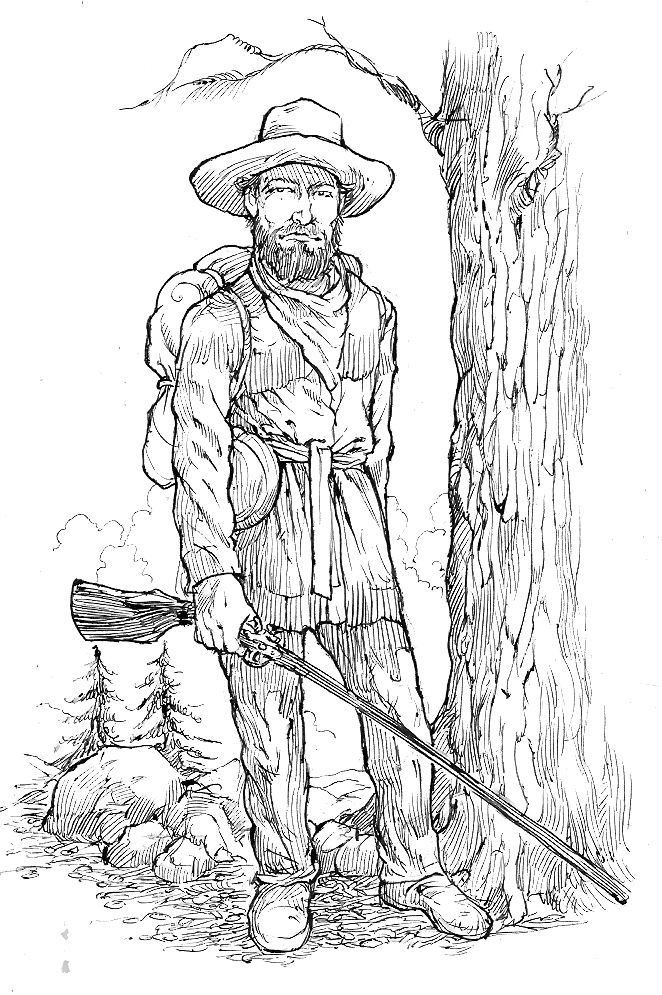
bidwell in buckskins

Drawing of John Bidwell by Steve Ferchaud

“Monday, 25th. Went about 6 miles and found it impossible to proceed. Went back about 2 miles and encamped — dug holes in the ground to deposit such things as we could dispense with. Did not do it, discovering the Indians were watching us . . .”

“Tuesday, 26th. Went S. about 3 miles and camped in a deep ravine. It was urged by some that we should kill our horses and mules — dry what meat we could carry and start on foot to find the way out of the mountains.”

Bidwell had rejoined the company after his detour to the grove of sequoias. While he was gone they had hired an old Indian to pilot them out of the mountains. They were sure that he had led them “into the worst place he could find” and then absconded. They suspected the Indians of wanting to get their horses for food, and they did not trust the guide.

When Bidwell caught up with his companions late on the 24th, they had abandoned 5 of the horses and mules that could no longer travel, and the Indians had taken them for meat. Now they had to consider whether it was time to kill the rest of the animals and travel on foot as lightly as possible.  They decided for the time being to keep their animals alive since, if nothing else, they were dinner on the hoof. How many of the men had mounts is unknown, but Bidwell was on foot.

Game was surprisingly scarce in the Sierra Nevada. All the deer must have been down in the valley, fattening on the lush grass. “When we killed our last ox [on the 22nd] we shot and ate crows or anything we could kill, and one man shot a wildcat. We could eat anything.”

They ate acorns, but the bitter tannin in the untreated acorns made them sick. Years later Bidwell could still vividly recall how he longed for good food, especially fat beef and bread.

Posted in Uncategorized | Leave a comment

Wandering around the Sierras

It was getting late in October, the Bidwell-Bartleson Party had run out of food, and they were still making their way down the canyons of the western side of the Sierra Nevada. On October 23, 1841, John Bidwell set off on his own to hunt for game, which was “exceedingly scarce.”

You would think that Bidwell would take someone else with him, but he doesn’t seem to have heard of the buddy system. His idea was to range ahead of the party looking for game to shoot, then rejoin them further down the trail. He didn’t find any game, he got himself lost in the steep and rocky canyons, and wound up spending the night in a strange and fantastic landscape.

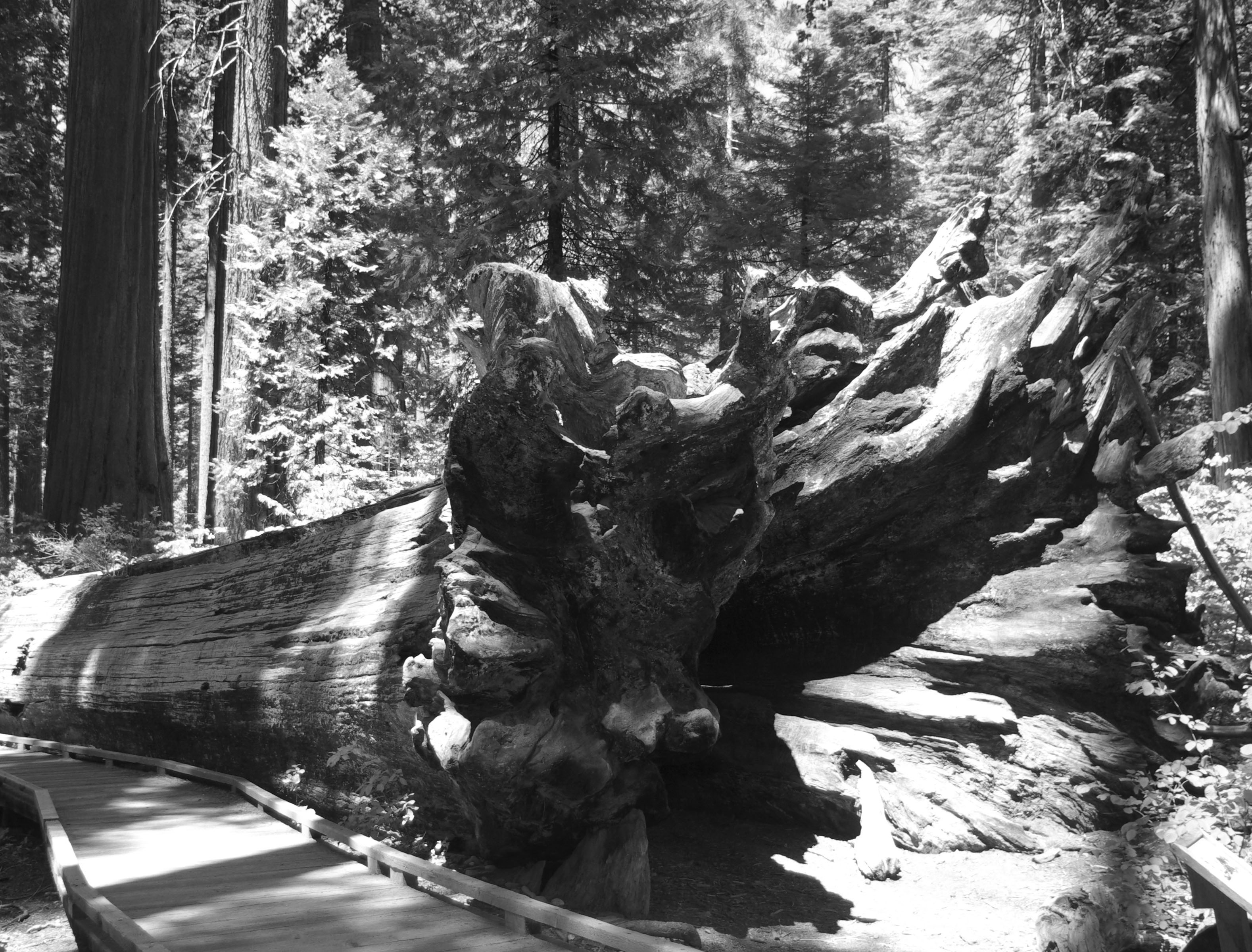
“Just at dark I came to an enormous fallen tree and tried to go around the top, but the place was too brushy, so I went around the butt, which seemed to me to be about twenty or twenty-five feet above my head. This I suppose to have been one of the fallen trees in the Calaveras Grove of Sequoia gigantea or mammoth trees, as I have since been there, and to my own satisfaction identified the lay of the land and the tree. Hence I concluded that I must have been the first white man who ever saw the Sequoia gigantea, of which I told Fremont when he came to California in 1844.” (Echoes of the Past)

Image

“The Father of the Forest,” the tree where John Bidwell sheltered in 1841. Picture taken in 2010. The roots are now much worn down compared to when Bidwell saw them.

Bidwell always considered himself the first white man to lay eyes on the giant sequoias, and many years later he proudly showed Annie the grove where he had spent a cold and sleepless night. The discovery of the grove is usually credited to Augustus Dowd in 1852, and he certainly publicized it, but Bidwell and others had stumbled across these giants of the forest before he did:  J.K. Leonard recorded seeing the trees in 1833 and Joseph Walker in 1834. Neither of their writings were available to Bidwell, so he was justified in thinking that he was the first American (other than the natives) to see these wonders.

Posted in Uncategorized | Leave a comment

Bidwell’s Address to the Society of California Pioneers

One of my favorite sources for information on John Bidwell is his 1897 address to the Society of California Pioneers. The Society was limited to those who had come to California before the end of 1849. Plenty of 49er’s joined, but there were not very many who could claim to have come earlier than John Bidwell.
 
In his speech to the Society members he describes California as he saw it under Mexican rule, in the era of ranchos and missions. Then he goes on to talk about the “foreigners” in California.
 
When I came to California there were very few foreigners here. By foreigners I mean Americans, English, Scotch, Irish, etc. in other words, all not Californian or Mexican born, the people here called foreigners.
 
And then he lists all the foreigners he knew, beginning at San Diego, and working his way up the state to Sonoma and Napa. He remembers all their names! He lists about 100 men (no women), and then allows that there might have been a few more, runaway seamen and the like, that he didn’t know, for a total of about 150 residents who were not Californios. In stating this number he is disputing other estimates that he considers exaggerated.
 
One hundred and fifty “autobiographies and reminiscences” recorded by the Society of California Pioneers are available at the Online Archive of California, including Bidwell’s address. Fascinating reading!


Posted in Uncategorized | Leave a comment

Cresting the Sierras

Sonora Pass, in the area where the Bidwell-Barleson Party crossed the Sierra Nevada.

The view from up there. Sonora Pass, in the area where the Bidwell-Bartleson Party crossed the Sierra Nevada.

The Bidwell-Bartleson Party climbed up narrow canyons on the eastern slopes of the Sierra Nevada, following streams and seeking grass for their mounts. Some were on horses or mules, others were on foot. On October 18th they crested the mountains, and John Bidwell wrote:

“Monday, 18th. Having ascended a about half a mile, a frightful prospect opened before us–naked mountains whose summits still retained the snows perhaps of a thousand years, for it had withstood the heat of a long dry summer, and ceased to melt for the season. The winds roared–but in the deep dark gulfs which yawned on every side, profound solitude seemed to reign. We wound along among the peaks in such a manner as to avoid most of the mountains which we had expected to climb–struck a small stream descending toward the West, on which we encamped, having come 15 miles.”

According to Michael Gillis, the “small stream” that they camped by was Clark’s Fork, which flows into the Middle Fork of the Stanislaus River. They didn’t know how far they had to go yet, but at least they were headed downstream. Considering that they were crossing the mountains without a guide, a map, or even a compass, they were doing pretty well.

Michael J. Gillis traced this journey in his article for the Overland Journal entitled “The 1841 Trans-Sierra Route of the Bidwell-Bartleson Party.” On the 18th he says that the group was climbing up Golden Canyon, and crested the Sierra Nevada at an elevation of 9,425 feet. The article isn’t available online, but I have a photocopy.

“In only four days, thanks to good weather, good luck and some savvy scouting, the Bidwell-Bartleson Party had made its way to the west side of the Sierra Nevada.” The worst of their journey was behind them, but before them they only saw an unending vista of snow-capped mountains, and they had no idea how far they still had to go. They didn’t even know that they had arrived in California. Another two weeks of struggle lay ahead of them before they reached the valley.

Posted in Uncategorized | Leave a comment

October 14, 1841

I’ll be signing books at the Chico Library Fall Festival this Saturday from 11 a.m. to 12:30 p.m. If anyone would like a copy of either John Bidwell or my new book The Miner Poet, or if you just want to chat about California history, please stop by and say “Hi!”

And where was John Bidwell on this date in 1841?

The Bidwell-Bartleson Party, minus Bartleson and his friends, was heading up the Walker River. A week earlier the erstwhile leader of the company, John Bartleson, with seven  of his friends had taken off on their mules, abandoning the rest of the group. There had been friction in the company, as you can imagine given their perilous situation, and Bartleson decided to push on ahead. They took all the meat from a freshly-slaughtered ox with them.

His words as they left were, “Now we have been found fault with long enough, and we are going to California. If you can keep up with us, all right; if you cannot, you may go to hell!”

Captain Bartleson’s words still rang in John Bidwell’s mind when he wrote about the incident 48 years later.  (Although Bidwell, mindful of the readership of The Century Magazine, put in a dash— for the word “hell.” I imagine that’s what the man said.)

Then on the 14th they came back, dragging their tails behind them. As Bidwell recorded:

“Thursday, 14th. This morning we saw at a distance Capt. B. with his 7 men, coming in a direction towards us, but we made no halt, ascended the stream about 20 miles. The mountains continued to increase in height.”

Captain Bartleson was back, and out of food.  “We were glad to see them,” Bidwell later reported, “although they had deserted us. We ran out to meet them and shook hands, and put our frying pans on and gave them the best supper we could. . . He seemed heartily sick of his late experience, but that did not prevent him from leaving us twice after that.”

Posted in John Bartleson, Uncategorized | Leave a comment

On the trail in October 1841

Notice how the weather is getting cooler in October? We are currently enjoying lovely fall days, but the days are shorter and the nights are cooler. What if you were trying to get to California and hadn’t yet crossed the Sierras?  That could be dangerous, as the Donner Party would find out 5 years after the Bidwell-Bartleson Party.

On October 11th, 1841 the Bidwell-Bartleson Party was still crossing Nevada. They followed the Humboldt River (they called it Mary’s River) to the Carson Sink, where the river disappeared into swamp and sand. Then they struck westward and reached the Walker River (which they mistook for the San Joaquin.) Here is John Bidwell’s journal entry for October 11, 1841:

Monday, 11th. Left the lake this morning going into the mountains on a S.W. course. Today we left the trail of Capt. B. and having traveled 19 miles, arrived on a stream which flowed rapidly, and afforded more water than Mary’s river. We thought now, without doubt, that we were safe on the waters of the St. Joaquin (pronounced St. Wawkeen) according to Marsh’s letter. Here grew willows, balm Gilead, and a few cottonwoods.”

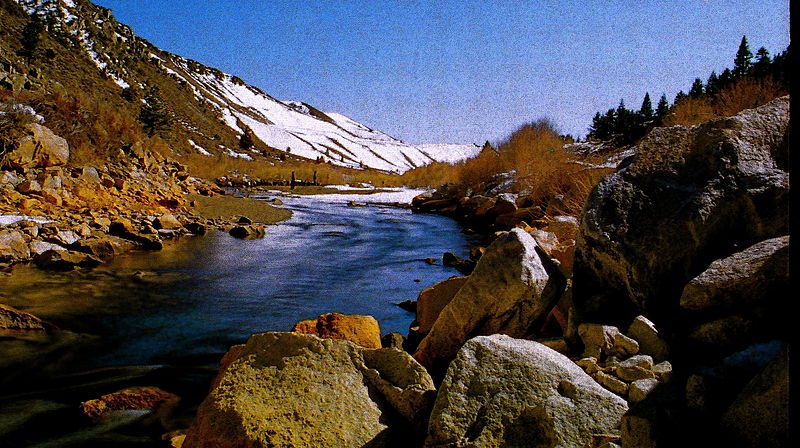
walkerriverThe Walker River made a good route up into the mountains, although future travelers on the California Trail would not travel this far south. In following the Humboldt Bidwell & Co. had missed the few miles of dry country that would have taken them to the Truckee River.

They still had three weeks of hard traveling ahead of them.

Posted in Uncategorized | Leave a comment