Who Was Humboldt and Why Are There So Many Things Named After Him?

California has a Humboldt County and so does Nevada. There is a Humboldt River and a Humboldt Bay and a Humboldt Current. At least eight towns in the United States are named for Humboldt. And then there is the Humboldt Wagon Road, a “current” interest of mine. Who was this Humboldt and what did he do to get his name all over North America?

It’s not because he explored North America. He never saw Humboldt County (either one) or the Humboldt River.
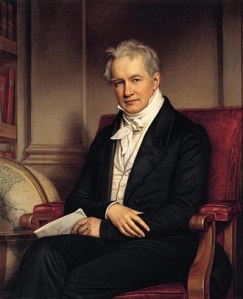
Alexander_von_Humboldt_-_1843Baron Alexander von Humboldt (1769-1859) was a Prussian naturalist and geographer. He explored Latin America extensively, and briefly visited the United States. meeting fellow natural philosopher (and President) Thomas Jefferson in 1804.

Having just bought the Louisiana Purchase, the U.S. government was eager to have the opinion, knowledge, and maps of the eminent explorer. Unfortunately, Humboldt couldn’t tell Jefferson much about the newly acquired territory, but they must have had some stimulating scientific and political discussions.

Louisiana1804a

1804 Map of the Louisiana Territory. Note the non-existence of the Great Basin and the conflation of the Sierra Nevada with the Rocky Mountains.

So if he never explored North America, how did we get so many features named for him? (There’s a Humboldt Peak in Colorado too.) Blame John C. Fremont. In his day there was no more prestigious name you could bestow than that of the foremost scientist of the era. What had been called Mary’s River, Fremont renamed the Humboldt River.

When gold and silver were discovered in the Nevada Territory, the northwest quadrant of Nevada became known as the Humboldt Mining District, after the river. And when Bidwell in 1861 began planning a wagon road to take freight and passengers to the Humboldt Mining District, he called his road the Humboldt Wagon Road.

Baron von Humboldt was vastly prolific and influential in the 19th century, and is undeservedly obscure today. An excellent recent book about him is The Invention of Nature : the adventures of Alexander von Humboldt, the lost hero of science, by Andrea Wulf.

Posted in Uncategorized | 3 Comments

The Last Stage Stop on the Humboldt Road

I got to take a tour up the old Humboldt Road today, thanks to Dave Nopel and the Chico History Museum (and Respect the Walls and the Chico Heritage Association.) I had been along parts of it before (much of it is now Highway 32) but I have never been as far as Jonesville.

DSCF5346We started at the Junction (the intersection in downtown Chico where Park Avenue, Main, Broadway and 9th Street meet), where the Humboldt Road begins. Back in the day this was the hub of industry and transportation in Chico.

DSCF5351

We drove up to the section of Old Humboldt Road, just off of Bruce Road, where you can conveniently see the ruts made by old iron-rimmed wagon wheels. Respect the Walls has done a great job of cleaning up this area.

From there we went to Forest Ranch. The toll booth for the road was located just before Forest Ranch. If you take a left turn off Hwy. 32 onto Forest Ranch Road you are driving along an old section of the Humboldt Road for a few miles, until it rejoins 32.

To get back on the old road from 32, turn right at the sign for Butte Meadows. We stopped for lunch at The Outpost in Butte Meadows (yum!) and then continued on the road a few more miles to Jonesville. There you can see the only remaining intact stagecoach stop on the Humboldt Road. A consortium of local residents is restoring it, and we were lucky enough to be invited inside. Our hostess, Barbara Mann, gave us some background on the building.

DSCF5356

The front part of the building is two stories, and contained a parlor (or reception area) and seven small bedrooms. They are currently restoring the floor in the two downstairs bedrooms. Back of this is a one-story extension that contains a long dining room and a kitchen.

DSCF5369

This is a beautiful setting, with a green grassy meadow surrounded by a conifer forest. Little Jones Creek runs nearby, on its way to join Butte Creek. You can easily understand why families built cabins here to escape the summer heat in the valley.

Not far from Jonesville the paving ends, but the gravel road continues to Lake Almanor, where it meets Highway 89. The original Humboldt Road crossed Big Meadows (now flooded to make Lake Almanor) and continued on to Susanville and the mining towns of Nevada.

Stay tuned and next time I’ll tell you why a road in California is named for a Prussian naturalist.


Posted in Uncategorized | 1 Comment

Prices in the Gold Rush

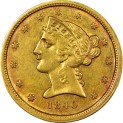
gold coinIt’s no wonder that Luzena was amazed when a miner offered her a $5 gold piece, “ma’am, for them biscuit.” According to Measuring Worth, $5 in 1849 was worth at least $157 dollars. A man might work a week for that much money. But everything in California was different than anything the 49ers had known back in the States.
One of the most fascinating things (to me at least) in Luzena’s account is the food she cooked and the prices she paid for it. It’s a vivid picture.

saltpork_300-jpg

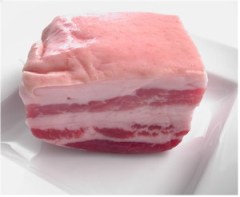
Luzena’s salt pork probably didn’t look this good.

My first purchase was a quart of molasses for a dollar, and a slice of salt pork as large as my hand, for the same price. That pork, by-the-by, was an experience. When it went into the pan it was as innocent looking pork as I ever saw, but no sooner did it touch the fire than it pranced, it sizzled, frothed over the pan, sputtered, crackled, and acted as if possessed. When finally it subsided, there was left a shaving the size of a dollar, and my pork had vanished into smoke.

I found afterward that many of our purchases were as deceptive, for the long trip around the “Horn” was not calculated to improve an article which was probably inferior in quality when it left New York. The flour we used was often soured and from a single sieve-full I have sifted out at one time a handful of long black worms.

The butter was brown from age and had spent a year on the way out to California. I once endeavored to freshen some of this butter by washing it first in chloride of lime*, and afterwards churning it with fresh milk. I improved it in a measure, for it became white, but still it retained its strength. It was, however, such a superior article to the original “Boston” butter, that my boarders ate it as a luxury. Strange to say, in a country overrun with cattle as California was in early days, fresh milk and butter were unheard of, and I sold what little milk was left from my children’s meals for the enormous price of a dollar a pint. Many a sick man has come to me for a little porridge, half milk, half water, and thickened with flour, and paid me a dollar and a half a bowl full.

Ten years later John Bidwell was complaining of the same thing. In an address to the State Agricultural Association in 1860 he said:

But a few years ago nearly all the farmers in this valley, and I among the rest, purchased nearly all the butter they used—butter that had been imported across the Isthmus of Panama, or around Cape Horn. Some of it seemed old enough to have made a voyage around the world. I became ashamed of it, and resolved that if I could not, with thousands of cattle, which I had at that time, make sufficient butter to supply my own family—and my family is large, over fifty, and sometimes a hundred in number—I would do without it.

By his family, Bidwell meant his employees and dependents on Rancho Chico. He was not married at the time and had no children. But he treated his workers like family, and he didn’t waste any time in establishing a dairy.

You may have noticed that everything in California cost a dollar. That seems to have been the smallest unit of currency, and was often equated with a pinch of gold dust.

Luzena continues:

The beans and dried fruits from Chile, and the yams and onions from the Sandwich Islands, were the best articles for table use we had for months. The New York warehouses were cleared of the provisions they had held for years, and after a twelve-months’ sea voyage, they fed the hungry Californians.

No wonder that miner was willing to give ten dollars for bread made by a woman! The alternative was bread (hard flat “pilot’s bread”) shipped ’round the Horn.

*Chloride is lime is Calcium hypochlorite, used as a bleaching agent and disinfectant. It’s hard to imagine that it could have made that butter any worse.

Posted in Luzena Stanley Wilson, Uncategorized | Leave a comment

Luzena in California (at last!)

Luzena Wilson finally made it to the crowded tent city around Sacramento. There she encountered men who were lonesome for the comforts of home.

It was almost dusk of the last day of September, 1849, that we reached the end of our journey in Sacramento. My poor tired babies were asleep on the mattress in the bottom of the wagon, and I peered out into the gathering gloom, trying to catch a glimpse of our destination.

gold coinThe night before I had cooked my supper on the camp fire, as usual, when a hungry miner, attracted by the unusual sight of a woman, said to me, “I’ll give you five dollars, ma’am, for them biscuit.” It sounded like a fortune to me, and I looked at him to see if he meant it. And as I hesitated at such a remarkable proposition, he repeated his offer to purchase, and said he would give ten dollars for bread made by a woman and laid the shining gold piece in my hand. I made some more biscuit for my family, told my husband of my good fortune, and put the precious coin away as a nest-egg for the wealth we were to gain.
In my dreams that night I saw crowds of bearded miners striking gold from the earth with every blow of the pick, each one seeming to leave a share for me. The next day when I looked for my treasure it was gone. The little box where I had put it rolled empty on the bottom of the wagon, and my coin lay hidden in the dust, miles back, up on the mountains. So we came, young, strong, healthy, hopeful, but penniless, into the new world. The nest egg was gone, but the homely bird which laid it—the power and will to work—was still there.

All around us twinkled the camp fires of the new arrivals.  A wilderness of canvas tents glimmered in the firelight; the men cooked and ate, played cards, drank whisky, slept rolled in their blankets, fed their teams, talked, and swore all around; and a few, less occupied than their comrades, stared at me as at a strange creature, and roused my sleeping babies, and passed them from arm to arm to have a look at such a novelty as a child.

Children were indeed a novelty in Gold Rush California, and young men who missed home and family and their younger siblings would go out of their way to see a young child.

Posted in Luzena Stanley Wilson, Uncategorized | Leave a comment

Luzena’s “languishing spark of womanly vanity.”

Luzena and her husband and their two little boys are close to the end of the trail—

The first man we met was about fifty miles above Sacramento. He had ridden on ahead, bought a fresh horse and some new clothes, and was coming back to meet his train. The sight of his white shirt, the first I had seen for four long months, revived in me the languishing spark of womanly vanity; and when he rode up to the wagon where I was standing, I felt embarrassed, drew down my ragged sun-bonnet over my sunburned face, and shrank from observation. My skirts were worn off in rags above my ankles; my sleeves hung in tatters above my elbows; my hands brown and hard, were gloveless; around my neck was tied a cotton square, torn from a discarded dress; the soles of my leather shoes had long ago parted company with the uppers; and my husband and children and all the camp, were habited like myself, in rags.

A day or two before, this man was one of us; today, he was a messenger from another world, and a stranger, so much influence does clothing have on our feelings and intercourse with our fellow men.

Ah, the “languishing spark of womanly vanity”! Poor Luzena, to be seen in that state.

We can scarcely imagine how bedraggled and filthy one would become on the overland trek. Think of how grubby you feel after a week of camping and no shower. Then multiple that by twenty or thirty. Give yourself at best one change of clothing.

And just try to find a picture that fits this description! No woman would have her photo taken in that condition. Photos of women on the trail are exceedingly scarce. This picture of the Joseph Byington family is an oft-repeated one. Notice the barefoot children. What the women were wearing on their feet is hard to see. They look clean enough though, and may be at the beginning of the trail and not the end.

Pioneer-Day

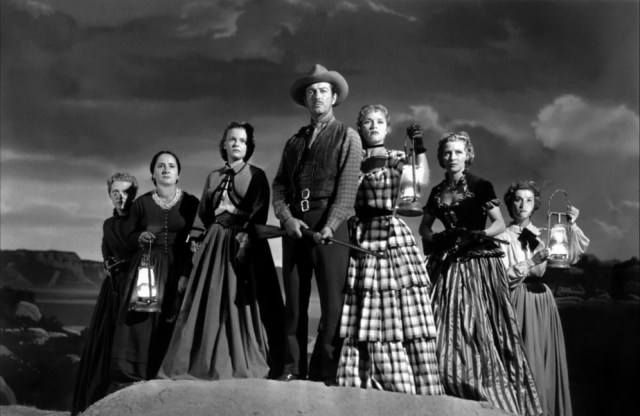
Hollywood has given us this image:

westwardWomenStill

Westward the Women with Robert Taylor and Denise Darcel

Try to picture what those clothes would look like at the end of the trail. And not a single woman has a bonnet or an apron.

Posted in Uncategorized | Leave a comment

The Hard March over the 40-Mile Desert

We rejoin Luzena Stanley Wilson on her overland journey to California–

toulon1

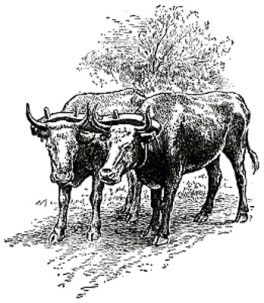
Ox-teamIt was a hard march over the desert. The men were tired out, goading on the poor oxen which seemed ready to drop at every step. They were covered with a thick coating of dust, even to the red tongues which hung from their mouths swollen with thirst and heat. While we were yet five miles from the Carson River, the miserable beasts seemed to scent the freshness in the air, and they raised their heads and traveled briskly. When only a half mile of distance intervened, every animal seemed spurred by an invisible imp.

They broke into a run, a perfect stampede, and refused to be stopped until they had plunged neck deep in the refreshing flood; and when they were unyoked, they snorted, tossed their heads, and rolled over and over in the water in their dumb delight. It would have been pathetic had it not been so funny, to see those poor, patient, overworked, hard-driven beasts, after a journey of two thousand miles, raise heads and tails and gallop at full speed, an emigrant wagon with flapping sides jolting at their heels.

Luzena jumps in her story from the Carson River to the “summit of the Sierra” and says nothing at all about the struggle to cross the mountains.

At last we were near our journey’s end. We had reached the summit of the Sierra, and had begun the tedious journey down the mountain side. A more cheerful look came to every face; every step lightened; every heart beat with new aspirations. Already we began to forget the trials and hardships of the past, and to look forward with renewed hope to the future.

Almost there!

Posted in Luzena Stanley Wilson, Uncategorized | Leave a comment

Dealing with the Desert

Remember the Independence Company? That was the company of young men who set out, with flags flying and a brass band playing, at the same time as Luzena and Mason Wilson’s wagon train left Missouri. Luzena, afraid of the Indians, begged her husband to “to ask at a neighboring camp if we might join with them for protection.” But the men were in a hurry.

They sent back word they “didn’t want to be troubled with women and children; they were going to California”.

They would meet again, in the “40 Mile Desert,” a desolate and fearsome section of the trail between the end of the Humboldt River and the Truckee River.

Our long tramp had extended over three months when we entered the desert, the most formidable of all the difficulties we had encountered. It was a forced march over the alkali plain, lasting three days, and we carried with us the water that had to last, for both men and animals, till we reached the other side. The hot earth scorched our feet; the grayish dust hung about us like a cloud, making our eyes red, and tongues parched, and our thousand bruises and scratches smart like burns. The road was lined with the skeletons of the poor beasts who had died in the struggle. Sometimes we found the bones of men bleaching beside their broken-down and abandoned wagons. The buzzards and coyotes, driven away by our presence from their horrible feasting, hovered just out of reach.

The night that we camped in the desert my husband came to me with the story of the “Independence Company”. They, like hundreds of others had given out on the desert; their mules gone, many of their number dead, the party broken up, some gone back to Missouri, two of the 8 leaders were here, not distant forty yards, dying of thirst and hunger. Who could leave a human creature to perish in this desolation? I took food and water and found them bootless, hatless, ragged and tattered, moaning in the starlight for death to relieve them from torture. They called me an angel; they showered blessings on me; and when they recollected that they had refused me their protection that day on the Missouri, they dropped on their knees there in the sand and begged my forgiveness.

Years after, they came to me in my quiet home in a sunny valley in California, and the tears streamed down their bronzed and weather-beaten cheeks as they thanked me over and over again for my small kindness.

Gratitude was not so rare a quality in those days as now.

forty_mile_desert_nevada_marker_thumb

Posted in Uncategorized | Leave a comment

Lightening the Load

Wagon train pioneers inevitably had to lighten their loads. First to go were heavy items like the rocking chair and the cast iron stove. Some emigrants took equipment that they thought would pay off in their new home, like pickaxes and millstones, and those too had to go. The road to California was strewn with cast-offs.

It was also strewn with dead beasts of burden. The oxen became worn down and when they died they were abandoned by the roadside. Some emigrants were left to pack everything on their backs and continue on foot through a scene littered with dead animals. The stench was terrific. Here is how J. Goldsborough Bruff depicted it:

The_RabbitHole_Springs_Wells_in_a_desert_cropped

Luzena has her own story of lightening the load:

After a time the hard traveling and worse roads told on our failing oxen, and one day my husband said to me, “Unless we can lighten the wagon we shall be obliged to drop out of the train, for the oxen are about to give out.” So we looked over our load, and the only things we found we could do without were three sides of bacon and a very dirty calico apron which we laid out by the roadside.

Luzena had long ago discarded her excess pots and pans. They must have been down to very little other than flour, if three sides of bacon and an apron were going to make a difference.

We remained all day in camp, and in the meantime I discovered my stock of lard was out. Without telling my husband, who was hard at work mending the wagon, I cut up the bacon, tried out the grease, and had my lard can full again. The apron I looked at twice and thought it would be of some use yet if clean, and with the aid of the Indian soap-root, growing around the camp, it became quite a respectable addition to my scanty wardrobe.

The next day the teams, refreshed by a whole day’s rest and good grazing, seemed as well as ever, and my husband told me several times what a “good thing it was we left those things; that the oxen seemed to travel as well again.” Long after we laughed over the remembrance of that day, and his belief that the absence of the three pieces of bacon and the dirty apron could work such a change.

Posted in Luzena Stanley Wilson, Uncategorized | Leave a comment

Monotony and Peril

Nothing but actual experience will give one an idea of the plodding, unvarying monotony, the vexations, the exhaustive energy, the throbs of hope, the depths of despair, through which we lived. Day after day, week after week, we went through the same weary routine of breaking camp at daybreak, yoking the oxen, cooking our meager rations over a fire of sage-brush and scrub-oak; packing up again, coffeepot and camp kettle; washing our scanty wardrobe in the little streams we crossed; striking camp again at sunset, or later, if wood and water were scarce. Tired, dusty, tried in temper, worn out in patience, we had to go over the weary experience tomorrow. No excitement, but a broken-down wagon, or the extra preparation made to cross a river, marked our way for many miles.

Oxen are slow beasts, steady and strong, but oh so slow. The company that made 15 miles a day reckoned it a good day. Imagine crossing Nebraska, flat, featureless, windy Nebraska, at a pace of two miles a hour. The oxen and the wind stirred up the dirt, and it blew about and got into everything. That was the monotony of crossing the prairie.

Luzena’s first crossing of the Platte River was fairly unremarkable, for the Platte is a shallow river. But the next crossing that she describes was different:


platteferry1

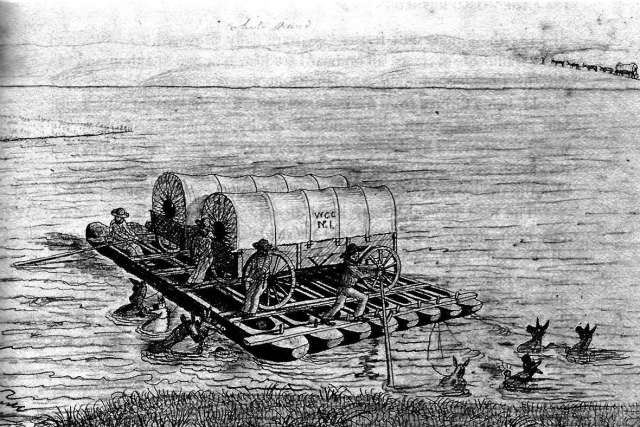
J. Goldsborough Bruff’s drawing of his company crossing the North Platte River

In strange contrast was the North Platte which we next crossed, a boiling, seething, turbulent stream, which foamed and whirled as if enraged at the imprisoning banks. Two days we spent at its edge, devising ways and means. Finally huge sycamore trees were felled and pinned with wooden pins into the semblance of a raft, on which we were floated across where an eddy in the current touched the opposite banks.

And so, all the way, it was a road strewn with perils, over a strange, wild country. Sometimes over wide prairies, grass-grown, and deserted save by the startled herds of buffalo and elk; sometimes through deep, wild cañons, where the mosses were like a carpet beneath our feet, and the overhanging trees shut out the sunshine for days together; sometimes over high mountains, where at every turn a new road had to be cleared, we always carried with us tired bodies and often discouraged hearts.

A monotonous road, strewn with perils. Who is up for a trip to California?


Posted in Luzena Stanley Wilson, Uncategorized | Leave a comment

“We were on the road to California”

coveredwagon

Luzena Stanley Wilson and her husband Mason set out for California one bright May morning in 1849.

The first day’s slow jogging brought us to the Missouri River, over which we were ferried in the twilight, and our first camp fire was lighted in Indian Territory, which spread in one unbroken, unnamed waste from the Missouri River to the border line of California.

That’s the way the American West looked to our pioneer forebears. It was one unbroken waste all the way to the Pacific Ocean. Utterly useless until the gold fields of California were attained. And of all the perils of the journey, there was only one that struck fear into Luzena’s mind. Indians!

Here commenced my terrors. Around us in every direction were groups of Indians sitting, standing, and on horseback, as many as two hundred in the camp. I had read and heard whole volumes of their bloody deeds, the massacre of harmless white men, torturing helpless women, carrying away captive innocent babes. I felt my children the most precious in the wide world, and I lived in an agony of dread that first night.

At this point in the westward migration there was actually little to fear from Indians. But every person in every wagon train had been brought up on tales of Indian depredations, and the fear of “the other” reigned supreme. But the Indians in this border region were only interested in trade.

The Indians were friendly, of course, and swapped ponies for whisky and tobacco with the gathering bands of emigrants, but I, in the most tragi-comic manner, sheltered my babies with my own body, and felt imaginary arrows pierce my flesh a hundred times during the night.

Luzena begged her husband to join with another wagon train for protection, but the “Independence Company” refused to take on women and children.

They sent back word they “didn’t want to be troubled with women and children; they were going to California”. My anger at their insulting answer roused my courage, and my last fear of Indians died a sudden death. “I am only a woman,” I said, “but I am going to California, too, and without the help of the Independence Co.!”

You tell ’em, Luzena!

Posted in Uncategorized | 1 Comment