John Bidwell and the 1864 Republican Convention

On May 27, 1864 John Bidwell arrived in New York City. He had traveled via the Isthmus of Panama from San Francisco to New York; the trip took a little over 3 weeks. He kept a journal with very brief entries.

He went East as a delegate of the California Republican Party. The national party at this time was called the National Union Party and was an amalgam of the majority of the Republicans plus Northern Democrats who favored the war. The convention, which was held in Baltimore, quickly nominated Abraham Lincoln for a second term. They also replaced Vice-President Hannibal Hamlin with War Democrat Andrew Johnson. Although Bidwell does not mention it in his journal, he was part of the delegation that went to the White House to announce the nomination to President Lincoln.

Besides attending the convention, Bidwell was also eager to go to the front and meet his hero, General Ulysses S. Grant. He was lucky enough to sleep in Grant’s tent and see the general at work “up close and personal.”

Republican_presidential_ticket_1864bSun. May 29.
Went to hear Henry Ward Beecher – In evening went to hear Dr. Chapin.
[Edwin Hubbell Chapin, Universalist Church]
Mon. May 30.
Left New York for & arrd at Washington D.C. –
May 31 – June 5.
[No entries]
Mon. June 6.
Went to Baltimore –
Tues. June 7.
Convention met –
Wed. June 8.
Convention closed its labors nominating Abraham Lincoln for President
and Andrew Johnson for Vice President, and adjourned.
Thurs. June 9.
Went to Washington – Saw Secy of War
Fri. June 10.
Remained at Washington – obtained passes to go to the front –
Sat. June 11.
Left for the front 10 a.m. on mail boat Lizzie Baker.
Sun. June 12.
Arrd at the White House 9 1/2 a.m.- At 10 1/2 a.m. set out for Gen. Grant’s
and arrived 2 1/2 P.M. –
Mon. June 13.
Left 7 a.m. Gen. Grant’s headquarters, for the White House.

gengrant

General Grant as Bidwell would have seen him.

Posted in Uncategorized | Leave a comment

May 27-28, 1841

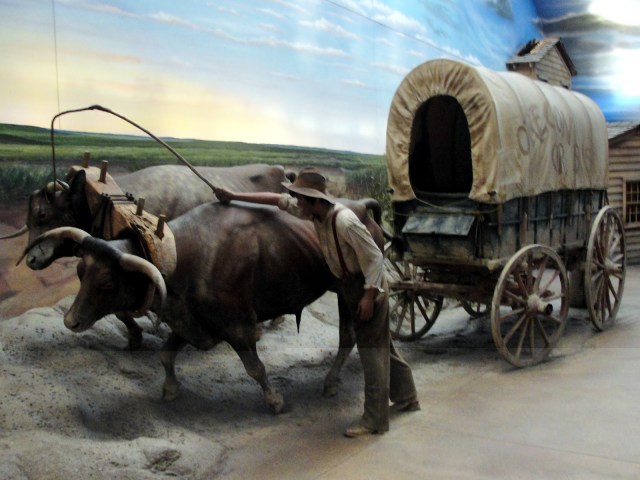
3wagon&oxen

this is what John Bidwell’s wagon and oxen would have looked like.

From John Bidwell’s Journal:

Thursday, 27th: Started late, being detained at repairing the wagons. The day was warm, but the evening mild and pleasant. Encamped in a commodious valley, well-watered by a beautiful little stream which glided smoothly through the scattering grove, come about 15 miles.

Sounds like a typical camping trip: a little delay with the vehicles, but altogether a pleasant day and a lovely camping spot.

Friday, 28th: Started about sunrise, travelled about 5 miles and stopped to take breakfast. The heat was oppressive and we were compelled to go 20 miles farther before we came to either wood or water. The stream on which we camped is a fork of the Kanzas and is well known to all the mountaineers, by the name of the Big Blue; an antelope was killed.

They are in the northeast corner of Kansas, traveling toward Nebraska. It still sounds like a typical camping trip: the weather is hot and they have to go farther than they expected to find good accommodations.

Posted in Uncategorized | Leave a comment

May 26, 1841

From Bidwell’s Journal:

Wednesday, 26th. Two wagons were broke today; about a dozen Pawnees came to our camp, stopped to repair the wagons, having come about 15 miles. A deer was brought in by C. Hopper.

Charles Hopper was a native or North Carolina and an expert hunter. He later brought his family to California and settled in the Napa Valley.

A man by the name of Williams, a Methodist preacher, overtook the company this evening on his way to Oregon Territory. He had not arrived in time to start with the company from the settlements, and had traveled entirely alone, without any gun or other weapon of defense, depending wholly on Providence for protection and support.

The Reverend Mr. Joseph Williams was 64 years old in 1841 when he set out to visit the Protestant missionaries in Oregon. (You may recall that Marcus and Narcissa Whitman had gone to Oregon in 1836 to proselytize the Indians.) He was the oldest member of the Bidwell-Bartleson Party. He left a short record of his experiences on the trail entitled Narrative of a Tour from the State of Indiana to the Oregon Territory in the Years 1841-2.

Williams intended to go west with the members of the Western Emigration Society, but on arriving at Westport found that they had already departed. “With much pain of mind” he went to the Shawnee Mission to consult with his Methodist brethren. There he learned the the company was only four days ahead of him. “I said within myself, surely the Lord is opening my way to go on.”

His church brethren tried to dissuade him from going, saying, “It was almost presumptuous for so old a man as I to attempt such a hazardous journey,” but Williams felt the call of God and was determined to answer it. He set off to catch up with the company, traveling with another missionary and “two Indian chiefs of the Caw Tribe.”

On the 26th he rode across the prairie, “happy in my soul,” until about 4 o’clock, when he spotted the company a few miles ahead. He stopped to feed his horse, then traveled on and by evening he joined the company. They told him how narrowly he had missed being captured by Indians. Williams didn’t seem particularly surprised, for he was confident that God was watching over him.

Posted in Rev. Joseph Williams, Uncategorized | Leave a comment

May 23, 1841

Bidwell’s Journal:

Sunday, May 23rd: All the oxen were gone this morning excepting nine. There was considerable complaint among the company, some saying at this slow rate of traveling we would have to winter among the Black Hills, and eat our mules etc. We, however, made a start about 9 in the morning, proceeded about nine miles and stopped to wait for Chiles’ wagon which overtook us about 5 P.M.; 14 Pawnees were seen by the wagon, well armed with spears etc. It was supposed they were on an expedition against the Kanzas.

Joseph Chiles was a member of the Western Emigration Society, but a little behind the others in getting started, and had to do some catching up. Once he and the men with him got with the main party, they were probably able to make better time, although the trip was slow going. Fifteen to twenty miles a day was the best they could do. They wouldn’t have to winter in the Black Hills, but the mules were another matter (and meal).


Posted in Uncategorized | Leave a comment

May 21, 1841

Friday, 21st. Our oxen left us last night, and it was 9 o’clock before we were all ready to start, passed a considerable stream called Vermillion, a branch of the Kanzas. On its banks were finer timber than we had heretofore seen, hickory, walnut, &c. &c. The country was prairie, hilly and strong; we passed in the forenoon a Kanzas village, entirely deserted on account of the Pawnees, [we] encamped by a scattering grove, having come about 15 miles.

On the 19th the emigrants had met some well-armed Kansas (Kaw or Kanza) Indians. who were expecting an attack by the Pawnees, in retaliation for an attack by the Kansas on a Pawnee village a short time before. The Kaw and the Pawnee were traditional enemies whose hostility had been intensified by pressure from the westward movement of American settlers.

The fear of meeting hostile Indians was one of the chief concerns of the members of the Bidwell-Bartleson party. Under the guidance of Thomas Fitzpatrick, who was well-acquainted with the Plains Indian tribes, they were able to avoid coming between rival native bands.

Posted in Uncategorized | Leave a comment

Nancy’s Bookshelf

Nancywiegman

Nancy Wiegman

This bookshelf is not my bookshelf. This Nancy is Nancy Wiegman, interviewer extraordinaire.

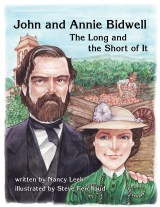
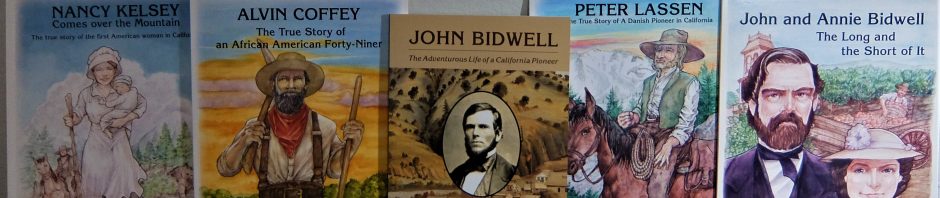
Back in November Nancy interviewed Steve Ferchaud and myself about our new picture book biography of John and Annie Bidwell, and also a bit about The Miner Poet: Poems of Pres Longley. Then when she went from a half-hour to an hour format, she brought me back in along with my daughter, Jean Leek Ping. Jean writes a blog — Howling Frog Books–about the the great variety books that she reads.

So here is a link to the podcast of the interview at mynspr.org. And here is a link to the books.

Posted in Uncategorized | Leave a comment

And They’re Off!

On May 19th the Bidwell-Bartleson Party started for California. John Bidwell, as secretary of the group, kept a journal. Later, while at Bodega Bay, he tidied up his journal entries and sent them back to a friend in Missouri, who had them printed as a guidebook. This is the source of the quotes in this and future entries.

Wednesday, 19th. This morning the wagons started off in single file; first the 4 carts and 1 small wagon of the missionaries, next 8 wagons drawn by mules and horses, and lastly, 5 wagons drawn by 17 yoke of oxen. It was the calculation of the company to move on slowly till the wagon of Chiles overtook us.

Our course was west, leaving the Kanzas no great distance to our left, we traveled in the valley of the river which was prairie excepting near the margin of the stream. The day was very warm and we stopped about noon, having traveled about 12 miles. (Bidwell-Bartleson Party, ed. by Doyce B. Nunis, p. 28-29)

The missionaries were led by Father Pierre Jean De Smet, a Belgian Jesuit who spent many years working among the American Indians. In 1841 he was on his way, with two other priests and three lay brothers, to minister to the Flathead Indians. He established St. Mary’s Mission on the Bitterroot River near Missoula, Montana. Bidwell described him as follows:

He was genial, of fine presence, and one of the saintliest men I have ever known, and I cannot wonder that the Indians were made to believe him divinely protected. He was a man of great kindness and great affability under all circumstances; nothing seemed to disturb his temper.(Echoes of the Past, p. 114)

More information on Father De Smet can be found in this article from Historic St. Mary’s Mission and Museum.

Posted in Uncategorized | Leave a comment

The Journey Begins

From A Journey to California, 1841, by John Bidwell:

May, Tuesday 18th 1841. Having waited at this place (2 miles W. of Kanzas river) 2 days, and all the Company being arrived, except those heretofore mentioned, the Company was convened for the purpose of electing a Captain and adopting rules of government of the Company; when T. H. Green was chosen President–and J. Bidwell, Secretary.

After the rules were read and adopted, J. Bartleson was elected Captain; it will be understood that Fitzpatrick was Capt. of the Missionary Company and pilot of the whole. Orders were given for the company to start in the morning, and the meeting was broken up.  (Bidwell-Bartleson Party, edited by Doyce B. Nunis, p. 28)

The Bidwell-Bartleson Party (as it is usually known today) was the first group of emigrants from the United States to make a planned overland journey to California. They left Missouri with the aim of reaching California. Half the group was persuaded to take the Oregon Trail to Oregon instead (which was the safer option), but Bidwell’s group, consisting of 32 men, one woman and her baby, maintained their determination to achieve their goal.

Bidwell and his friends traveled part of the way with Father Pierre Jean de Smet’s missionary party. They were lucky to have made this connection, because Father de Smet had hired a guide, Thomas Fitzpatrick, a man with many years experience in the Far West.

Posted in Uncategorized | 2 Comments

A Chico History Weekend

This has been a weekend full of Chico history events.

John Bidwell 1850

John Bidwell in 1850

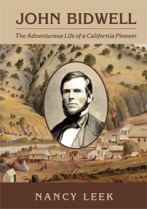
Saturday morning I gave a talk at the Chico Museum on “Early Days at Rancho Chico,” all about John Bidwell’s activities during the 1850s. I crammed as much history as I could into 60 minutes, because there was so much to talk about. It was well attended — about 60 people came.

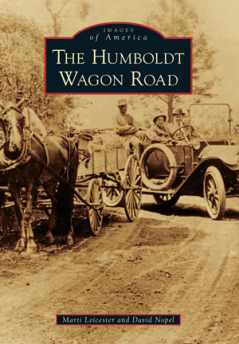
In the afternoon I took the tour, led by Dave Nopel, on “Rocks and Ruts.” We met at the Junction, where Broadway, Main, Park, 8th and 9th Streets all meet, and where the Humboldt Road begins. From there we followed the road through town, taking a jog around the freeway, and on up into the hills to see wagon ruts and rock walls. Along the way Dave, who “knows all there is to be knowed” about the Humboldt Wagon Road, told us about its humboldt roadorigin and significance. He should know — he literally wrote the book about it, along with Marti Leicester.

 

It was a beautiful day to be looking at the foothills. At several places along the old Humboldt Road the ruts can be seen, worn into the soft lava cap by the iron rims of the wagon wheels. This was a route traversed by freight wagons, lumber wagons, and stagecoaches. The road never paid off for John Bidwell the way he hoped — the railroad took the shipping business that he was planning to send by this road to the mines in Nevada and Idaho. But it became a significant route for the lumber trade and for valley residents seeking relief from the hot summers in the mountains.

DSCF0694

Wagon ruts can still be seen next to the paved Humboldt road in some places.

Butte County residents are familiar with the rock walls that can be seen along roads and in fields around Chico. These were built to fence in cattle, clear rocks out of fields, and keep cowboys busy during slow times. They are fine examples of the art of rock wall building and a part of our history. They will stand firm unless disturbed. Unfortunately, the rocks are steadily disappearing.

Folks, leave the rocks where they are! They are being stolen. A group called Respect the Walls is working to preserve this heritage by documenting and seeking protection for the walls. They have a website and a Facebook page. Please help them by not taking any more rocks.

DSCF0697

A rock wall along the Humboldt Road, about half the height it should be.

Then today (Sunday) I took a tour of downtown Chico with Randy Taylor, sponsored by the Chico Heritage Association. Another great tour, focusing on the buildings — the ones that have changed, the ones that have stayed the same, and the ones that are gone — along Main Street and Broadway.

If you like historical tours it’s not too late. There is one of the South Campus neighborhood with John Gallardo on Saturday,May 28th at 1 p.m. Find out about the Language Houses and other residences next to the Chico State campus.

Posted in Uncategorized | Leave a comment

Wagons West

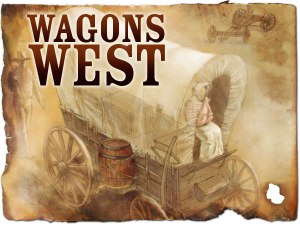
westwagons600450bThe Chico Enterprise-Record today published a full-page color feature marking the 175th anniversary of the “first organized wagon train that left Missouri for California.” I can’t find it on the E-R webpage, but you can find it at the Orange County Register site.

John Bidwell, one of the leaders of the Bidwell-Bartleson Party, helped blaze the California Trail, the overland route that would bring hundreds of thousands of migrants to the Golden State. The migration that started with one small group in 1841, would become a flood in 1849 and the early 1850s.

Although the feature states that the Bidwell-Bartleson Party left Independence, Missouri on May 9th, 1841, they did not actually get going quite that soon. John Bidwell showed up at the rendezvous at Sapling Grove, a campground near Westport (now part of Kansas City) on May 9th.  When he arrived he found only one other wagon there. Other emigrants trickled in over the next several days. On May 18th they formally organized their party, electing a president, secretary, and captain, and on May 19th they started out on the trail.

I will be posting more about the adventures of John Bidwell on the California Trail in the coming days, so stay tuned.

Posted in Bidwell-Bartleson Party, Uncategorized | 4 Comments