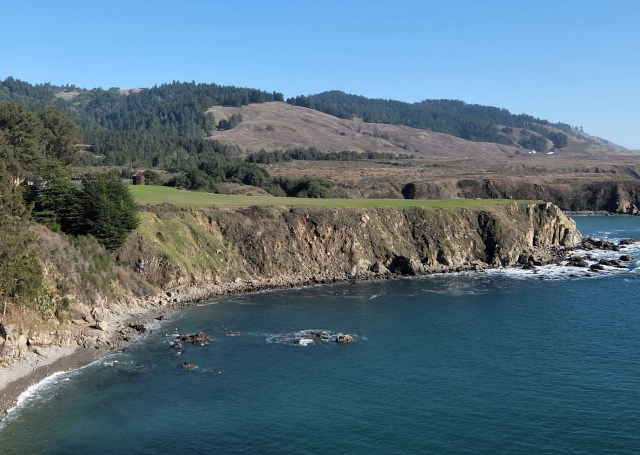
A Trip to Fort Ross on the Penultimate Day of 2019

dscf8539-2.jpg

The corner blockhouse of the Fort Ross stockade is just visible on the left.

Last Monday I took a trip up the California coast to Fort Ross with some family members. Our #2 son and his family live in the Midwest; his wife was born in Russia. They were in California visiting us for the holidays. What better and more historical place to take a Russian than Fort Ross State Historic Park?

It was a beautiful sunny day, a perfect day for a drive along the coast. Fort Ross is rather remote — about 90 miles north of San Francisco — so it doesn’t get as many visitors as it deserves, but it is well worth the trip. The entrance fee is only $8 per car, so bring the whole family if you like. Bring a lunch too — there are picnic tables near the parking lot, or you can picnic near the shore with a rock for a table, as we did.
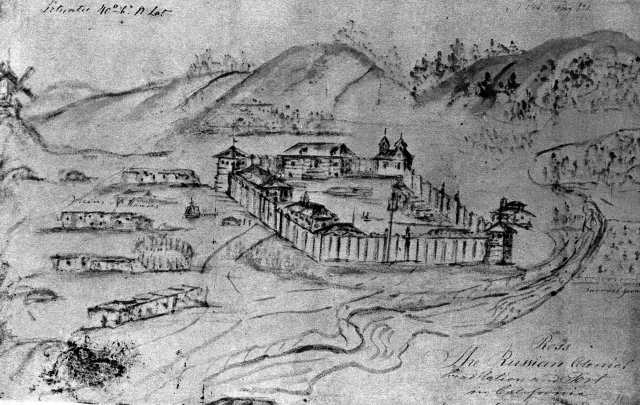
Fort_Ross_California_1843

A drawing of Fort Ross, 1843

According to the State Parks website:

Fort Ross was a thriving Russian-American Company settlement from 1812 to 1841. This commercial company chartered by Russia’s tsarist government controlled all Russian exploration, trade and settlement in the North Pacific, and established permanent settlements in Alaska and California. Fort Ross was the southernmost settlement in the Russian colonization of the North American continent, and was established as an agricultural base to supply Alaska. It was the site of California’s first windmills and shipbuilding, and Russian scientists were among the first to record California’s cultural and natural history. Fort Ross was a successfully functioning multi-cultural settlement for some thirty years. Settlers included Russians, Native Alaskans and Californians, and Creoles (individuals of mixed Russian and native ancestry.)
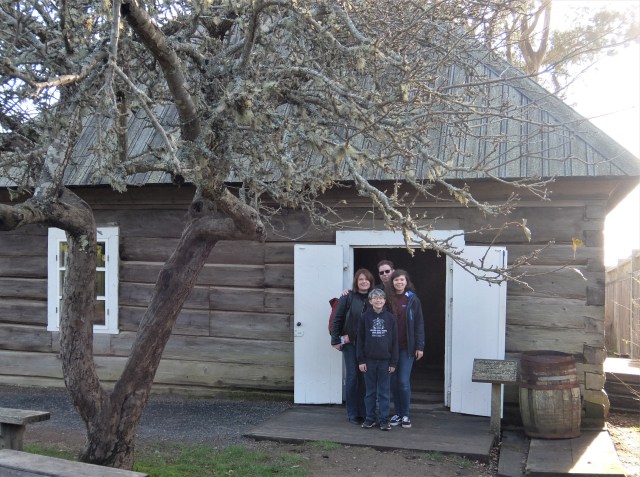
DSCF8549 (2)

Posing in front of Rotchev House

Fort Ross is one of the oldest properties in the California State Parks system. When the state acquired it in 1906, the only original building still standing was the Rotchev House. The rest of the fort — the stockade, the bastions, the officials’ quarters, the magazin (for storage),  and the chapel — have been restored to make the fort look as it did in its heyday.
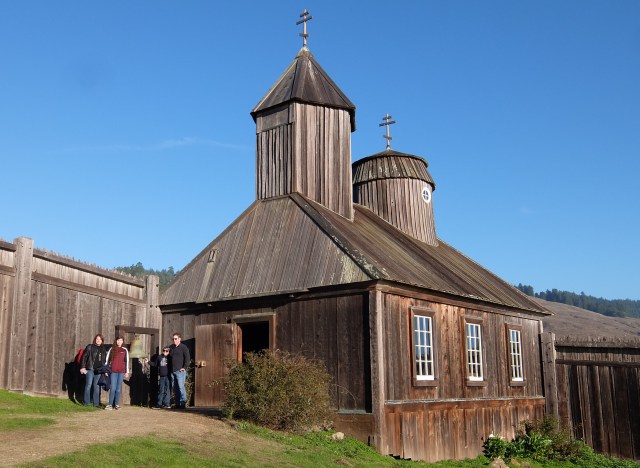
DSCF8563 (2)

The restored Fort Ross chapel

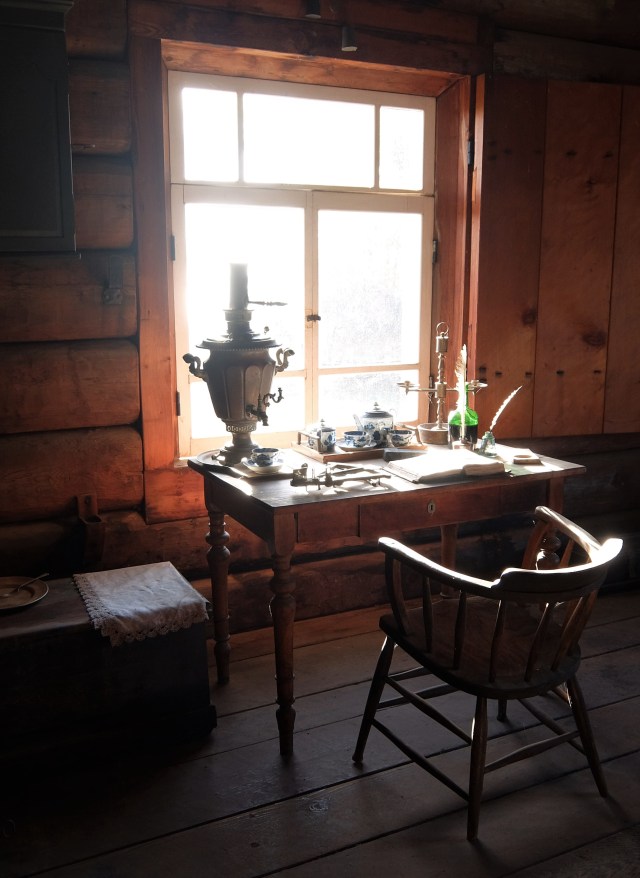
DSCF8555 (2)

Inside Kuskov House, with samovar, tea set, sextant, candlestck, and journal

For more information about Fort Ross, including events at the fort, check out the Fort Ross Conservancy website.

Posted in Fort Ross, Uncategorized | Leave a comment

Christmas with the Bidwells 2019

bidwell-dec-2019 (11)

The Bidwell Mansion Association celebrated “Christmas with the Bidwells” on December 6th with delicious holiday treats, live music, and a vignette inside Bidwell Mansion.

In the vignette, Mrs. Swasey (LaShona Haskell), William Swasey (Mike Swann), John Bidwell (Nick Anderson) and Annie Bidwell (Robyn Engel), discuss Christmas dinner at Sutter’s Fort in 1845. You can read that true story in two previous posts here and here.

You can watch the video of their performance on YouTube. The sound quality will improve after a few seconds when the party moves into the dining room.

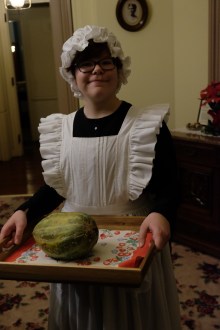
bidwell-dec-2019 (17)The last casaba melon was served by Katie the maid (Emily Ping).
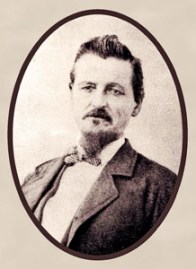
Our thanks to our wonderful actors and all the friends who make Bidwell Mansion a special place to visit.

Enjoy!

Posted in Casaba melon, Christmas, Uncategorized, William F. Swasey | Leave a comment

Pres Longley’s Christmas Column

pres

Pres Longley, the Bard of Butte

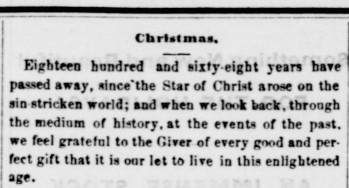
Pres Longley, the “Bard of Butte,” wrote many columns and poems for the newspapers. This column appeared in the Weekly Butte Record on December 26th, 1868. It’s lengthy, so I am just going to give you the beginning, and the part addressed “to the juvenile readers of the Record about Santa Claus.”

WBR18681226.1.1-1552-636-699-377-349w

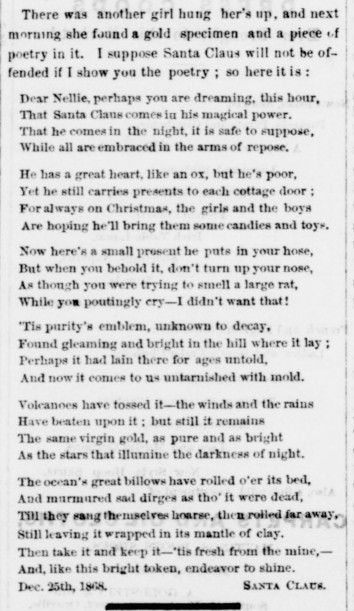
In spite of the troubles of this old world, Pres encouraged his readers to live in gratitude and good cheer. He then tells the story of a “lazy girl” who hung up her stocking on Christmas Eve, and found nothing in it in the morning but the following two lines:

Your stocking is dirty, I’ll put nothing in it,
Till you wash out the dirt; ’twill take but a minute.

But another girl, who kept her stockings clean, had better luck, and here is her poem:

WBR18681226.1.1-1538-3831-709-1223-354w

Now that’s something I would like to find in my stocking, a nugget of gold, “as pure and as bright / as the stars that illumine the darkness of night.” May we all have a merry and joyful Christmas!

Posted in Pres Longley, Uncategorized | Leave a comment

“A Pioneer Repast” and Its Author

SFC18921225.1.13-2968-3644-972-709-243wA couple weeks ago I told you about Christmas dinner at Sutter’s Fort in 1845 and its crowning finale, a genuine John Bull plum pudding.  All the information for those two posts came from an article that appeared in the San Francisco Call newspaper on Christmas Day, 1892.

When I read that article, I knew I had found a fabulous story of early days in California. But I was faced with the question: Who wrote the article? There was no name attached, just the initial “S” at the end. Who could “S” be?

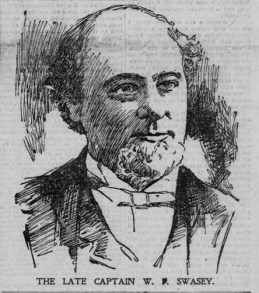
I am confident the story was written by William F. Swasey, a pioneer who traveled overland to California and arrived at Sutter’s Fort on September 23, 1845. According to Bancroft’s California Pioneer Register, Swasey was employed for two months or more at Sutter’s Fort as assistant bookkeeper. He was in the right place at the right time to experience the banquet, and he later he was known for writing about his California experiences.

At Sutter’s Fort he got to know Captain Sutter, John Bidwell, Samuel Hensley, and Pierson B. Reading. But he was young and ambitious, and went looking for bigger opportunities. After three or four months at Sutter’s he went on to Monterey, where he worked for both William Heath Davis and Thomas O. Larkin as a clerk.

SFC18961226.1.1-4457-3888-1777-2013-444wThen the Mexican War broke out and he joined the California Battalion. After the war, in 1847, he went to San Francisco, where he became a merchant, a dealer in real estate, and a notary public. He was a founding member of the Society of California Pioneers and wrote many  obituaries of the old pioneers that he had known. In 1891 he published The Early Days and Men of California, which gives his eye-witness account of the conquest of California and brief biographies of many pioneers. You can find the book on Google Books and download it for free.

We owe the preservation of Sutter’s New Helvetia Diary, a day by day account of events at Sutter’s Fort, to Mr. Swasey. I don’t know how it came into his hands, but in 1881 he passed it on to John Bidwell. In 1886 Bidwell delivered the diary to the historian Theodore H. Hittell. As Bidwell recorded in his journal:

Thurs., May 27. San Francisco
Norton Bush’s studio, Swasey’s,  Montgomery Block, Hittell’s Office. Col. Bee’s Events: Saw painting of Sutter’s Fort at N.Bush’s – Went to Swasey’s place or office.- Delivered old diary of Sutter to Hittell.

I am sure William Swasey had many other entertaining stories to tell about life in California. I hope I’ll be able to find some more to share.


Posted in William F. Swasey | Leave a comment

A Real John Bull Plum Pudding

The cook at Sutter’s Fort, an Englishman, promised he could produce a Christmas dinner “that would rival Delmonico’s best efforts.” (Delmonico’s Restaurant in New York City being the epitome of fine dining.)

Campion_dinner

A banquet at Delmonico’s, not to be confused with dinner at Sutter’s Fort. From Wikipedia.

He also promised to top off the whole affair with “a dessert consisting of a real John Bull plum pudding.” It sounded irresistible, but where was he to get the necessary ingredients?

SFC18921225.1.13-2952-5008-969-880-242w2

As our author notes, the cook had no spices, no butter or milk or eggs. The only fruit he had was the little sour grapes that grew along the river banks. How could he make a real plum pudding?

After five courses of variations on beef and chile colorado, the diners were ready for relief to the rumbling stomachs. It was time for that crowning achievement, the plum pudding!

1a59d629c80c9b4c0f22b199d451548fHe brought it in with an air of great self-gratulation, and such a pudding! It is doubtful if another, to compare with it, has ever been or ever will be concocted. In its construction the cook had used common beef tallow liberally, and filled it with the aforesaid sour grapes, and seasoned it unsparingly with chile colorado, black pepper, salt and garlic. He also made a sort of sauce with the panoche sugar and tallow, and had also dosed that liberally with chile and black peppers.
The pudding was served to the diners, and they all watched as Captain Sutter tasted his portion. Captain Sutter was a man of the most courteous manners, and felt it his duty to eat whatever was put before him. But this dish bothered him.

As he would gulp it down, he would look around at us, with a sort of dazed and helpless look, evidently to see if we were really eating it, and how the thing was affecting us. But he was too well bred and dignified in bis manners to say a word.

Poor Captain Sutter! At last another man asked “Cook, what is it?”

“Why, sir.” replied the cook, “it is a regular Christmas plum pudding, Mexican style!”

And so ended Christmas dinner, 1845, at Sutter’s Fort.

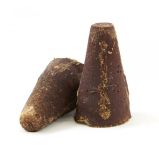
rohrzuckerblock-piloncillo-2933-004hm02_600x600Note: The author mentions “panoche” sugar. This is unrefined Mexican brown sugar, formed into a cone, and also known as piloncillo. You can buy it in most grocery stores. “Unbolted” flour is coarse, unsifted whole wheat flour.
Posted in Christmas, Uncategorized | Leave a comment

A Pioneer Repast

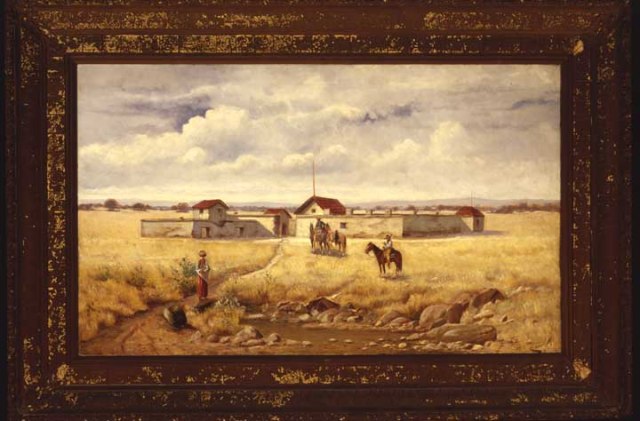
SuttersFort

Sutter’s Fort in the 1840s

If you were living at Sutter’s Fort in 1845, before the Gold Rush, what was available for you to eat? Would you enjoy lots of good foodstuffs, or a limited diet? It could be both, depending on the time of year and your own imagination. But one thing is for sure — there would be beef.

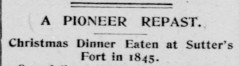
Looking in the California Digital Newspaper Collection for information on women and side saddles, I came across something completely different. With the headline “A Pioneer Repast,” it was the story of Christmas dinner at Sutter’s Fort in 1845, by a man who was there.

SFC18921225.1.13-2968-3644-972-709-243w

It was published in the Christmas Day edition of the San Francisco Call in 1892. I turned the story into a vignette for the Bidwell Mansion Association’s annual “Christmas with the Bidwells” party and we will be performing it this Friday, December 6th inside Bidwell Mansion.

The gentleman telling the story relates how he went to the cook and asked him what he could come up with for Christmas dinner:

The cook was an English Cockney, but a good fellow withal, who, when approached upon the subject. declared that he could get up a menu that would rival Delmonico’s best efforts, if I would only leave the whole matter in his hands. I agreed to his terms, but did not quite see how he could do it, as our commissariat consisted wholly of beef, frijoles (brown beans), unbolted flour, Mexican panoche sugar, about the color of natural beeswax and of about the same consistency, with an abundance of chile colorado (red peppers), plenty of salt and black pepper, with coffee and tea. There were no vegetables, butter or milk, but he was so confident I let him have his own way.

Not only did the cook claim he could create a spread to rival Delmonico’s, but he also promised a genuine “John Bull plum pudding.”

And yet, as the author says, all he had to work with was beef, beans, unbolted (unsifted) whole wheat flour, red peppers, and brown Mexican sugar. Christmas Day came and the men sat down to dinner “with expectancy and no little curiosity.” Out came the first course:

The first course was beef soup, garnished with frijoles, chile colorado and garlic; the second course was roast beef: the third course was baked beef pie; the fourth course was stewed beef, and the fifth course was fried beef, accompanied with black, unbolted flour bread. All these dishes were garnished with the same condiments as the first, but the chile colorado dominated over all the others, and our bodies were aglow with heat, and our stomachs were like a boiling cauldron.

SFC18921225.1.13-2960-5863-976-649-244w

You can’t say that the cook didn’t do his best to vary the menu!

c8ddfa8b558f5294063e491ad57801b6

And what of the “John Bull plum pudding? Wait until the next installment and I will tell you about the English cook’s greatest culinary accomplishment.

We will also solve the mystery of the author of this piece, a man who only signs himself as “S”.


Posted in Christmas, Uncategorized | Leave a comment

A Leader in Public Service in Butte County

In a fascinating article in Diggin’s, the quarterly of the Butte County Historical Society, Nancy Brower tells the story of three pioneering women in local politics: Minnie Abrams, Mattie Lund, and Florence Danforth Boyle. She writes:

Most people are startled to hear that Minnie Abrams was elected Butte County Superintendent of Schools in November 1906, five years before the historic California suffrage election.

Who knew that women could serve in public office before they could even vote for themselves? And yet they could, and they did.

Minnie Sharkey Abrams was born in 1863 to William and Amanda Sharkey. In 1886, as a twenty-three years old school teacher, she made her first attempt to be elected county Superintendent of Schools. The editor of the Oroville Mercury commended her for her “brains, natural ability, pluck and energy.” She lost that race, but it did not deter her from trying again.

CR19061102.1.7-114-4162-621-253-310w

In 1906, Minnie, now a married woman with four children, was still just as dedicated to the education of young people. Once again she ran for county superintendent and this time she won by a wide margin. She served with great force and devotion until her unfortunate death at the age of 50 in 1914.

It won’t be any surprise to learn that she was committed to the cause of woman’s suffrage. When women gained the right to vote in California in 1911, Minnie Abrams was the first to register to vote in Butte County. She wasted no time in going to the county clerk and putting her name on the register.

Although I was surprised to learn of Minnie Abrams’ election and career, she was not the only woman elected to office in California before 1911. Several women served in public office, the most common one being county Superintendent of Schools. The first woman to run for office was Laura DeForce Gordon, who ran for the State Senate in 1871 on the third party Independent ticket. She did not win.

Donna M. Coleman was elected Shasta County Superintendent of Schools in 1875, the earliest California woman elected that I could find. For more on historic women in politics, the online place to search is Her Hat Was in the Ring, a site dedicated to U.S. women who ran for political office before 1920.

Posted in Uncategorized | 4 Comments

Our American Stories and Me

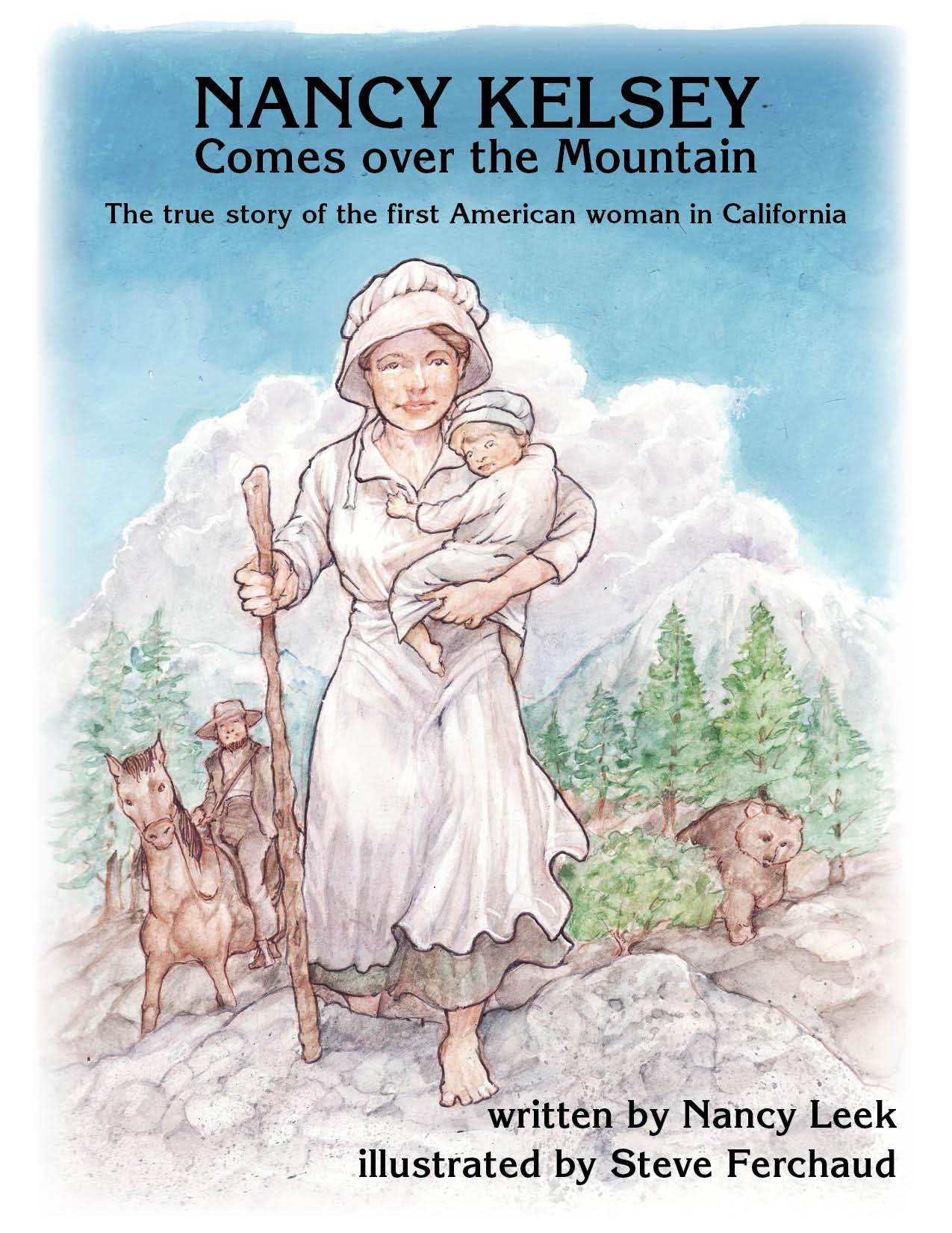
Nancy-Kelsey-pic

I’m on the radio!

And you can listen to me right here!

You can hear me (and a couple of other people) talking about real pioneer woman Nancy Kelsey on Our American Stories. In addition to true stories from American history, this syndicated radio program covers business, sports, and contemporary stories of American heroes.

The nearest radio station that carries Our American Stories is KSAC 105.5 FM in Sacramento. But you can also tune in online at Our American Network or subscribe to their podcast.

I enjoyed researching and recording my part of the program. I have to thank Steve Michaels for recording me in his fabulous studio, and Nick Anderson for putting me in touch with Steve. I know some wonderful people.

Posted in Uncategorized | Leave a comment

The First Newspapers in California

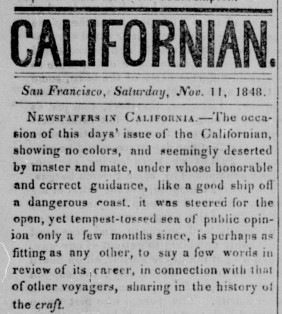
On November 11, 1848, the last issue of the first newspaper to appear in California was published.  The Californian had begun life in August 1846 under the editorship of Walter Colton and Robert Semple in Monterey. By the fall of 1848, with gold fever rampant, it became impossible to continue printing the paper. Everybody was running off to the goldfields: as Colton wrote in Three Years in California: “the blacksmith dropped his hammer, the carpenter his plane, the mason his trowel, the farmer his sickle, the baker his loaf, and the tapster his bottle.”

In the last issue, the Californian (under another editor and printed in San Francisco), gave a brief history of the newspaper, like a ship now “deserted by master and mate.” It ended on a hopeful note, insisting that the paper would continue, but the editor himself had been “called abroad” (to the goldfields?) and this was the last issue.

C18481111.1.2-56-2315-1128-1257-282w

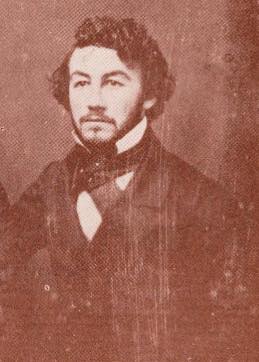
The Californian would be resurrected by Edward Kemble and combined with the California Star (which he bought from Sam Brannan), to become the Weekly Alta California. Kemble was only twenty years old, but he was already an experienced newspaperman, having grown up in the business under his father, an editor in Troy, New York. At the age of 18 he had come with Sam Brannan (and a printing press) on the ship Brooklyn to California with a ship-load of Mormon emigrant refugees.

77025202_10157824382962769_3591054407095025664_n

Edward C. Kemble, A History of California Newspapers, 1846-1858.

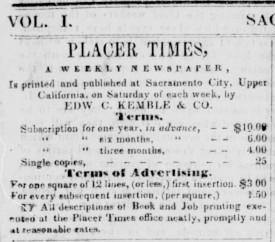
Since he now had two printing presses, Kemble took one of them and went to Sacramento to start another newspaper, the Placer Times. The first issue appeared on April 28, 1849.

PT18490428.1.1-52-484-1101-969-275w

November 11th is not only the last date for the Californian, it was also Kemble’s birthday in 1828. So “Happy Birthday” to Edward Kemble. Anyone researching California Gold Rush history owes a great debt to Kemble and his newspapers.


Posted in Edward Kemble, Uncategorized | Leave a comment

Chivalry vs. Tammany

   Gwin and Broderick

Political power in California was in the hands the Democratic Party during the 1850s. Or at least, that’s the way it started out. The opposing party, the Whigs, were fading nationally, and in California, where the majority of men were engaged in mining and other working class jobs, the Democrats ruled.

And yet, the Democratic Party had a fatal flaw, a crack that ran through the heart of its solid hold on power. Slavery divided the party in California, just as it did the Northern and Southern states. In California, the party divided into two factions, popularly known as the Chivalry and the Tammany (or Free Soil) wings.

SDU18570910.1.2-1108-156-973-981-486w

Sacramento Daily Union 10 September 1857

The Chivalry was the party of southerners, slaveholders, and anyone else who was pro-slavery.  It also included men who were not from the South or pro-slavery, but opposed the Tammany tactics of David C. Broderick, the boss of San Francisco. William M. Gwin, U.S. Senator, was the leader of the Chivalry.

(Were their slaves in California? Yes, there were. Although forbidden by the California Constitution, some southerners brought slaves with them during the Gold Rush, and it would take time and effort to eradicate slavery from the state.)

The “Chivs,” also called “Rose-water Democrats,” had a great deal of power in the party, but they were hated by those adamantly opposed to seeing slavery imported into California, or the state divided into a slave-holding half, and a free half.

SDU18570910.1.2-1130-5560-955-615-477w

Sacramento Daily Union 10 September 1857

David C. Broderick led the Tammany wing. Its other nickname, the “Hard-Fisted Democrats,” gives you an idea of what kind of men they were. Broderick had been schooled in politics under Boss Tweed in New York City. He ruled in San Francisco, and had in his hand numerous lucrative patronage jobs. He wasn’t going to let a bunch of “Rose-water Democrats” call the shots.

Since Broderick’s group also allied themselves with the short-lived Free Soil Party, they were often referred to as Free Soilers. The Free Soil Party in the East was comprised of former Northern Democrats and Whigs, who sought to ban slavery in all the newly-acquired territory in the West. As Free Soilers, David Broderick and his crew were not so much interested in the rights of slaves and African-Americans as they were in free soil for white men.

So it gets complicated. The nicknames (and worse) flew about like chicken feathers — “Bone-and-Sinew Democrats,” “Piano Democrats,” “Bogus Democrats,” “LeCompton” and “Anti-LeCompton Democrats,” The Democratic Party was not united, and that would spell trouble for the party when upstart rivals came on the scene, as we will soon see.


Posted in David C. Broderick, William M. Gwin | Leave a comment