“Dear Charlie”

md1260381293Meet Horace Snow, young Yankee in California, seeking gold and enjoying an existence far different from life in old New England.
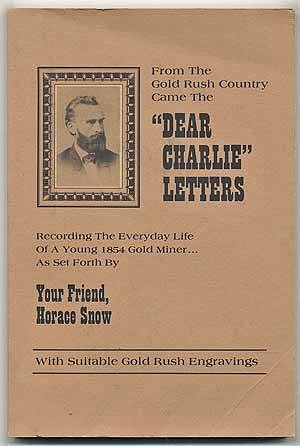
The Forty-Niners and the other gold seekers of the 1850s were for the most part literate men, and so there is no shortage of journals and collections of letters written by them, telling of their experiences in the goldfields. But seldom do I come across a book as lively and entertaining as the “Dear Charlie” Letters: Recording the Everyday Life of a Young 1854 Gold Miner . . . As Set Forth by Your Friend, Horace Snow. This book is a publication of the Mariposa County Historical Society and is available from Amazon.com and probably at the Mariposa Museum.

Horace Snow (and what a classic New England name that is) was born in New Hampshire in 1831. He studied to be a schoolteacher at the Massachusetts Normal School, but in 1853, at the age of 22, he set out for California to find his brother Hiram, whom he had not seen for three years, and maybe some gold too. He wrote numerous letters to his friends back home, but his most faithful correspondent, a “true chum,” was his friend Charlie Fitz.

What I like about his letters is his descriptions of life in the goldfields. Here he is, cheerfully telling about their log cabin:

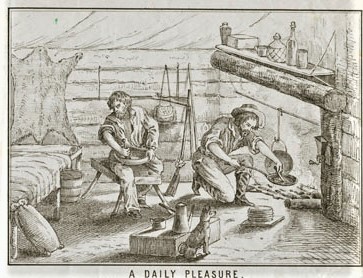
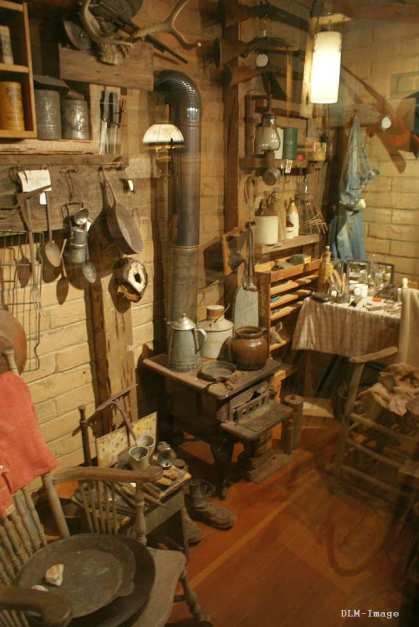
I am living in an old fashioned log cabin about twelve by fifteen feet. It is very secure against any enemy, being built up of large logs and well mossed. We have only one door and one window to our rustic mansion, choosing darkness rather than light, you see. The internal arrangements are very tasty, myself having control. Our cabin is divided into two parts, inside and out. The inside being all in one room and also the out.

Now, in America, you use wood for floors, which decays and has to be repaired, but we have a slab from Mother Earth, durable and always in its place. Somehow or other our patent stove happens to be a huge fire place. How pleasant it seems to build up a right smart fire and get up in front of it and talk over old times.

Our window is a small trap door which we use as a cat hole. Instead of reposing on soft down, we rest our weary limbs on a piece of canvas attached to two poles. Everything in our cabin is just as handy as can be. Each one has his own space and a place to put his own things.

Our domestic family consists of four hens, one dog, and a cat. The dog keeps thieves away at night, the cat takes care of the rats and mice and the hens furnish us with eggs; therefore, you see, we have something for them all to do. Eggs usually are three dollars per dozen, though now only one and a half. Taking all things into consideration, we are getting to be quite independent. Own a house, barn, some stock, plenty of land, and all the wild animals we can catch.

Eggs, by the way, back in the States, would cost more like a nickel apiece. Prices were high in the mines.

MinersCabin-1

Here is the Mariposa Museum’s replica of a miner’s cabin. Crowded but cozy, as you can see.

Posted in Horace Snow | Leave a comment

Come hombres all! A Madrigal!

ST18501203.1.3-1764-930-872-2081-218w

Sacramento Transcript, 3 Dec. 1850

As usual, I was looking for one thing in the old newspapers, and came up with another.

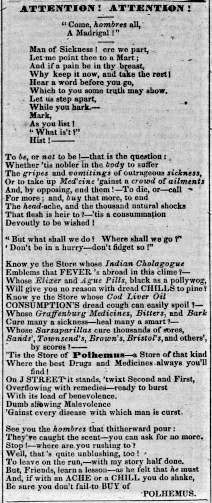
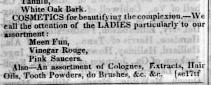
Most businesses advertised their wares by simply listing them, but not J. L. Polhemus. He had a lively and creative mind, and put his ad into verse.

Dr. John L. Polhemus, (the “doctor” is doubtful) owned the foremost pharmacy in Sacramento, located on  J  Street, between 1st and 2nd. Later he would move to J and 7th.

He was born in New Jersey in 1825 and died of consumption in 1866 at the age of 41. He is buried in the Sacramento City Cemetery.

J. L. Polhemus offered all kinds of potions and pills, most of which are long forgotten. Indian Cholagogue, anyone? (According to the dictionary, a cholagogue is an agent that promotes the flow of bile into the intestine. I’m not sure what that would accomplish.)

Bu Sarsaparilla is still with us. Similar to root beer, it began as a health remedy but stayed on as a soft drink.


With apologies to Shakespeare:

To be, or not to be ! — that is the question : Whether ’tis nobler in the body to suffer
The gripes and vomitings of outrageous sickness,
Or to take up Med’cine ‘gainst a crowd of ailments
And by opposing, end them ! — To die, or — call
For more ; and, buy that more, to end
The head-ache, and the thousand natural shocks
That flesh is heir to? — ’tis a consummation Devoutly to be wished!

ST18501022.1.1-52-3510-881-2633-220w2

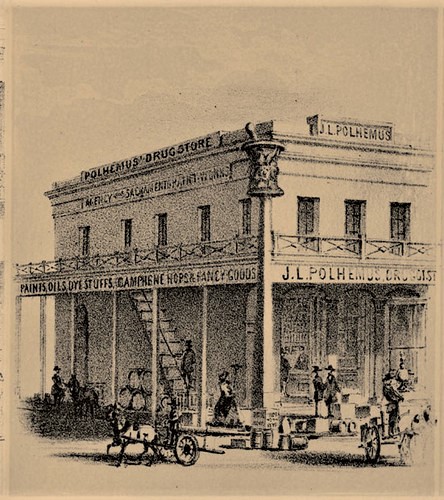
He also carried cosmetics “for beautifying the complexion,” although I have no idea what “Meen Fun,” (was that Chinese?), “Vinegar Rouge”, or “Pink Saucers” were. But I am sure that ladies shopping at Polhemus’ Drug Store would find everything they needed to make themselves alluring.

polhemus

Polhemus’ Drug Store, corner of j and 7th, 1857, courtesy of Calisphere

Posted in Uncategorized | Leave a comment

Nancy’s Bookshelf

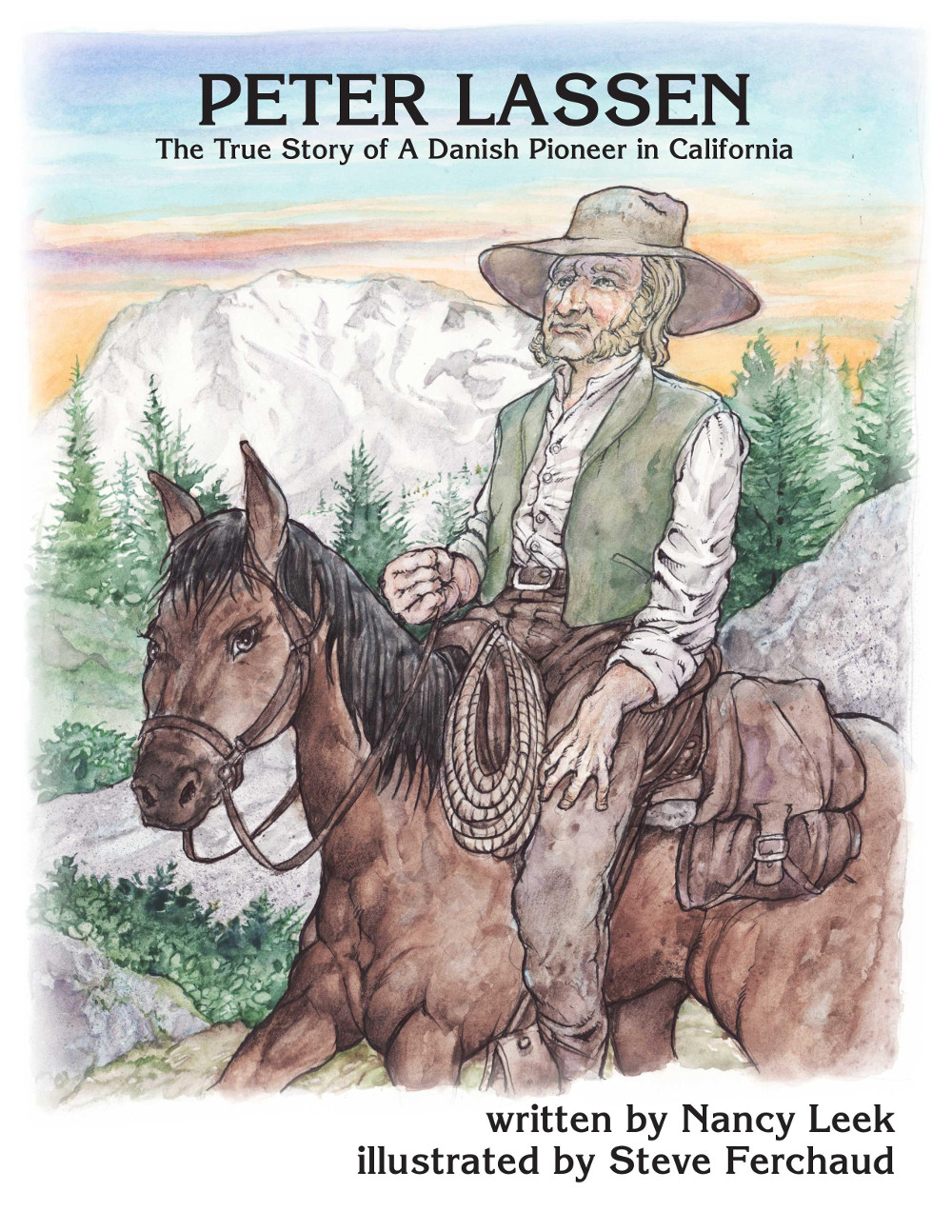
PLcoverNot my own bookshelf, but the local radio program where Nancy Wiegman interviews authors about their books.
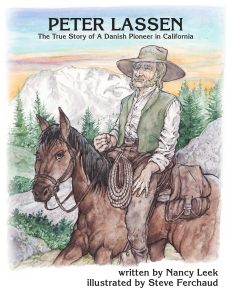
If you would like to hear these two Nancys talk about my new book on Peter Lassen, you can listen to the podcast on mynspr.org. As an added bonus, Nancy W. filled out the hour with the interview we did back in 2011 when my John Bidwell biography came out. The entire program is all about Peter Lassen and John Bidwell.

You can catch Nancy’s Bookshelf every Wednesday morning at 10 a.m. on North State Public Radio (KCHO) 91.7 FM. But if you miss it, not to worry, you can listen by going to the podcast page.

Thanks, Nancy!


Posted in Uncategorized | Leave a comment

“Placer Mining”

IMG_20190514_143435254-2

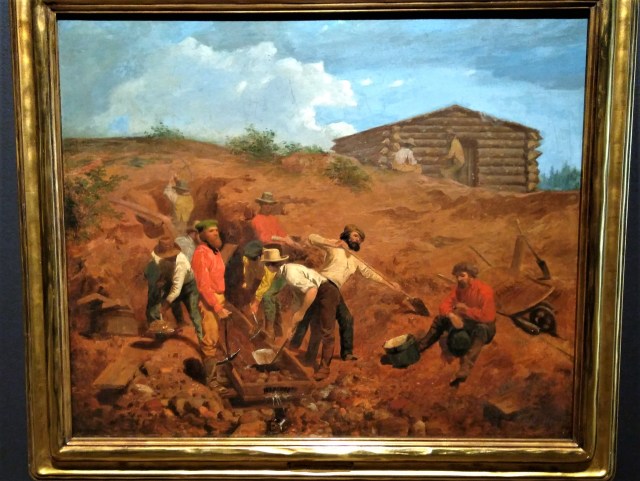
Just putting this here because I like the painting — “Placer Mining” by William F. Chadwick, 1854. It hangs in the Crocker Art Museum in Sacramento.

Not much is known about the artist. He was born in Maine in 1828 and came to California during the Gold Rush in 1849. He must have had some training in art as a young man. By 1860 he had returned to Maine and was a merchant in Portland. He appears to have died in the 1860s.

The miners in the painting are using a Long Tom, a type of sluice box. A man with a pick axe is at the head, carving out the hillside. Others shovel dirt into the box. A flume bearing running water comes in from the left and pours into the box to wash the dirt. The object is to catch the heavy gold in riffles on the base of the box. In this case the riffles look like they are rocks at the near end.

Chadwick has depicted a diverse cast of prospectors — each one is wearing a different style of hat, for instance.  You can’t help but think it is a scene drawn from his own experience in the goldfields.

Posted in Uncategorized | Leave a comment

In Old Sacramento

DSCF7163

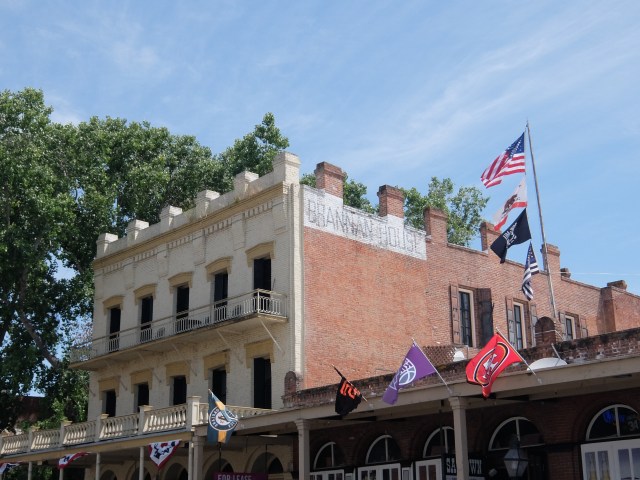
Brannan House

Old Town Sacramento is a fun place to visit, even if it is full of junky tourist trap shops. Jim and I went there today to take the Sacramento History Museum‘s Underground Tour.

DSCF7161 (2)

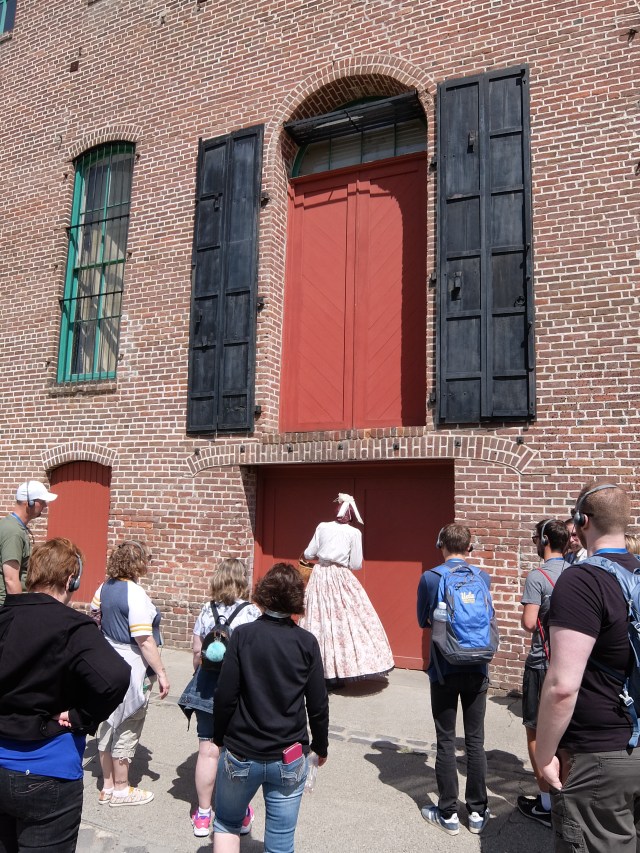
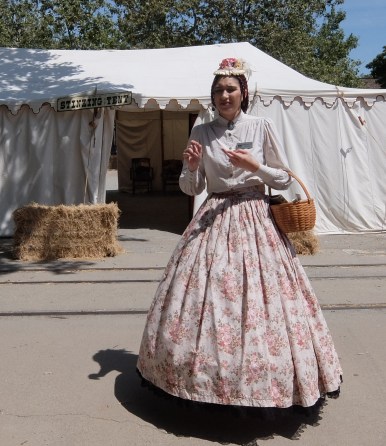
Eugenie outside the Stinking Tent saloon

Our guide on the tour was “Eugenie Dumas Hunt,” a real person portrayed by a young woman who did an excellent job of impersonating a young French lady of the mid-19th century. (Even if her charming French accent did have a tendency to come and go.)

Very little is known (as far as I can tell) about the real Eugenie, except that she ran the Hotel de France and Restaurant, made a pile of money doing it, married William Hunt, had three children, and is buried in the old Sacramento Cemetery.

About two-thirds of the tour is above ground, looking at the river and the old buildings, while the guide explains the sequence of buildings built of sticks and canvas, then wood, and then brick. Next it’s into the basement of two buildings (no photography allowed underground) to see how the buildings were jacked up and new foundations put underneath.

DSCF7164

Unlocking the underground entry

The entire downtown was raised 9 feet. The process took 13 years.

It was a costly business, and if you didn’t want to pay to have your building raised to street level, then you could take the other option: allow your three-story building to become a one story structure. That explains the difference you may see between buildings on the street.

Raising the streets and buildings was only one part of a three-pronged effort to prevent future flooding. The other two solutions were build higher levees and divert the American River. I knew about raising the city and building levees, but I didn’t know that they had also moved the confluence of the Sacramento and American Rivers a mile upstream. I’d show you a map if I could find one.

Some archeological digging has been done under the buildings, and on display inside the underground rooms are some of the artifacts found: combs, bottles, chinaware, various implements, and a set of  weighted  “cheater’s dice.”

It was a fun tour and I recommend it to anyone interested in the history of old Sacramento. And if you are wondering why they built a city on a spot so prone to flooding year after year, blame Sam Brannan. But that is a tale for another time.

Posted in Uncategorized | Leave a comment

Thomes and Toomes — part 2

thomes2Let’s find out about Robert Hasty Thomes. He was born in Cumberland County, Maine in 1817, a direct descendant of Mayflower pilgrims. He started his westward journey as a young man and in 1839 he joined the Bidwell-Bartleson Party in Missouri. John Bidwell later said:

When May came, I was the only man that was ready to go of all who signed the pledge [of the Western Emigration Society]. In Weston, however, there was a man who had said from the beginning that he would go to California when May came. This was Robert H. Thomes, a wagon maker at that time. (John Bidwell, Dictation to S.S. Boynton, 1877)

Robert Thomes left only a brief account of his journey, dictated to his old friend and partner, Albert G. Toomes in 1868, who sent it to the San Francisco Evening Bulletin.

I sat down with my old partner, THOMES, a few days ago and got to talking of old times in California, and all that sort of thing. It occurred to us to make a list of our early companions in the hard journey we made from Independence a long 27 years ago, and our hairs are getting gray, and we often remember those blessed old bailies and merianders of gay Monterey. I claim that we were the 1st regular emigrants who ever started from the States to California, and those who arrived in the country before us dropped in by mere chance, as old trappers, whalemen and sailors from the Island and Boston ships.

Albert Toomes (of which more later) also came to California in 1841 by the southern route, in the Workman-Rowland Party. The two men met up in San Francisco and worked as carpenter and builders there. In 1843 Thomes and Toomes moved to Monterey and went into partnership as builders. They are frequently mentioned in the papers of Thomas O. Larkin, the American consul in Monterey.

They built a house in Monterey for Don Manuel Jimeno Casarin, secretary of state (and sometimes acting governor) of Alta California under Governor Micheltorena. This was a job that paid off handsomely for the two men, As Toomes relates.

You know when THOMES and self got the ranchos up here from MICHELTORENO and JIMENA the place was out of the world, and league farms to be had for the asking; but it is quite different now. The Indians, once so numerous, are nearly all gone, and the rail cars will soon rush by our doors, and land is worth $20 per acre. That house we built in Monterey for Governor JIMENA in 1845, was one of the best jobs we ever did in our lives; for the old gentleman not only paid us well, but got us our farms without any of the trouble others had.

68098647_135371383173Thomes’s ranch was Rancho Saucos, where the town of Tehama is now located. As far as I know, he never married. He died March 26, 1878, and is buried in the Tehama Cemetery.

Posted in Robert Thomes, Uncategorized | Leave a comment

The Partnership of Thomes and Toomes

Melinda said their story would make a good buddy movie. Maybe they were too similar to give their story the contrast it needs, but pioneers Robert H. Thomes and Albert G. Toomes certainly were life-long friends.

tehama museum1Yesterday I went to the Tehama County Museum to hear Melinda Rist give a talk on the Mexican land grants of Tehama County. Melinda is an archivist working at the Butte County Hall of Records.

If you have never visited the Tehama County Museum, stop by some Saturday afternoon and check it out. It’s a great little history museum in the town of Tehama, just over the river from Los Molinos (on Highway 99).

The museum is housed in the Masonic Lodge built in 1856, which also served at one time as a schoolhouse.

Thomes and Toomes came to Tehama County looking for a place to settle in 1844, along with some other men from Monterey (Job Dye, William Chard) and guided by John Bidwell and Peter Lassen. They found the land they wanted on either side of the Sacramento River: Robert Thomes got Rancho Saucos on the west side of the Sacramento River, and Albert Toomes took Rancho de los Molinos on the east side, just above Lassen’s Ranch.

tehama land grants

Melinda’s map of the Mexican land grants in Tehama County.

The thing I have always wondered about is: How are their names pronounced? Toomes is not too hard — it’s pronounced like Tombs. Thomes? Is it pronounced Thomas, Tomes, or Toms? Melinda said “Tomes,” (long O) but I came across an old newspaper article referring to “Tom’s Creek” which is Thomes Creek, the creek that runs through his ranch.

So how did Robert H. Thomes pronounce his own name? Inquiring minds want to know!

More about Messrs. Thomes and Toomes next time.

Posted in Uncategorized | 1 Comment

California Bound!

covered-wagons-1On May 19, 1841, the Bidwell-Bartleson Party started for California. John Bidwell, as secretary of the group, kept a journal. Later, while at Bodega Bay, he tidied up his journal entries and sent them back to a friend in Missouri, who had them printed as a guidebook. This is the source of most of what we know about this first group of emigrants to head for California.

Wednesday, 19th. This morning the wagons started off in single file; first the 4 carts and 1 small wagon of the missionaries, next 8 wagons drawn by mules and horses, and lastly, 5 wagons drawn by 17 yoke of oxen. It was the calculation of the company to move on slowly till the wagon of Chiles overtook us.

Our course was west, leaving the Kanzas no great distance to our left, we traveled in the valley of the river which was prairie excepting near the margin of the stream. The day was very warm and we stopped about noon, having traveled about 12 miles. (Bidwell-Bartleson Party, ed. by Doyce B. Nunis, p. 28-29)

The wagon train was very lucky to have joined up with the missionary party. Without the guidance of the trail guide — Thomas Fitzpatrick — hired by the missionaries, they probably would have gotten hopelessly and fatally lost.

The missionaries were led by Father Pierre Jean De Smet, a Belgian Jesuit who spent many years working among the American Indians. In 1841 he was on his way, with two other priests and three lay brothers, to minister to the Flathead Indians. He established St. Mary’s Mission on the Bitterroot River near Missoula, Montana. Bidwell described him as follows:

He was genial, of fine presence, and one of the saintliest men I have ever known, and I cannot wonder that the Indians were made to believe him divinely protected. He was a man of great kindness and great affability under all circumstances; nothing seemed to disturb his temper.(Echoes of the Past, p. 114)

More information on Father De Smet can be found in this article from Historic St. Mary’s Mission and Museum.

Posted in Uncategorized | Leave a comment

The Ballad of John Bidwell

I have been looking through a Butte County history curriculum binder developed by the Butte County Office of Education for 3rd grade teachers, and I came across a catchy little item. It’s “The Ballad of John Bidwell”, written by the 3rd and 4th grade students of Canyon View School (which was in Magalia). I will append a few footnotes, but other than that, without further ado, here it is: (Use whatever tune you like to sing along.)

John Bidwell lived on an eastern farm
And dreamed of open spaces.
Injun Joe*, a trapper came
To tell of far-off places.

He stayed at home until eighteen
And then he started west.
He found out in St. Louis
That Missouri land was best.

He made his money teaching school.
One day he went to town
And while he was buying farming tools**
A claim-jumper stole his ground.

He heard of California
And decided he would go
Although the way was still unknown
And wagon wheels move slow.

In ’41 the wagons left,
Led by a famous scout.
Across the Rockies steep they went***
With hearts both bold and stout.

The scout then had to leave them
With their wagons pointed west.
He said, “There is no trail at all, boys,
You’ll have to do your best.”

They reached the Great Salt Basin
And had to circle south.
There was no buffalo for food
And all around was drought.†

They left their wagons far behind —
The way was much too steep —
The trail they made too narrow,
And the canyons far too deep.

Bartelson, their captain,
Was a double-crossing man.
He stole the meat, and rode away,
Shouting, “Get there if you can.”

They crossed the High Sierras
And didn’t even know.!
How surprised they were to see
The valley far below.

Then down they walked to Dr. Marsh
From out of the mountains wild —
A thirty†† hungry, happy men;
One woman and a child.

John went on to Sutter’s Fort,
His journey at an end.
He worked for Sutter several years
And was his closest friend.

He didn’t have the fever
Of those who came to seek
For fortune. He only wanted gold
For a ranch on Chico Creek.

The American River was rich with soil
But Bidwell said, “I’d rather
Try my luck on another stream,
I’ll travel up the Feather.”

With friends he went up towards the hills.
He hadn’t traveled far
Until he panned out gold before
At a place now Bidwell Bar.

He bought 22,000 acres
With gold that he had panned.‡
He knew the country’s future
Was in its fertile land.

He went to Washington, D.C.
To help build up the state.
He brought back plants and trees, and planned
To make the Valley great.

He married pretty Annie
Who was a faithful wife.
She loved the Chico Indians
And helped them all her life.

And now, if you have read this far, here are a few notes.
*Injun Joe. It’s unfortunate that this occurs in the very first stanza, since it is not only objectionable, but inaccurate. Bidwell heard about California from a French-Canadian trapper, Antoine Robidoux, who had a more famous brother, Joseph, but they did not (as far as I can ascertain) have any Native blood, although many trappers did.

** and books!

*** The scout was Thomas Fitzpatrick, who knew the trail well enough to guide them to the South Pass, where the Rockies are not steep.

drought. A note in the original says “they didn’t know this word.” I’m guessing that the teacher helped them find a word that (sort of) rhymed with “south.”

†† thirty-two, actually.

‡ with considerable help from the Mechoopda Indians whom he hired!

I’m glad Annie made it into the last stanza. I am impressed with how much these students knew about John Bidwell.

I am not sure when the binder materials were created — sometime before 1993, which is the date on an order form in the binder. I wonder if anyone uses this anymore?


Posted in Uncategorized | 2 Comments

A Parade for a Pioneer


bicentennielWe all enjoyed the Chico Pioneer Day Parade today. Grand Marshal was Butte County Sheriff Kory Honea, beloved by all for his heroic leadership during the Camp Fire. Honorary Grand Marshals were John and Annie Bidwell, in recognition of the bicentennial of John Bidwell’s birth in 1819.

DSCF3868 (2)

DSCF3830 (2)

John and Annie: The Long and the Short of It

John and Annie were portrayed by Nick Anderson and Robyn Engel, who fit the roles to a T, since Nick is over 6 feet tall, like Bidwell, and Robyn is only 4 feet 8 inches tall (or should that be “short”?), just like Annie.

They rode in a lovely 1915 Motel T Ford, owned and driven by Dudley Stone. Walking along, carrying the banner and representing the Bidwell Mansion Association were Quinn, Ian, and Bodie (sorry, guys, I didn’t get your last names) and Adrienne Glatz, BMA board president, and myself, Nancy Leek.

It looked to me like the men were 49ers dressed up in their best duds and come to town to spend some of that gold dust.

dscf3857.jpg

Wells Fargo Bank was there with their replica Concord stagecoach, and it was a treat to climb in and try it out. The BMA also had a booth on the City Plaza, where we gave away casaba melon seeds and schedules of upcoming events. (If you would like some free seeds, they still have them to give away at the Bidwell Mansion SHP Visitor Center. It’s open Saturday, Sunday, and Monday.)

DSCF3892 (2)

DSCF3897 (2)


Posted in Uncategorized | Leave a comment