The Scandalous Saga continued — Disorder in the Court

Sarah Althea Hill, now Mrs. David S. Terry, along with her attorney-husband, were back on court on September 3, 1888 to hear the decision in one of the appeals. The California Supreme Court had supported the lower state court ruling that the marriage was legitimate, but the federal court had ruled just the opposite — the marriage contract was invalid. Justice Stephen J. Field would now pronounce on the appeal to the federal court’s decision.

800px-STField-SCjustice2Field was the judge who replaced Terry on the California Supreme Court in 1856. In 1863 he was appointed by President Lincoln to the newly created tenth Supreme Court seat. This seat had been added to give balance to the court by bringing in a justice from the Pacific states. (That’s a nice bit of trivia — When were there ever ten supreme court justices?)

At the time, the U.S. supreme court justices also were responsible for the federal circuit courts, and it was in this capacity that Justice Field gave his ruling that the federal judgement would stand. He ordered Mrs. Terry (Allie) to surrender the marriage contract.

Allie was outraged. She had guarded that precious contract as her only means of getting her alimony. She not only refused to give it up, she went further. She accused Justice Field of having been bought off by the “Sharon people.”

DAC18880904.1.4-1674-2925-829-763-414w

Daily Alta California, 4 September 1888

act1scene2Justice Field was not going to stand for that. He ordered the marshal to remove Mrs. Terry from the courtroom. As she continued to revile the judge, the marshal moved to take her out. Her husband, David Terry, stopped him, declaring “No living man shall touch her!’ and then struck the marshal in the face with his fist. As the marshal dragged Allie screaming out of the courtroom, Terry hastened after, drawing his Bowie knife as he went.
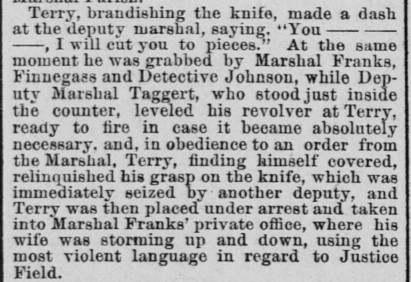
 

DAC18880904.1.4-1682-4557-823-564-411w

Daily Alta California, 4 September 1888

Terry, struggling to strike a blow with the knife, was overpowered and disarmed. A loaded revolver was found in Allie’s satchel. Screams and shouts filled the courtroom.

The members of the press were having a field day. What a way to sell papers! The headline in the Morning Press was “TERRYFIED.”

But Stephen Field was not cowed or terrified by this display of violence. After the mid-day recess he came back and sentenced David D. Terry, former Chief Justice of the California Supreme Court, to six months in jail for contempt of court, and his wife to 30 days.

While in jail, Allie continued to rail against Justice Field, and her husband, Terry, sent the judge several threatening letters. In less than a year, the tragic end of the Sharon-Hill-Terry drama would play out in a railroad depot dining room.

Next: Showdown at the Lathrop Depot


Posted in Sharon v. Hill, Uncategorized | 1 Comment

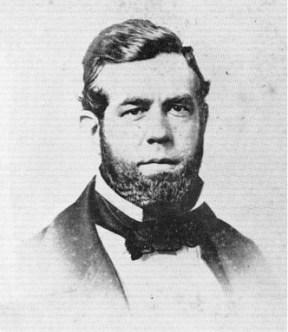
The Tempestuous Life of David S. Terry

The most famous duel in California history took place in 1859 between David S. Terry, Chief Justice of the California Supreme Court, and U.S. Senator David C. Broderick.

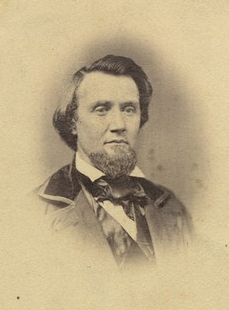
david terryDavid Smith Terry was born in Kentucky in 1823 and moved with his family to Texas as  young boy.  All his life he considered himself a southerner and supported the southern cause. He studied law in Texas and was admitted to the bar in 1845, fought in the Mexican War in 1846, and in 1849 joined the gold rush to California. Like many others, he found riches not in the diggings, but in his professional field. He rose rapidly in the ranks of law and politics and in 1855 he won a seat on the California Supreme Court, supported by the Know-Nothing Party. Other than that, Terry considered himself a Democrat.
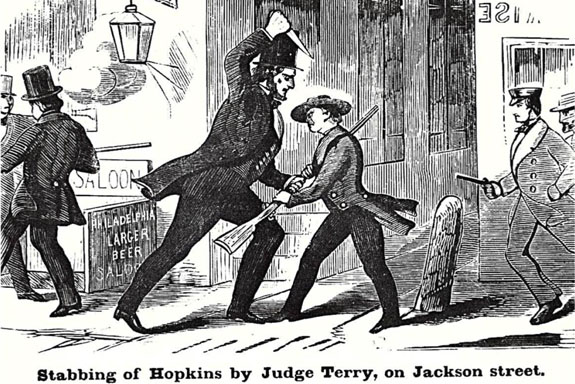
At 6 foot 3 inches, Terry was an imposing figure. He was known for his hot temper. In 1856, representing the state government, he went to San Francisco to take on the Vigilance Committee, an extra-legal band of citizens formed to fight crime and corruption. In an altercation he stabbed Sterling A. Hopkins in the neck with a Bowie knife. Terry was jailed, but released when Hopkins survived the attack.

TerryStabbingMahoney-sized

DavidBroderick-sizedIn 1859 Terry failed in his bid to be re-elected to the Supreme Court, and he blamed his loss on fellow Democrat David C. Broderick. Terry was a leader of the southern faction of the party; Broderick represented the northern abolitionist wing. The former friends fell out over their irreconcilable political views (as did the entire Democratic Party soon after).
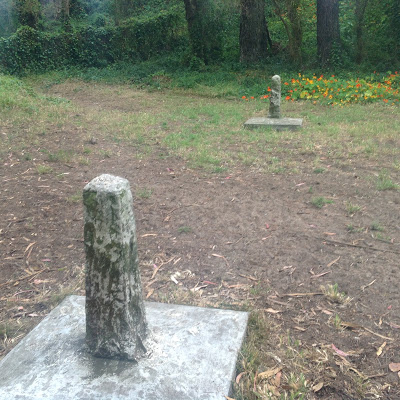
They traded insults until Terry sent a note demanding a retraction of remarks made by Broderick. His refusal to do so led to their meeting at Lake Merced (just outside San Francisco city limits in Daly City) early on the morning of September 13, 1859. Broderick fell, fatally wounded by a pistol ball. His death made him a hero and martyr in the fight against slavery, and Terry’s political career was ruined.

You can read more about the Broderick-Terry Duel in this Wikipedia article and at this National Park Service site.

AAA-9219

IMG_0761

The two pillars mark the spots where Terry and Broderick stood to fire

Just then the Civil War came along, and Terry went back to Texas and joined the Confederate Army, rising to the rank of colonel. After the war he returned to California and resumed his legal practice.

In 1884 he became part of the team of lawyers assisting Sarah Althea Hill in her bid to get her marriage to former senator William Sharon validated and then dissolved. In December of the same year Terry’s wife, Charlotte, died. In January 1886 he married his client, Allie. Together, with great determination, they continued to pursue her right to a portion of property belong to millionaire Sharon, who had died in 1885.

Public interest in the case languished for two years, although the lawyers were busy with a few side issues. Then in 1888 drama erupted once again in the courtroom.

Next: “Marshal. put that woman out!”


Posted in Sharon v. Hill, Uncategorized | 1 Comment

Blooming Bonanza

DSCF6906 (2)

The view in Upper Bidwell Park

It’s a great year for wildflowers — get out and enjoy them while they last. Today I went to Upper Bidwell Park to hike around a bit and see what’s in bloom. There are plenty of—

DSCF6902 (2)

Blue dicks

DSCF6909 (2)

Popcorn flower

DSCF6911 (2)

Bird’s eye gilia (and a little bit of goldfields)

DSCF6910 (2)

Frying-pans (a kind of California poppy)

DSCF6912 (2)

Fiddlenecks

DSCF6904 (2)

Goldfields — endless swaths of them

DSCF6913 (2)

Tidytips — mostly seen near the parking lot

DSCF6900 (2)

Something new (to me) — California Man-root (Marah fabacea)

DSCF6916 (2)

And old Monkeyface Rock watching over it all. Get out and enjoy before the summer hits us!


Posted in Uncategorized | Leave a comment

The Scandalous Saga continued — No Palimony for Allie

DAC18851227.1.2-86-183-951-677-475w

Daily Alta California, 27 December 1885

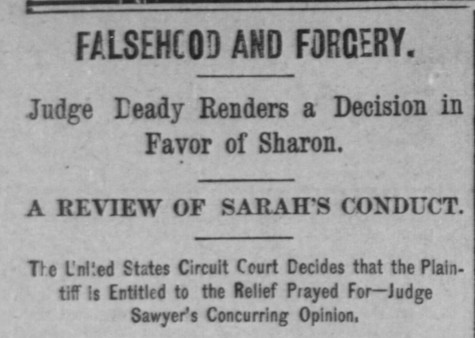
Senator Sharon’s suit against Sarah Althea Hill concluded in December 1885. The federal court had spent more than a year going over the same ground that the superior court of California had thoroughly dug up in 1884 and Judge Deady came to the opposite conclusion of Judge Sullivan. He ruled that there had never been a marriage between Sharon and Miss Hill. The marriage contract was a forgery and the “Dear Wife” letters had nothing wifely about them.

DAC18851227.1.2-1024-5153-933-323-466w

Daily Alta California, 27 December 1885

sharon---libr-congr02

William Sharon

The former senator and wealthy man about town was deprived of the satisfaction of this vindication. In November 1885, a month before the judge gave his decision, rich old William Sharon passed away. Allie now claimed to be his widow, but under the court ruling, Allie was neither wife nor widow.

The judge came down hard on Allie. He found her conduct to be “contumacious, frivolous, and contradictory” and her testimony “reckless, improbable and false.” Nellie Brackett recanted her testimony and said that she had helped to forge the documents. As far as Judge Deady was concerned, Allie was a fraudulent adventuress.

Allie shed no tears for the man she had claimed as husband. The decision was no sooner handed down than she married David S. Terry, one of her attorneys, Together they continued to fight for her right to half of Sharon’s considerable property. Appeals were filed in both courts against both rulings, for and against her. Allie could still hope that someday she would profit from the whole vexatious kerfuffle.

TerryDavidLawyer

David S. Terry

In the meantime, she was legitimately Mrs. David S. Terry, married by a Catholic priest at St. Mary’s Church in Stockton on January 7th, 1886, less than two weeks after the end of the federal case. This wedding came complete with witnesses, a public ceremony, a marriage certificate, and a ring. There would be nothing secret or contentious about this marriage. The bride was thirty-two years old; the groom was sixty-two.

David Terry was a man who, as a newspaper reporter stated, was “both feared and respected throughout the San Joaquin Valley.” He had a large ranch near Fresno, a handsome home in Stockton, and a successful career as a politician and attorney. His wife had died the previous year, and over the course of the Sharon v. Sharon trial, he had become close to his attractive, if volatile, young client.

He was famous as a former California Supreme Court Justice and a tough fighter in a courtroom. But what made him notorious was the second most famous duel in American history.

Next: A Look Back at the Terry-Broderick Duel

Posted in Sharon v. Hill | Leave a comment

The Scandalous Saga continued — in Federal Court

No sooner was the divorce trial of Sarah Althea Hill and Senator William Sharon concluded in Sarah Althea’s favor, than the federal suit brought by Sharon against Allie began. It took up most of the year 1885 and went over much the same ground.

At the same time a number of spin-off suits were being pursued. Senator Sharon, of course, appealed the divorce decision. At the same time, Allie sued him for her alimony, which he refused to pay. The attorneys in the case and a variety of witnesses were sued for a variety of causes: libel, contempt of court, fraud, and obscenity were some of the charges. The obscenity charge was brought against Allie’s attorney G. W. Tyler for calling Neilson (the man who started the whole thing) an “infernal puppy.” Such language!

DAC18850804.1.1-1926-737-953-1227-476w

Daily Alta California, 4 August 1885

All of this was wearing on the lady, and she was getting desperate, for her money and for the whole thing to be over.  During testimony by an expert being questioned about the authenticity of the marriage contract, Allie kept up a steady stream of abuse and threats against Senator Sharon and his attorneys, Barnes and Evans, loud enough to be heard throughout the courtroom. Then Evans noticed that she was fingering a revolver on the table in front of her.

DAC18850804.1.1-1956-4443-911-713-455w

Daily Alta California, 4 August 1885

(Although referred to as “Judge” Evans, he was not the sitting judge in this case, but Sharon’s attorney.)

Sarah (who I have mostly called Allie) was severely reprimanded by Federal Justice Stephen J. Field. We shall see how Field’s involvement in the case would come to endanger his life. In the meantime, a deputy marshal was assigned to “take all such measures as may be necessary to disarm the said defendant and keep her disarmed and under strict surveillance” in the court.


Posted in Sharon v. Hill | Leave a comment

Sharon v. Hill Meets The Wasp

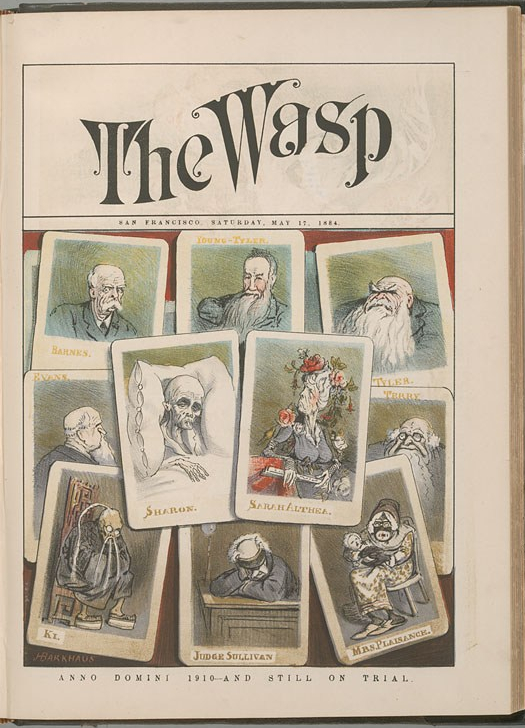
The Wasp was a satirical weekly published in San Francisco from 1876 until 1941. Its editor from 1881 to 1885 was that acerbic wit, Ambrose Bierce. Here is the cover of the magazine for May 17, 1884. At this point the divorce trial was in full swing, the case having begun on September 8, 1883 with William Sharon’s arrest for adultery. The Wasp showed the players “Anno Domini 1910” — what they would look like if the trial dragged on for another 26 years.

hb9q2nb3kd-FID3

Central in the cover are William Sharon, looking like a skeleton, and Sarah Althea, bedecked with roses. She was known for the elaborately fashionable costumes she wore in the courtroom. At upper and middle left are Sharon’s two attorneys, William Barnes and O.P. Evans. Top and middle right are G.W. Tyler and David Terry, attorneys for Sarah Althea, along with Tyler’s son, “Young Tyler,” top center.

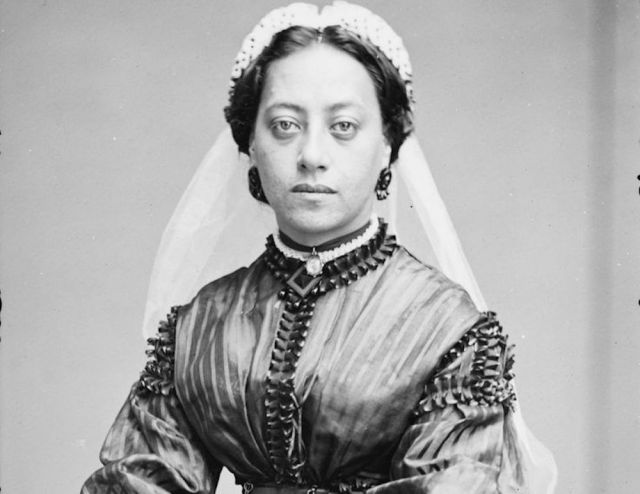
Across the bottom are Ki, Sharon’s Chinese manservant, Judge Sullivan, sound asleep, and Mrs. Mary Ellen Pleasant, here labeled Mrs. Plaisance. The newspapers invariably  referred to her as Mammy Pleasant, although she detested that nickname. She was a successful San Francisco businesswoman, and was frequently in the courtroom as a friend and supporter of Allie. She was also a handsome woman who did not look anything like this caricature. But this kind of casual racism was what you got in 19th century journalism.

pleasant2

Possibly Mary Ellen Pleasant

Posted in Uncategorized | 2 Comments

The Scandalous Saga continued — Mrs. Sharon’s Triumph

The trial came to a conclusion on September 16, 1884 and after due consideration, judgement was rendered by Judge J.F. Sullivan on December 24th. He concluded that under California law a marriage contract such as Sarah Althea Hill claimed she possessed could be valid. He accepted that both the contract and the “Dear Wife” letters were genuine, and he granted her a dissolution of the marriage between her and her husband, William Sharon.

He also believed that both plaintiff (Allie) and defendant (Sharon), as well as many of the witnesses, were guilty of perjury on the stand. Nevertheless, Allie was entitled to alimony and a division of property. Sharon swore that she would not get one cent. He would fight it to the end.

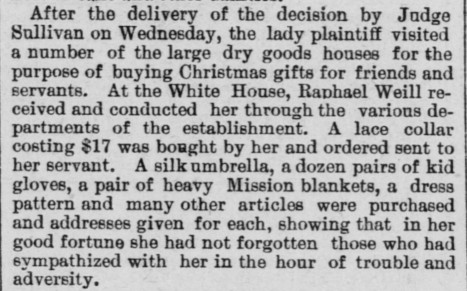
While her attorneys congratulated each other and celebrated their victory, Allie went shopping. A reporter from the Daily Alta California visited her the day after Christmas and found her relaxing “on a richly embroidered lounge,” next to a table “almost covered with glasses and champagne bottles, some empty and others yet to be opened,” evidence that she had been called upon by many well-wishers. He noted some of the purchases she made on Christmas Eve.

DAC18841226.1.1-2004-5025-935-583-467w

Daily Alta California, 26 December 1884

She certainly enjoyed her Christmas. But her ordeal was far from over, and she would never see the money she had worked and schemed so hard for. Senator Sharon appealed the decision and delayed payment with all his considerable craftiness. And then, lurking in the background, was the counter-suit that he had filed in federal court.  Allie would soon find herself once again in the courtroom.

Posted in Sharon v. Hill, Uncategorized | 2 Comments

The Scandalous Saga continued — Sharon Takes the Stand

Ex-Senator of Nevada William Sharon finally took the stand to tell his story late in May of 1884. Sarah Althea Hill, he said, had first come to his office in August, 1880, ostensibly seeking investment advice. He told her that he did not give such advice, but they chatted amiably for about a half an hour. He denied ever dictating or seeing a marriage contract and he also repudiated the “Dear Wife” letters. He said he may have written some of these, but the word “wife” was a forgery.


He gave his version of how their relationship developed.

DAC18840527.1.1-1072-3237-929-1013-464w

Daily Alta California, 27 May 1884

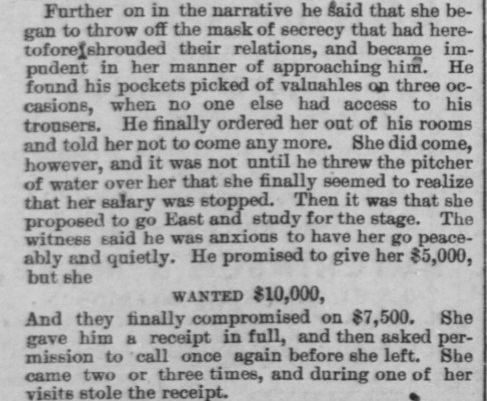
William Sharon had no hesitation in presenting himself as both a hard-headed businessman and a cold-hearted lover. As far as he was concerned, the liaison was a strictly financial transaction. He was completely cynical about the business. When asked why he thought she would respond to his offer he said:

DAC18840528.1.1-1074-6291-949-167-474w

Daily Alta California, 28 May 1884

Eventually he tired of Allie’s requests for additional money and her emotional antics. She was interfering with business and taking liberties. So he had no qualms about discarding her and moving on. But she was not so easily gotten rid of.

One time she climbed over a transom to get into his rooms and fell in a heap on the floor. He told her, “I wish you had broken your d — d neck.” Another time she hid in a closet, giving his Chinese manservant Ki a fright. He finally had to pay her off with money to finance a trip East to study acting.

DAC18840528.1.1-94-6035-975-1241-487w

Daily Alta California, 28 May 1884

At the end of his testimony, Sharon had to admit that he was “habitually free with women” and that he had had other mistresses, but Allie was the only one he had introduced to some of his friends and family, or invited to his mansion at Belmont, or had allowed to live in his hotel.  With that the case rested until July, when the judge would give his ruling.

Posted in Sharon v. Hill | Leave a comment

The Scandalous Saga continued –Pistols in the Courtroom

DAC18840410.1.1-50-747-985-593-492w

The San Francisco of the 1880s was still the Wild West and both men and women often went armed, even into Court.

Mrs. Mary Shawhan was summoned to testify about her relationship with Sarah Althea Hill. She was described as a “well-preserved, pleasant-faced, pleasant-voiced matron of about 45 years of age”, with a wealth of blonde hair, and inclined to “embonpoint,” (in other words, she had an ample bosom.)

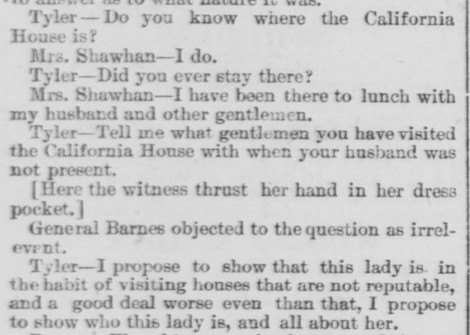
Mrs. Shawhan knew Allie as “Miss Hill”, not “Mrs. Sharon.” She related conversations in which Miss Hill spoke of being engaged to the senator, and said that Allie wanted to sue the senator for breach of promise (not divorce).. This exchange went along in a friendly enough manner, until Mr. Tyler, the lead attorney for Allie, began asking questions of Mrs. Shawhan that implied she was less than respectable.

DAC18840410.1.1-100-3279-941-671-470w

Daily Alta California, 10 April 1884

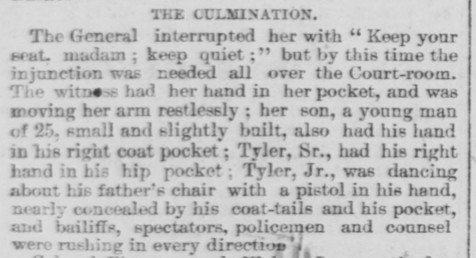
Mrs. Shawhan began fingering a pistol in her pocket. Her son, a young man named McCune (“Mac”) Shawhan, moved from his seat at the back of the court with his hand in his pocket. Attorney Tyler thrust his hand in his own pocket, announcing he could take care of himself.

DAC18840410.1.1-96-5043-943-1020-471w

Daily Alta California, 10 April 1884

By this time the court was in an uproar, with at least four pistols either being waved about or grasped in readiness. Tyler’s son, also an attorney on Allie’s team, drew his pistol and rose to defend his father.

DAC18840410.1.1-98-6406-953-517-476w

Daily Alta California, 10 April 1884

The morning session ended with the lawyers from the opposing sides trading boasts and insults. After consultation with his fellow judges, Judge Sullivan came back in the afternoon with the order that no one with arms upon their person would be admitted to the courtroom during this trial.

elisha-cook-jr-670x405Young “Mac” Shawhan, “small and slightly built” sounds like he should be played by Elisha Cook, Jr., the young “gunsel” in The Maltese Falcon.
 

Posted in Uncategorized | Leave a comment

Dr. Poynter, One More Time

Readers of this blog might recall that last year I did a series on the first novel written and published in California: Entewa, the Mountain Bird, by J.R. Poynter M.D., published in Marysville in 1852.

I have one more little item about Dr. Poynter. Among the letters in the John Bidwell Collection at the California State Library is a letter from Poynter, written in September 1852.

Did they know each other? Did they discuss business or politics? Did Dr. Poynter offer John Bidwell a copy of his new novel?

Alas, no. It is a decidedly prosaic letter, concerning the loss of a mule. But that was an important matter, so here is the letter.

Sacramento River   Sept. 16th 1852

Major Bidwell

Dear Sir

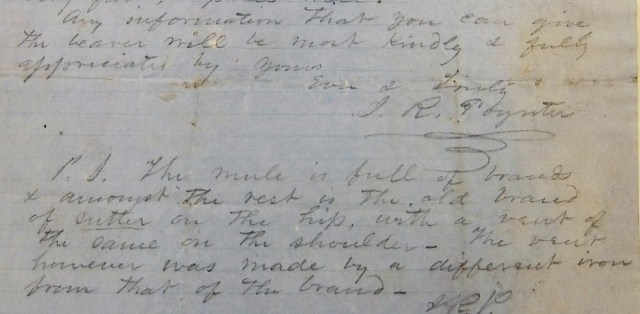
The bearer of this, Mr. Shelley, is in search of a mule which was either taken or strayed from my encampment between the 5th and the 10th of last month. Should you know of any such animal amongst your stock I would be very much obliged to you to inform the bearer, that he may examine & see whether or not it is mine. The mule is a long-bodied mare mule, was shod before when she left here, is a sort of dark brown color with gray hairs dimly [?] intermixed and very much saddle marked. She is a mule that Nye brought from the states when he first came to California. She is a very long-backed mule, with hind legs rather more crooked than usual, walks very fast, & paces well.

Any information that you can give the bearer will be most kindly & fully appreciated by yours

Ever & truly

J. R. Poynter

P.S. The mule is full of brands and amongst the rest is the old brand of Sutter on the hip, with a vent of the same on the shoulder. The vent however was made by a different iron from that of the brand.  J.R.P.

DSCF6774 (2)

This letter shows you how important a good working animal was to men of the 1850s. What’s more, that mule would have been familiar to John Bidwell, even if she didn’t show up mixed in with his own animals. Michael Nye came to California along with Bidwell in 1841 and she must have been one tough mule to survive that trip and still be considered a valuable animal eleven years later.

Posted in Entewa, J. R. Poynter | Leave a comment