Bidwell the Democrat

John Bidwell told his biographer Rockwell Hunt that during his early years in California he was an “incorrigible Democrat.” As a young man from Missouri, he naturally allied himself with the party of Andrew Jackson.  The Democrats were the party for the small farmer and the working man. Their opposition in the first half of the 19th century were the Whigs, the party of entrepreneurs and large land owners.

Later in his life he would become disaffected by the Democrats and change his allegiance, but during the 1850s he voted Democrat and helped to organize the Democratic Party  in California. In 1860 he was a delegate to the Democratic National Convention, where he supported Stephen Douglas for president, against the rest of the delegates, who were Southern sympathizers and supported Breckinridge.

The Democrats dominated California politics during the 1850’s. In the first statewide election on November 13, 1849 (although in reality California was not yet a state) John Bidwell was elected to the state senate, representing the Sacramento district. In December he went to San Jose and together with the rest of the new legislature began the process of building a state government.
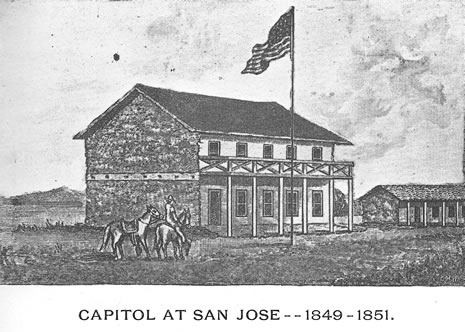
san-jose-state-cap1850-5a

He later wrote:

We had to frame a code of laws, and our constitution was almost a literal copy of the constitution of New York. A few members who had been able to get copies of the statues of N.Y. introduced nearly all the bills, and they were almost literal transcriptions of the N.Y. laws.  . . . I was head of the committee on corporations, also on the committee of county boundaries. I was chosen for this because I had more knowledge of the counties than perhaps any one else there.

I wrote the first charter of the City of San Francisco, for which the newspapers gave me great credit, but I didn’t deserve the credit, because I had copied it almost entirely from the charter of St. Louis. There was nothing very remarkable in getting up the code of laws.

And so began Bidwell’s political career in California. There was one earlier event – in August 1849 he was elected to the state constitutional convention.  But he never got the word of his election until it was too late. He hadn’t campaigned for the position, and in the summertime he was up in the hills, mining for gold. By the time he found out that he had been selected by voters to help write the constitution, it was too late to go to Monterey and take part.

Posted in politics | 1 Comment

Politics and John Bidwell

It’s an election year again and the day to cast your vote for president (and other offices) is just around the corner. The two major parties have put forth their candidates and many people are not happy with the choices before them.

Let’s forget about those two for a moment and take a look at another presidential candidate — Chico’s own John Bidwell. What were his political views? Which party did he support?

sc17270
John Bidwell
photograph

Most people in Chico know that John Bidwell was the Prohibitionist candidate for U.S. president in 1892. (It’s no surprise that he lost to Grover Cleveland.)  But Bidwell was active in politics long before the Prohibition Party came along. What was John Bidwell before he was a Prohibitionist?

Democrat?  Republican?  Some obscure special interest third party?  How about all three?

Yes, indeed.  Good old steady John Bidwell was all of those, and he tried to become governor of California on each one of those political tickets. Who knew?

John Bidwell was not the type to lightly change his allegiance, but as politics in California and in the United States changed over the course of the 19th century, he changed too.  From “incorrigible” Democrat (as he described himself), to staunch Republican, to Anti-Monopolist, to Prohibitionist (with a nudge from Annie), Bidwell served his state and pursued his ambitions. In subsequent entries during this election year I’ll explore Bidwell’s political career and we’ll see what kind of politician he was.

Posted in politics, Prohibition Party | Leave a comment

On the Trail — September 25, 1841

Saturday, 25th. The creek became perfectly dry and its banks rose to high perpendicular precipices, so that there was no other road than the dry bed of the stream. Having come about 15 miles, we encamped in a place affording a little grass and water, where we could see nothing but the sky. But the men who ascended the precipice to see what was in the prospect ahead said that in about a mile we would come to a valley–this was delightful news.

Traversing the stony dry creek bed made the animals “tender-footed and sore,” a new worry to add to their many others. But the report of the scouts who climbed up the the top of the cliff gave them heart.  There was a valley and a river ahead, and it might be Mary’s River.

They continued on, day after day, through difficult country, still not sure that they were on Mary’s River. They averaged 15-20 miles a day — good progress — but in doubt every step of the way. By September 30th they had spent more than a week on this stream (probably the South Fork of the Humboldt River) that led northward, and they had been told that Mary’s River ran west southwest. Just imagine their anxiety!

Posted in Uncategorized | Leave a comment

On the Trail — September 23-24, 1841

Thursday, 23d. We could see no termination of the valley, nore any signs of Mary’s river. We therefore concluded that we were too far south, and passed over the mouintains to the north, where we struck a small stream running toward the NW. On this we encamped and found plenty of grass, a few fish were caught, some of which were trout, which led us to the conclusion that this was a branch of Mary’s river.

Friday, 24th. As we descended the stream it rapidly increased in size, and proved to be the branch of a larger stream. The country was desolate and barren, excepting immediately on the streams, where grew a few willows and cottonwoods.

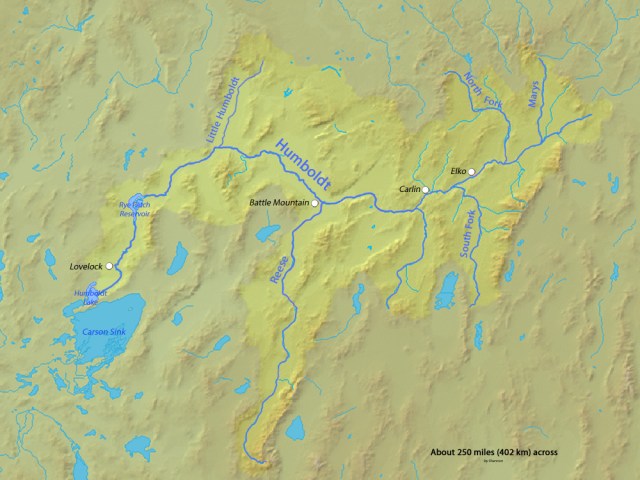
humboldtrivermap

They were still searching for Mary’s River (the Humboldt), the river that would be their lifeline across the desert.  The prospect was gloomy; this canyon was leading them directly north, not west or south. The advice they had gotten from Fort Hall warned:

“You must not go too far north; if you do you will get into difficult canyons that lead towards the Columbia River, where you may become bewildered and wander about and perish.”

Could they be too far north, when just days before they had been too far south?

But the report of the scouts who climbed up the the top of the cliff gave them heart.  There was a valley and a river ahead, and it might be Mary’s River.

I surmise that they were on one of the creeks that flows out of the Ruby Mountains north to the Humboldt River, about halfway between present day Elko and Wells. Or possibly they were on a stream that would take them to the South Fork of the Humboldt, and thence north to the river.

Posted in Uncategorized | Leave a comment

On the Trail — September 22, 1841

Wednesday, 22nd.  This morning 80 or 90 Indians were seen coming full speed from the W. Many had horses–one was sent about a half a mile in advance from the rest–so we ought also to have done, but Capt. B. was perfectly ignorant of Indian customs, and the whole band of savages were suffered to come directly up to us, and almost surround our camp, when Mr. B. Kelsey showed by forcible gestures they would be allowed to proceed no farther. The Indians were well armed with guns and bows and arrows. The only words I recollect hearing Capt. Bartleson say were “let them gratify their curiosity!!”

This incident further sunk Bartleson’s reputation in John Bidwell’s eyes. The custom on the plains was for parties meeting for the first time to send out “ambassadors” to check each other out and find out what the other party’s intentions were. Did they want to trade? Did they need help? Or were they looking for trouble? Bartleson, by carelessly ignoring this custom, was endangering the entire company.

The Indians, as it turned out, were Shoshones, and friendly, although obviously capable of inflicting damage if they so chose. “Besides,” says Bidwell, “they were not a little acquainted with warfare, for they undoubtedly visited the Buffalo Country (having many robes) which requires much bravery to contend with the Blackfeet and Chiennes, who continually guard their buffalo in the region of the Rocky mountains.”

The Indians did want to trade, and offered a dressed buckskin for a handful of ammunition. They then rode on either side of the Bidwell-Bartleson Party for several hours, until they gradually dropped off and went their way.

Posted in Uncategorized | Leave a comment

On the Trail — September 21, 1841

Once Bidwell had rejoined his companions, they rested up for a day. Then on the 20th they traveled through some rough terrain — the Ruby Mountains — still looking for Mary’s River, as the Humboldt was then known. Two of the men went out hunting and returned with meat.

Tuesday, 21st.  Hunters returned; many antelope were seen and 2 or 3 killed. About 10 o’clock a.m. as we were coasting along the mountain in a W. direction, we came to some hot springs, which were to me a great curiosity. Within the circumference of a mile there were perhaps 20 springs, the most of which were extremely beautiful, the water being so transparent we could see the smallest thing 20 or 30 feet deep. The rocks which walled the springs, and the beautifully white sediment lodged among them, reflected the sun’s rays in such a manner as to exhibit the most splendid combination of colors, blue, green, red, etc. I ever witnessed.

The water in most of them was boiling hot. There was one, however, more beautiful than the rest; it really appeared more like a work of art than nature. It was about 4 feet in diameter, round as a circle, and deeper than we could see–the cavity looked like a well cut in a solid rock, its walls being smooth and perpendicular. Just as I was viewing this curiosity, some hunters came up with some meat. We all partook, putting it into the hot spring, where it cooked perfectly done in 10 minutes—this is no fish story!

ruby-valley-hot-springs

Ruby Valley Hot Springs

George R. Stewart, in The California Trail, writes: “One sure point is marked by the hot springs which they passed on September 21 and which Bidwell described in some detail. These beautiful springs still bubble out near the base of the Ruby Mountains, just as they did when Bidwell saw them.”

They must have been at the Ruby Valley Hot Springs, which can still be visited, but which are in a very remote area. This Travel Nevada site has information and pictures, and is also the source of the photo of one of the springs.

Posted in Uncategorized | Leave a comment

On the Trail — September 18, 1841

The night of September 17th, Bidwell’s two oxen, carrying packs, got lost.ox-team

Saturday, 18th. Morning found us on the east side of a mountain not far from its base but there were no signs of water; the lost oxen not having come up, I, in company with another young man, went in search of them while the company went on, promising to stop as soon as they found water. I went back about 10 miles, but found nothing of their trail–the sun was in a melting mood–the young man became discouraged and in spite of all my entreaties returned to the company.

The young man who went with John Bidwell to search for the oxen was “Cheyenne” Dawson. Under the hot summer sun he gave up, saying that there were plenty of cattle in California. Which was true, but Bidwell had to go on — without his oxen he had nothing.

Water in the company was in very short supply. Before they left on their search they were each given about a half cup (4 oz.) of water. This was all they had until the next day.

About an hour after [Dawson departed] I found the trail of the oxen which bore directly north. After pursuing it some distance, I discovered fresh moccasin tracks upon the trail, and there began to be high grass, which made me mistrust the Indians had got the oxen. But my horse was good and my rifle ready. . . . But what made me most anxious to find the oxen was the prospect of our wanting them for beef. We had already killed 4 oxen and there were but 13 remaining, including the lost ones, and the Co. was now killing an ox every two or three days.

After 10 miles of following their tracks, Bidwell found the oxen where they had stopped to lay down in the grass. He got them up and moving, hastening to rejoin the company. They had promised to stop and wait for him when they found water.

I traveled all night,and at early dawn came to where there was plenty of water and where the company had taken their dinner the day before, but they had failed to stop for me according to promise.

Bidwell was decidedly miffed at this. He figured that he had been abandoned by his companions. He searched in ever widening circles until he saw three men who were coming to find him.

It was a great relief. I felt indignant that the party had not stopped for me – not the less so when I learned that Captain Bartleson had said, when they started back to find me, that they “would be in better business to go ahead and look for a road.” He had not forgotten certain comments of mine of his qualities as a student of Indian character.

Obviously there was no love lost between those two. Bidwell, who considered himself a good judge of character and a man of “self-possession,” looked on Bartleson as a hot-headed ignoramus. Bartleson would do nothing in the future to change that assessment.

Posted in Uncategorized | Leave a comment

A Memorable Encounter on the Trail

Thursday, 16th. All hands were busy making pack saddles and getting ready to pack. While thus engaged an Indian, well advanced in years, came out of the mountains to our camp. He told us by signs that the Great Spirit had spoken to him to go down upon the plains in the morning, and on the E. side of the mts. he would find some strange people, who would give him a great many things. Accordingly he had come. We gave him all such things as we had intended to throw away; whenever he received anything which he thought useful to him, he paused and looking steadfastly at the sun, addressed him in a loud voice, marking out his course in the sky, as he advanced in his invocation, which took him  about 2 minutes to perform. As he received quite a number of articles, it took him a considerable part of the day to repeat his blessings. No Persian, in appearance, could be more sincere.

Nearly every man who left an account of the trip remarked upon this Indian. Dawson notes: “We signed to our aged host that the wagons and everything abandoned were his, all his, and left him circumscribing the heavens — the happiest, richest, most religious man I ever saw.”

Jimmy John said,”One old Indian in particular appeared to be very thankful for every thing he received if any one gave him a present. He would hold it up between him and the sun and say over it a long preamble.”

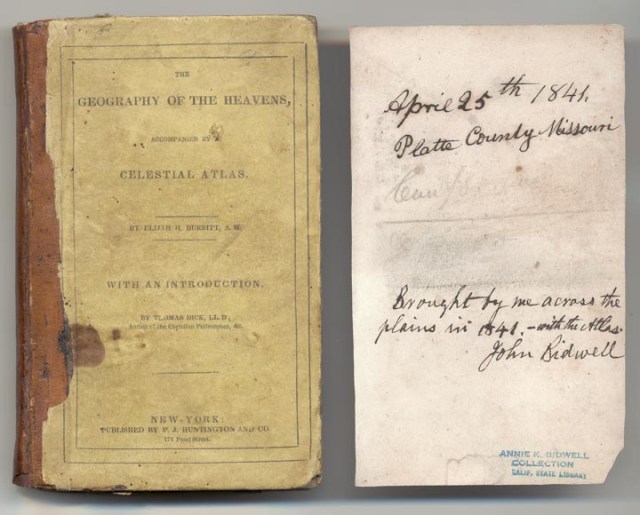
The Company divested itself of extra clothing, cooking equipment, tools, empty containers — anything non-essential. One thing that John Bidwell did not leave behind however were his two books. He had an astronomy manual titled The Geography of the Heavens and a large celestial atlas that went with it. He carried these all the way to California and kept them all his life. astronomybook


Posted in Uncategorized | Leave a comment

On the Trail — September 15-16, 1841

Wednesday, 15th. Started very early, day was exceedingly warm, passed through a gap in a ridge of mountains, came to a high dry plain, traveled some distance into it, saw the form of a high mountain through the smoky atmosphere — reached it, having come about 15 miles — found plenty of water — our animals were nearly given out. We were obliged to go so much further to get along with the wagons. We concluded to leave them and pack as many things as we could.

Thursday, 16th. All hands were busy making pack saddles and getting ready to pack.

John Bidwell tells more about the company’s packing adventures in The First Emigrant Train to California.

Packing is an art, and something that only an experience mountaineer can do well so as to save his animal and keep his pack from falling off. We were unaccustomed to it, and the difficulties we had at first were simply indescribable.

The trouble began the very first day. But we started — most of us on foot, for nearly all the animals, including several of the oxen, had to carry packs. It was but a few minutes before the packs began to turn; horses became scared, mules kicked, oxen jumped and bellowed, and articles were scattered in all directions.

ox-with-pack

This is the only picture of an ox with pack that I could find, by “Country Mama” on a photography forum 

It was a scene both comic and desperate. Oxen are not used to carrying packs — I imagine that trying to get some kind of pack onto the back of an ox is not an easy thing. But Bidwell had no choice — his two oxen were all he had to carry his belongings, other than his own back. They were also his dinner on the hoof.

Note all the strapping in this picture, and imagine trying to arrange that without the handy straps and buckles.

Posted in Uncategorized | Leave a comment

What the Heck Was Halo Chamuck?

C18481007.2.9.1-a1-552w.jpg

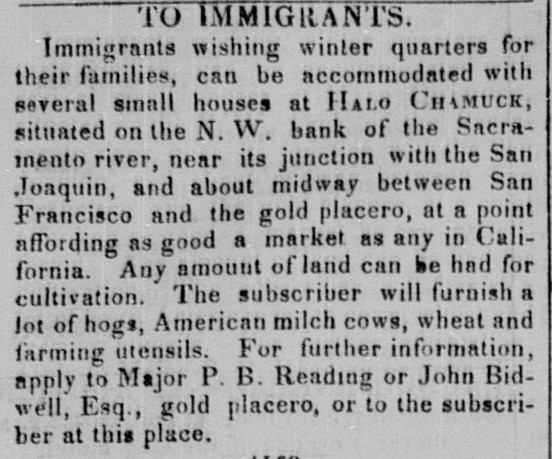
This advertisement appeared in the Californian on September 23, 1848:

IMMIGRANTS. Immigrants wishing winter quarters for their families, can be accommodated with several small houses at HALO CHAMUCK, situated on the N. W. bank of the Sacramento river, near its junction with the San Joaquin, and about midway between San Francisco and the gold placero, at a point affording as good a market as any in California. Any amount of land can be had for cultivation. The subscriber will furnish a lot of hogs, American milch cows, wheat and farming utensils. For further information, apply to Major P. B. Reading or John Bidwell, Esq., gold placero, or to the subscriber at this place.

The item appeared several times in the Californian, signed with the name of the editor, J. D. Hoppe. He also published letters, signed A FRIEND TO ENTERPRIZE and probably written by himself, extolling the virtues of the new settlement on the Sacramento.

So where was this wonder-place that he was promoting, and what did Reading and Bidwell have to do with it?

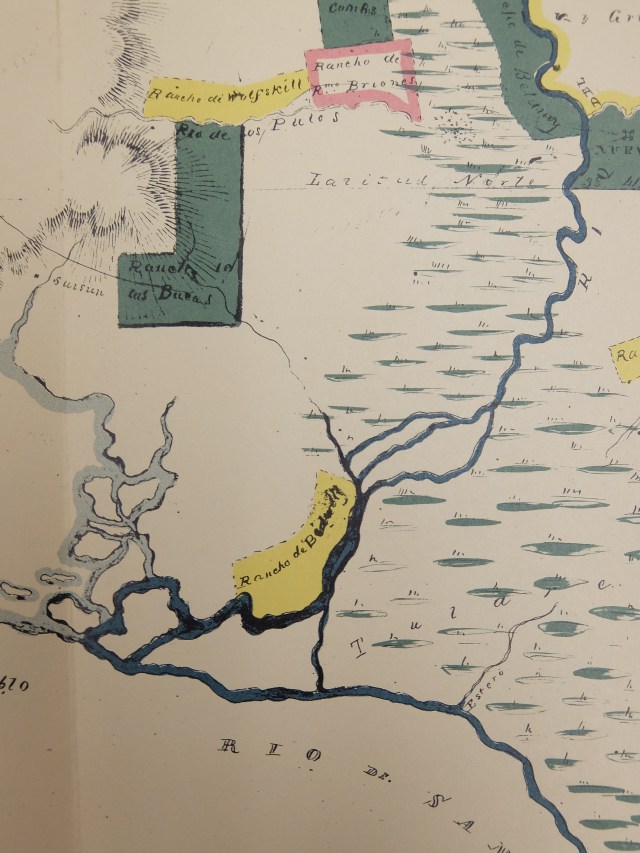
The future community of Halo Chamuck was located on John Bidwell’s first rancho.

dscf1724

A section of Bidwell’s Mapa del Valle del Sacramento, created for the Land Commission. Rancho de Bidwell (Ulpinos) is colored yellow.

In October 1844 John Bidwell was granted title to Rancho Los Ulpinos by Governor Micheltorena. The grant lay along the northwest banks of the Sacramento River, where the river enters the delta and joins with the San Joaquin River. In January 1846 Bidwell attempted to develop the land and attract immigrants. With the help of Indians he built an adobe house where Cache Slough enters the river. In the fall he managed to attract some immigrants to settle there. The winter of 1846-47 was a harsh one however, and the immigrants suffered from lack of food. According to Rio Vista — History and Development, by Mrs. Duncan S. Robinson:

But the rigors of a severe winter, with lack of adequate food supplies, resulted in the disbanding of both the white and Indian settlers. During the long, hard winter, the hungry and discouraged Indians frequently used the expression “Hale-che-muck”, which meant “nothing to eat”, hence the origin of the name of the Bidwell settlement: Hale-che-muck! !

So Halo Chamuck = “Nothing to eat!” Seems a strange thing to name a town that you want to attract settlers to, but there it is in the newspaper. Did the promoters think that no one would ask what the name meant?

In spite of the harsh winter of 1846-47 driving off the first settlers, Hoppe continued to promote Halo Chamuck (or Halo Chamo, as he sometimes spelled it). In August 28, 1847 he printed a lengthy letter, praising the location:

Amongst the many enterprizes of the day, the laying out of a city on the Sacramento River near its mouth, the proprietors of which are John Bidwell, Esq., Maj. Redding, and Captain J. D. Hoppe, in my opinion is of the greatest importance . . . The said city is to be called Halo Chamo, and is beautifully situated  . . .  the water deep and the anchorage good . . . especially well adapted for agriculture and grazing . . . many different kinds of timber . . . etc. etc.

Starving winters were not Halo Chamuck’s only drawback. John Bidwell never settled there himself for any length of time. He claimed that the mosquitoes from the nearby tule marshes were so bad that he fell sick from sheer loss of blood. He preferred Butte County’s more salubrious climate.

In 1854 Bidwell’s title to Rancho Los Ulpinos was confirmed by the Board of Land Commissioners. By then he was firmly established at Rancho Chico and he began selling off portions of Rancho Ulpinos. One of the buyers was Col. N. H. Davis, who established a town site not far from the failed town of Halo Chamuck and named it Brazos del Rio, meaning Arms of the River, since it was located where three channels of the Sacramento River come together.

The town was promoted as a way station for steamboats plying the route between Sacramento City and San Francisco. The river teemed with salmon, and a successful salmon fishery was established. All went swimmingly (as it were) until the rains of 1862. The town washed away in the floods.

When the town was reestablished on higher ground, it was renamed Rio Vista, and there it is to this day, where state highway 12 crosses the mighty Sacramento.

For more on the history of Rio Vista, check out this article on the Solano History website. Click on the map below to go to an 1877 map of Solano County, where you can see Rancho Los Ulpinos and Rio Vista on the lower right.

solano-map

Posted in Uncategorized | Leave a comment