How to Write a Constitution, According to the Wasp

More cartoons!

constitutions

The Wasp, 20 July 1889

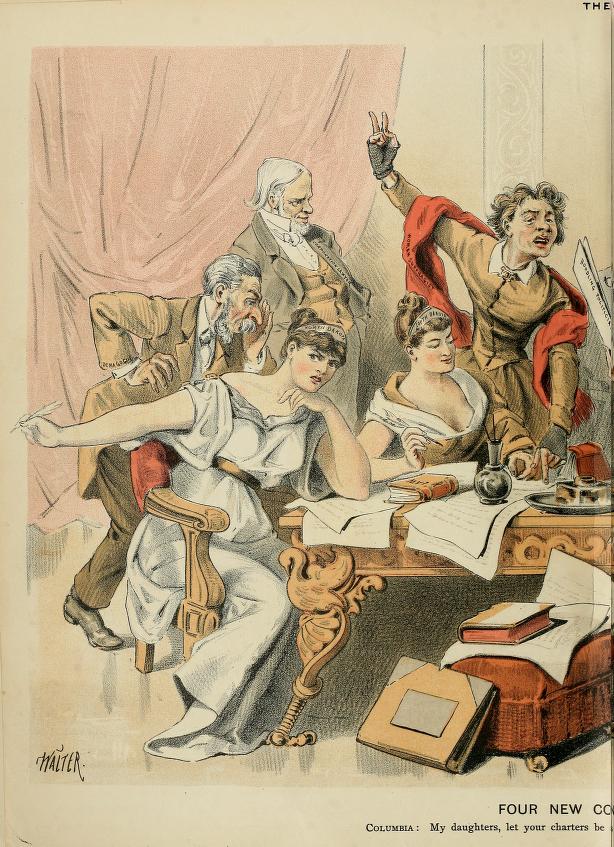
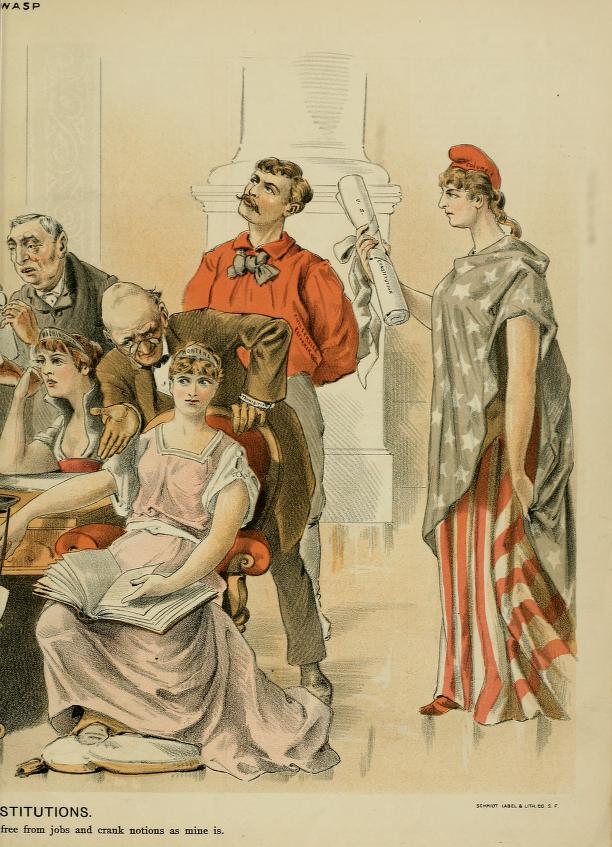
1889 was the year that North Dakota, South Dakota, Washington, and Montana all were admitted to the Union. And here we have those four fair ladies, sitting down to write their state constitutions. Columbia, on the right, is saying, “My daughters, let your charters be as free from jobs and crank notions as mine is.”

And what were those crank notions that beset the political mind in 1889? Behind the ladies, left to right, are a demagogue, a corporation lawyer, a proponent of women’s suffrage, a “boodling” politician, a prohibitionist, and a civil service reformer (in a red shirt). Is the civil service reformer meant to look innocent or devious? I’m not sure.

“Boodle,” in the political jargon of the day, was money gotten from bribes and graft.

A closer look:

waspjulydec1889unse_0052

Not a fan of “Votes for Women,” were they?

waspjulydec1889unse_0053

ColumbiaStahrArtworkColumbia is wearing a Phrygian cap, or liberty cap, which dates back to ancient times and during the French Revolution became a symbol of liberty. Here’s a World War I poster showing Columbia with her American flag drapery and liberty cap.

Uncle Sam is still a common symbol of the USA, but we don’t see Columbia much anymore. Maybe it is time to bring back Columbia.


waspjulydec1889unse_0466Here’s a bonus Phrygian cap for you, from the December 28th, 1889 issue of the Wasp. “The Advance of Republicanism Startles the World.” Our goddess here is not Columbia (no stars and stripes), but Liberty or the ideal of a Republic. The startled nations are Austria, England (with Spain clutching her robe), bearded Russia, and on the battlement, Prussia.


Posted in Uncategorized | Leave a comment

A Scandalous Saga of Cartoons

The Wasp delighted in lampooning the Sharon trial in cartoons. There were far more than it is worth showing here. So — one more cartoon, probably the last, showing what the principal players would look like if the trial dragged on for another 25 years, as it felt like it might.

waspjanjune188412unse_0373B

Poor old William Sharon and Sarah Althea Hill, who claimed to be his wife, are featured in the center. If Sharon had lived until 1910, he would have been 89 years old, a not impossible age, but in reality he died in 1885, at the age of 64, a year after this cartoon appeared. Althea, who did indeed love to deck herself in roses, lived until 1937 (!), unfortunately dying in the state asylum for the insane.

Surrounding the pair are their attorneys, with Judge Sullivan (who must have had a tendency to fall asleep on the bench) at the bottom.

The two figures who draw our eye are Ki, on the left, and Mrs. Plaisance, on the right. Artists in the Wasp drew minorities and people of color in the harshest style of caricature. Ki was Sharon’s Chinese manservant — there is no photograph of him that I know of, so I don’t know if he really wore a queue and a Fu Manchu mustache. That was just the way the artist would invariably indicate a man from China.

BTJPAM-715x899“Mrs. Plaisance” is Mary Ellen Pleasant, usually labeled Mammy Pleasant. She was a friend and supporter of Althea, a successful businesswoman, and a fascinating figure in her own right, who looked nothing like this cartoon.
Here is the only undisputed photograph of Mary Ellen Pleasant. This is how Sarah Althea Hill would have known her.


Posted in Sharon v. Hill, Uncategorized | Leave a comment

Allie and Judge Sullivan

“The trial of Althea’s divorce suit began in March of 1884, without a jury, before Judge Jeremiah Sullivan of the superior court of San Francisco. It continued, off and on, until September. In court, Althea told her story with a goodly number of embellishments, many of them rather transparently false.” (Maccracken, Brooks W., “Althea and the Judges,” American Heritage, June 1967)

At the end of this months-long trial, once every argument, witness, and participant had been exhausted, Judge Sullivan gave his opinion that the marriage of William Sharon to Sarah Althea Hill was valid, based on the piece of paper Allie produced. He was reluctant to believe that lovely Althea, educated at a convent, could be a liar.

There were no witnesses to the contract. It was simply her word against his. How it could be a valid marriage when there were no witnesses, no ceremony, and no filing of a marriage certificate, was never addressed. Judge Sullivan opined that “mutual consent without any form of solemnization, followed by copulation, constitutes a valid marriage.” (quoted in The Wasp, 3 January 1885) Neither contestant denied the copulation part. The contract, however, was labeled a forgery by William Sharon, who said he was “too old a fish” to be caught like that.

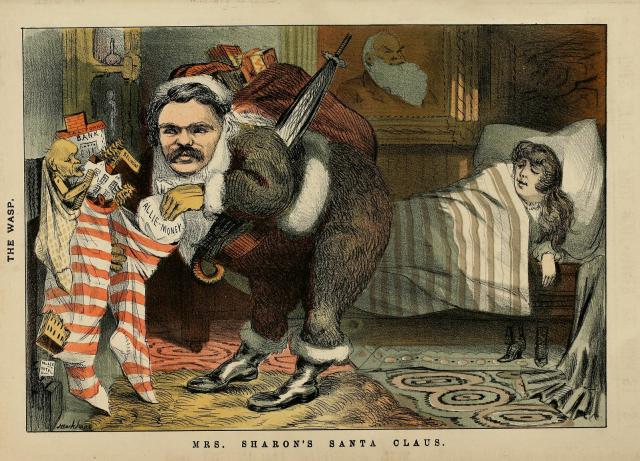
Judge Sullivan granted Althea a divorce and $2,500 a month alimony. The Wasp caricatured Judge Sullivan as Santa Claus, stuffing Althea’s Christmas stocking with “Allie-money” . . .

waspjanjune188514unse_0024

The Wasp, 3 January 1885

. . . And as a zookeeper in charge of a cage full of ravening creatures. “Sarah Althea” is the shrieking cat, and the two gorillas are her attorneys, G.W. Tyler and son. Senator Sharon is the baby being held by his attorney, Barnes.

waspjanjune188514unse_0256


Posted in Sharon v. Hill, Uncategorized | Leave a comment

The Wasp Loved a Juicy Scandal

And there was none juicer in 1880s San Francisco than the case of Sharon v. Sharon, which pitted elderly millionaire William Sharon against his mistress/wife (take your pick) Sarah Althea Hill. I wrote about this Scandalous Saga last year and you can follow the whole story by clicking through to that post and subsequent posts. It is a story replete with civil suits ranging from divorce to libel to slander; criminal prosecutions from adultery to larceny to murder; allegations of forgery, blackmail, and voodoo, and pistols and knives drawn in the courtroom. It has it all!

At the time I found a couple of cartoons from the Wasp about the scandal and courtroom drama, but now I have a few more to show you.

After the court dismissed the suit against William Sharon for adultery on a technicality, Sarah Althea Hill promptly sued for divorce, claiming that they had a secret marriage. Hence we have this cartoon titled “Re-Opening the Ball.” Althea, decked out in extravagant fashion, is on the arm of wizened old ex-Senator Sharon (or he is on her arm).

althea ball

Judge Sullivan starts up the music, while the crowd of attorneys promenades in. The fat man with the spade beard and spectacles is David S. Terry, who will later marry Althea and come to a Very Bad End.

The bearded gentleman dressed up as a lady in yellow with a bright red fan is Althea’s attorney, George W. Tyler. He is also the central figure in the scene of courtroom mayhem below. As he questioned Mrs. Shawhan, and implied that she was less than respectable, she fingered a pistol in her pocket, and Tyler reached to draw his own pistol. Pandemonium ensued — you can read about it in the Pistols in the Courtroom post.

waspjanjune188412unse_0290

Posted in Uncategorized | Leave a comment

Sacramento History Tours

The Sacramento History Museum has some fun and short video tours you can enjoy during this time of confinement. The museum is closed, and they probably don’t encourage you wandering around the streets of Old Sacramento, but there are still some fun things to do virtually.

Anytime Tours

Take a few minutes to take an Anytime Tour. They have Anytime Tours in Old Sacramento and Anytime Tours at the Old City Cemetery, presented by costumed guides. The stories about bold businesswomen of early Sacramento are a particular treat.

Posted in Uncategorized | 1 Comment

The Pacific Tourist — 1881

Take a ride on the Union and Central Pacific Railroads!

pacifictourist1881will_0011

This series of guidebooks told you everything you needed to know as you rode the train across the continent, bound for California. Once you got to the Golden State, the book guided you on all the routes throughout the state, describing each station and town, and all the beauties and wonders to be seen along the way. It was lavishly illustrated with etchings of the scenic marvels of America.

Here is the page telling you what to expect as you journey northward on the Central Pacific Railroad through Chico and Red Bluff to its terminus at Redding. Gridley and Biggs are “both new and flourishing towns,” and Chico is “one of the best and most prosperous towns in California,” where you can see the beautiful home of General Bidwell, one of California’s “most enterprising citizens.”

pacifictourist1881will_0318

If your destination is anywhere else in Northern California not on the rail line, such as  Big Meadows, Cherokee Flat, or Orland, the guidebook tells you all about the connecting stagecoach lines. What a valuable book! Well worth the price of $1.50 for the railroad (paperback) edition, or $2.00 for the hardback edition.

Don’t leave home without it!

(My thanks to the California State Library, which pointed out that these books are available on the Internet Archive.)

Posted in Uncategorized | Leave a comment

California Wants a Canal

cal bounty

I like these cartoons that feature California as a goddess in all her glory, so here is another one. This one shows California looking peeved. What has her so exasperated?

The caption reads:

A YEAR OF PLENTY: California — What shall I do with this bounteous harvest of fruit and grain? My barns verily burst with plenty and my cup runs over. Would that the Nicaragua Canal were completed, and then I might find market for my surplus.

You might wonder about the idea of a canal through Nicaragua, but it was an idea afloat at the time.

There had been talk of a canal to link the Atlantic and Pacific Oceans during most of the 19th century. The French began a canal across the Isthmus of Panama in 1881, and after great expense of lives and capital, gave up the project in 1894 when it went bankrupt. This cartoon appeared in the Wasp in 1891, when U.S. interests were speculating about beating the French across by taking a different route.

Instead, the U.S. took over the French project in 1903, after promoting a revolution in Panama that brought about its separation from Colombia. The Panama Canal was completed in 1914.

waspjulydec1891unse_0260BCalifornia also had the transcontinental railroad as a means of getting her produce to eastern markets, but the railroad wasn’t enough. California was (and is) so bountiful that she needs a vast transportation web to distribute the fruit of her fields.

This cartoon was by Charles W. Saalburg. You can read about his career here.


Posted in Uncategorized, Wasp | Leave a comment

How The Wasp Saw Women

As much as I enjoy paging through the Wasp and looking at the cartoons, I have to acknowledge that it was a newspaper produced by men for men. Two cartoons from 1878 issues of the Wasp will give you a pretty good idea of how the editor and cartoonists (who were all men) saw women.

The problems of women’s fashions:

waspvol3pt11878unse_0054

Elaborate trains or “trails” stirred up dust, knocked aside small children, and created a public hazard to men crossing the street. Other than that, the Wasp liked to depict pretty women fashionably dressed. But they didn’t go along with the idea of giving women the vote. Shall women vote, they asked?

waspvol3pt11878unse_0215

“To be sure they shall, the little dears!” was the condescending opinion of the Wasp.

waspvol3pt11878unse_0217B

Sigh. With that kind of attitude, it’s no wonder it took another 33 years for women to get the vote in California, and 40 years before they could vote in national elections.

Posted in Wasp | Leave a comment

The Death of General Bidwell

DSCF6810 (3)

Account of General’s attack of heart trouble in Vallombrosa, April 4, 1900

The following account was written for Annie Bidwell by one of her maids, Florence, who had gone with General Bidwell on the morning of April 4, 1900. I don’t know Florence’s last name. The account can be found in the John Bidwell Collection in the California State Library.

DSCF6806 (3)

Chico April 4, 1900

On Wednesday morning at eight o’clock, General drove up the creek with William Conway, taking me with him to open the gate (when he came back) as he said he was only going to be gone about one hour. We drove up the South side, then crossed a little below the Dam, onto the North side. We kept close to the creek for a ways as the General said I am just going this way to mark out a new road. I will tell you what to do William and then I will leave you to your self as I am not going to stop today.

Mechoopda Band

The Mechoopda Band. William Conway is at the center of the front row, holding a trumpet. Photo courtesy of Special Collections, Meriam Library, CSU Chico.

When we got down to where Harry was working the General told William to put on his rubbers and help him out of the wagon. I got into the front seat and held the horses when the General got to the ground he gave a little stamp and said there, I am as spry as a young boy. Now William our Log has burned pretty well but we will take the chain and pull it over a little way. Now Harry get your horses. They pulled it over and then the general took the crow bar and showed William how to knock the fire out of the root without putting out the fire. He then had William take the big ax and chop off a big knot from the stump they were burning. He then called Harry and had him pull the logs that were on the ground a little uphill to the spot where they were when he was take sick. He and Harry sawed a little while and then quit.

The General then went back to see how William was getting along then went and done a little more sawing, then quit and walked around a little while. Then he turned to me and said are you cold Florence, for I was sitting right in the shade with the North wind blowing hard. I told him I was and he had Harry drive the horses to the South side of the log in the sun and I was only there a few minutes watching the General as he poked around the fire and started a little blaze as the chips fell down from William’s ax.

It seems strange but I never took my eye off the General that morning. I followed every movement just with the thought the ground is so uneven and so many little rock and limbs lying around from the tree they were burning so as to warn him if he should happen to go near anything he would stumble over. While watching him he laid the crowbar down and stood for a moment with his hand on the stump as if thinking. Then he called to Harry and said, Harry you take the horses, and Florence you come here. Of course I waited for Harry to get to the horses before I let go of the reins as they were very restless.

William looked up and said I think there is something the matter. The General was then walking to the log with his head held down as if he had the neuralgia. I said Jump Billy and I jumped at the same time leaving the horses alone for Harry had not yet got into the wagon. We both got to the General at the same time. I said he has got neuralgia Billy hold him up. He was then sitting like he does when he had that pain. He had hold of him only a few seconds when he dropped his head back and gasped for breath like as if he were having a fainting fit. I said to William he has fainted and started Harry to town in all haste.

I ran to the creek and got some water and loosened his clothes around his neck and rubbed him as best we could. When we fixed up a place as best we could and laid him on the ground he seemed better in a few minutes and wanted to know what was the matter and what were we all doing. We said keep quiet General you will be all right in a little while and as he commenced to rally he wanted to be propped up and complained of too much weight on his chest though there was nothing there. As he got a little better he asked for some water then he complained of being cold and to cover him up. When you got to the spot and you now what. . .

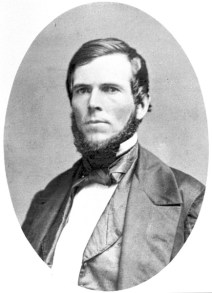
Bidwell1890The account breaks off there, although there must have been a little more to it. The General was taken home in the wagon and died later that day. His heart attack came as he was doing one of the jobs he loved best — road-building.

Posted in Uncategorized | Leave a comment

Another Cartoon from the Wasp

stage

I am putting this one up just so you can admire the artistry of the cartoonist Charles Saalburg. It appeared in the Wasp on February 7, 1891.

Sometimes the Wasp explained the cartoons, but I couldn’t find anything in this issue. The cartoon deals with national politics and I think they assumed that the readers would understand the issues and know the players. I am not going to attempt to explain every figure, but I will point out a few things.

The driver of the “Stagecoach of State” is President Benjamin Harrison, and next to him is his Vice-President, Levi Morton. Two of the men riding on top at the back are Senators Henry Cabot Lodge and William McKinley, both Republicans. (The Wasp favored the Republicans.) Riding inside the coach is Uncle Sam.

waspjanjune1891unse_0148

Each of the horses is labeled with the name of a bill. Foremost among the opponents of Harrison’s plan of progress is former (and future) President Grover Cleveland (Democrat), with his boulder of Vengeance.

waspjanjune1891unse_0149

Other Democrats are shoving in logs labeled Ignorance and Capricious Obstruction. I don’t know who all of them are, but the one in the middle is Republican Senator John J. Ingalls of Kansas, who was getting a lot of criticism in the Wasp at the time.

If you would like to look at more of these cartoons, you can access the Wasp at the Internet Archive. (A fabulous resource, by the way.) Here is the link for the California State Library collection. On the left, search the collection for Wasp, or for Wasp 1890 (or some other year) for a particular year.

Enjoy!


Posted in Wasp | Leave a comment