California Bound!

covered-wagons-1On May 19, 1841, the Bidwell-Bartleson Party started for California. John Bidwell, as secretary of the group, kept a journal. Later, while at Bodega Bay, he tidied up his journal entries and sent them back to a friend in Missouri, who had them printed as a guidebook. This is the source of most of what we know about this first group of emigrants to head for California.

Wednesday, 19th. This morning the wagons started off in single file; first the 4 carts and 1 small wagon of the missionaries, next 8 wagons drawn by mules and horses, and lastly, 5 wagons drawn by 17 yoke of oxen. It was the calculation of the company to move on slowly till the wagon of Chiles overtook us.

Our course was west, leaving the Kanzas no great distance to our left, we traveled in the valley of the river which was prairie excepting near the margin of the stream. The day was very warm and we stopped about noon, having traveled about 12 miles. (Bidwell-Bartleson Party, ed. by Doyce B. Nunis, p. 28-29)

The wagon train was very lucky to have joined up with the missionary party. Without the guidance of the trail guide — Thomas Fitzpatrick — hired by the missionaries, they probably would have gotten hopelessly and fatally lost.

The missionaries were led by Father Pierre Jean De Smet, a Belgian Jesuit who spent many years working among the American Indians. In 1841 he was on his way, with two other priests and three lay brothers, to minister to the Flathead Indians. He established St. Mary’s Mission on the Bitterroot River near Missoula, Montana. Bidwell described him as follows:

He was genial, of fine presence, and one of the saintliest men I have ever known, and I cannot wonder that the Indians were made to believe him divinely protected. He was a man of great kindness and great affability under all circumstances; nothing seemed to disturb his temper.(Echoes of the Past, p. 114)

More information on Father De Smet can be found in this article from Historic St. Mary’s Mission and Museum.
Posted in Uncategorized | Leave a comment

The Ballad of John Bidwell

I have been looking through a Butte County history curriculum binder developed by the Butte County Office of Education for 3rd grade teachers, and I came across a catchy little item. It’s “The Ballad of John Bidwell”, written by the 3rd and 4th grade students of Canyon View School (which was in Magalia). I will append a few footnotes, but other than that, without further ado, here it is: (Use whatever tune you like to sing along.)

John Bidwell lived on an eastern farm
And dreamed of open spaces.
Injun Joe*, a trapper came
To tell of far-off places.

He stayed at home until eighteen
And then he started west.
He found out in St. Louis
That Missouri land was best.

He made his money teaching school.
One day he went to town
And while he was buying farming tools**
A claim-jumper stole his ground.

He heard of California
And decided he would go
Although the way was still unknown
And wagon wheels move slow.

In ’41 the wagons left,
Led by a famous scout.
Across the Rockies steep they went***
With hearts both bold and stout.

The scout then had to leave them
With their wagons pointed west.
He said, “There is no trail at all, boys,
You’ll have to do your best.”

They reached the Great Salt Basin
And had to circle south.
There was no buffalo for food
And all around was drought.†

They left their wagons far behind —
The way was much too steep —
The trail they made too narrow,
And the canyons far too deep.

Bartelson, their captain,
Was a double-crossing man.
He stole the meat, and rode away,
Shouting, “Get there if you can.”

They crossed the High Sierras
And didn’t even know.!
How surprised they were to see
The valley far below.

Then down they walked to Dr. Marsh
From out of the mountains wild —
A thirty†† hungry, happy men;
One woman and a child.

John went on to Sutter’s Fort,
His journey at an end.
He worked for Sutter several years
And was his closest friend.

He didn’t have the fever
Of those who came to seek
For fortune. He only wanted gold
For a ranch on Chico Creek.

The American River was rich with soil
But Bidwell said, “I’d rather
Try my luck on another stream,
I’ll travel up the Feather.”

With friends he went up towards the hills.
He hadn’t traveled far
Until he panned out gold before
At a place now Bidwell Bar.

He bought 22,000 acres
With gold that he had panned.‡
He knew the country’s future
Was in its fertile land.

He went to Washington, D.C.
To help build up the state.
He brought back plants and trees, and planned
To make the Valley great.

He married pretty Annie
Who was a faithful wife.
She loved the Chico Indians
And helped them all her life.

And now, if you have read this far, here are a few notes.
*Injun Joe. It’s unfortunate that this occurs in the very first stanza, since it is not only objectionable, but inaccurate. Bidwell heard about California from a French-Canadian trapper, Antoine Robidoux, who had a more famous brother, Joseph, but they did not (as far as I can ascertain) have any Native blood, although many trappers did.

** and books!

*** The scout was Thomas Fitzpatrick, who knew the trail well enough to guide them to the South Pass, where the Rockies are not steep.

drought. A note in the original says “they didn’t know this word.” I’m guessing that the teacher helped them find a word that (sort of) rhymed with “south.”

†† thirty-two, actually.

‡ with considerable help from the Mechoopda Indians whom he hired!

I’m glad Annie made it into the last stanza. I am impressed with how much these students knew about John Bidwell.

I am not sure when the binder materials were created — sometime before 1993, which is the date on an order form in the binder. I wonder if anyone uses this anymore?


Posted in Uncategorized | 2 Comments

A Parade for a Pioneer


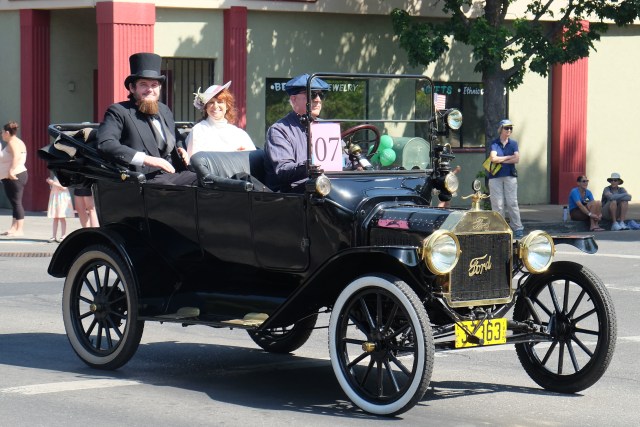
bicentennielWe all enjoyed the Chico Pioneer Day Parade today. Grand Marshal was Butte County Sheriff Kory Honea, beloved by all for his heroic leadership during the Camp Fire. Honorary Grand Marshals were John and Annie Bidwell, in recognition of the bicentennial of John Bidwell’s birth in 1819.
DSCF3868 (2)

DSCF3830 (2)

John and Annie: The Long and the Short of It

John and Annie were portrayed by Nick Anderson and Robyn Engel, who fit the roles to a T, since Nick is over 6 feet tall, like Bidwell, and Robyn is only 4 feet 8 inches tall (or should that be “short”?), just like Annie.

They rode in a lovely 1915 Motel T Ford, owned and driven by Dudley Stone. Walking along, carrying the banner and representing the Bidwell Mansion Association were Quinn, Ian, and Bodie (sorry, guys, I didn’t get your last names) and Adrienne Glatz, BMA board president, and myself, Nancy Leek.

It looked to me like the men were 49ers dressed up in their best duds and come to town to spend some of that gold dust.

dscf3857.jpg

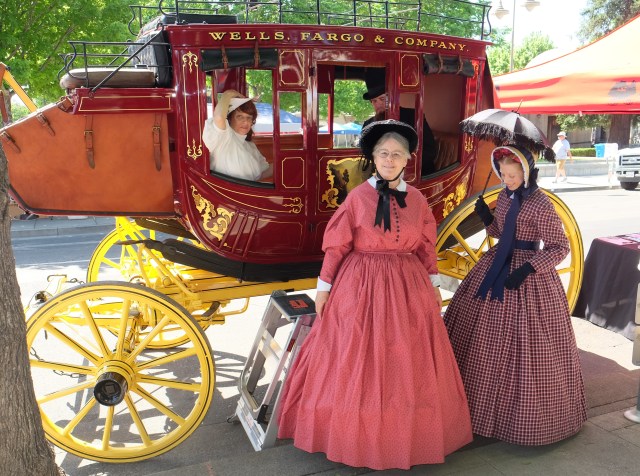
Wells Fargo Bank was there with their replica Concord stagecoach, and it was a treat to climb in and try it out. The BMA also had a booth on the City Plaza, where we gave away casaba melon seeds and schedules of upcoming events. (If you would like some free seeds, they still have them to give away at the Bidwell Mansion SHP Visitor Center. It’s open Saturday, Sunday, and Monday.)

DSCF3892 (2)

DSCF3897 (2)


Posted in Uncategorized | Leave a comment

John Bidwell Joins the Hall of Fame


bicentennielThe Oregon-California Trails Association (OCTA) has a Emigrant Hall of Fame, and John Bidwell is joining it this year.

Last year I submitted an application for him on behalf of the Bidwell Mansion Association.  I recently got the welcome news that JB is in! He joins a small and select group of trail pioneers in the Hall of Fame: Jesse Applegate, Marcus and Narcissa Whitman, and Dr. John McLoughlin. (Note that these are all Oregon pioneers. John Bidwell is the first Californian.) He will be honored at the OCTA convention in Santa Fe, New Mexico, September 4-7, 2019.

The Hall of Fame also honors preservationists, authors, philanthropists, and public officials who have worked to preserve the western trails and educate the public about the history and value of these historical resources. OCTA began the Hall of Fame in 2015.

What qualifies John Bidwell for the Emigrant Hall of Fame? He was not only a member of the first group of emigrants to set out overland for California, but it is because he kept such a detailed daily journal that we know so much about their route, their struggles, and their adventures.

logo-octa

The Oregon-California Trails Association is a non-profit, 501 (C) (3) Association and is the nation’s largest and most influential organization dedicated to the preservation and protection of overland emigrant trails and the emigrant experience. They publish the Overland Journal, a quarterly full of interesting articles about western history. Their website also has many valuable resources, some of which you can only access by becoming a member. It’s worth it!

Posted in Uncategorized | Leave a comment

On the Banks of Deer Creek

DSCF6984

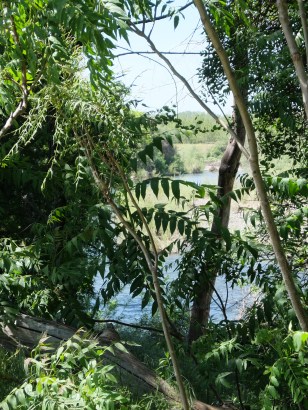
Out there beyond the trees is Deer Creek

Yesterday I went on a treasure hunt an archeology field trip to Vina to dig around in the dirt and see what we could find. My friend Josie Smith invited me to join Dr. Eric Ritter’s Shasta College Field Archeology class, looking for any remains of Peter Lassen’s occupation of the property that is now the Abbey of New Clairvaux.

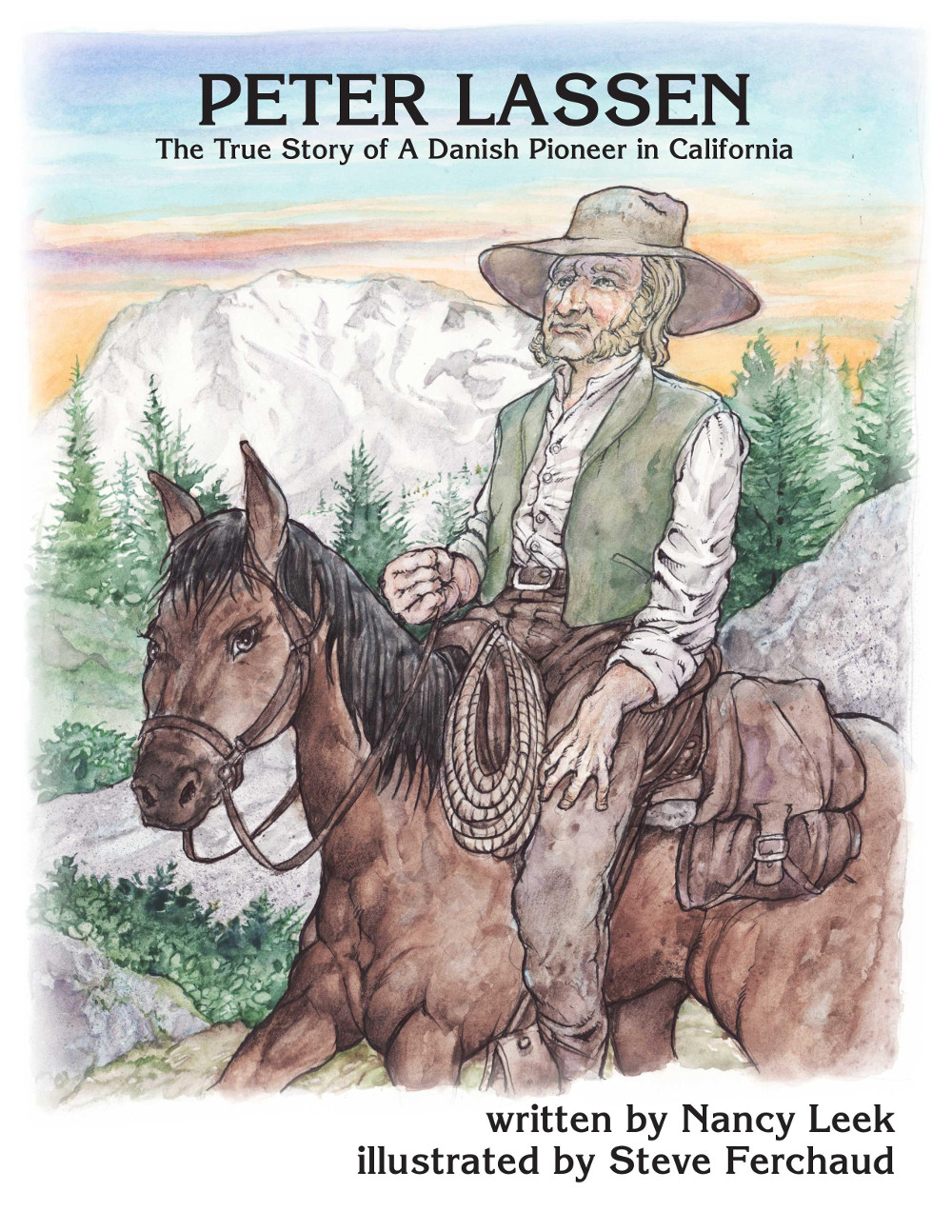
Peter Lassen’s ranch lay along Deer Creek in Tehama County. Historians only have a general idea of where his house and other buildings were located, but it was somewhere next to the creek. We were working in an area behind the current monastery buildings.

On a previous visit flags had been planted all over a field about the size of a two-car garage — each flag marked a spot where a metal detector indicated that something lay beneath the surface. It was our job to dig down and see what it was.

DSCF6974

Josie in a field of flags

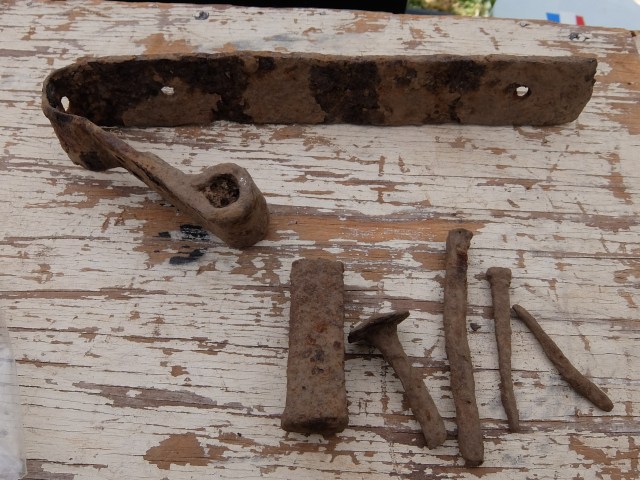
Well, most of the time it was an old square nail, or the fragment of a nail. Sometimes we couldn’t find anything at all. But once in a while something interesting turned up — the rivet for a wagon wheel rim, a hand-forged link of chain, and a bent, hand-forged door hinge. (Eric found the hinge.)

DSCF6978

Chain, chain, chain

DSCF6982 (2)

Four hours of digging — door hinge, mystery piece of iron, rivet, nails

Four hours down on my knees in the dirt, chopping away at the weeds and the soil, rooting around in the dirt for a scrap of iron — what fun! I’d do it anytime!


Posted in Peter Lassen, Uncategorized | Leave a comment

Bidwell Bicentennial

bicentennielThe year 2019 marks the 200th year since the birth of John Bidwell. He was born in Chautauqua County, New York, on August 5th, 1819.

In honor of General Bidwell’s Bicentennial, the Bidwell Mansion Association has lots of great activities planned for this year.

Here is what you can look forward to:

DSCF5296 (2)

John and Annie at the 2019 Pioneer Day Parade

Saturday, May 4th: The Pioneer Day Parade. John and Annie will be honorary grand marshals. What will they be riding on? a horse-drawn buggy? a horseless carriage (as Annie would have called an automobile)?, a hay wagon? something else? Come on down to the parade and see.

After the parade visit the BMA booth at City Plaza and plant a casaba melon seed to take home and put in your garden. It was Bidwell’s favorite!

DSCN0538

Mmmmm – casaba melon!

Monday, May 27th: Memorial Day ceremony at Chico Cemetery, with a tribute to General John Bidwell, who served in the Mexican War and as a brigadier general in the California Militia during the Civil War.

Saturday, June 22nd: Annie’s Birthday Tea Party inside Bidwell Mansion. Two seatings at 11:30 and 2:30 for a classic tea, with tiny sandwiches, delicious scones, fresh fruit, tea and lemonade.

Wear your favorite fancy hat! Tickets will be on sale soon.

DSCF3590

Saturday, July 13th: Annual Slice of Chico sidewalk sale downtown with free watermelon and casaba melon, in honor of John Bidwell’s business legacy.

Also Saturday, July 13th: Twilight Family Night at Bidwell Mansion State Historic Park. Games, stories, snacks, and a camp fire!

Bidwell1866-w-hat

The Birthday Boy!

Sunday, August 4th: Bidwell Bicentennial Birthday Bash at Bidwell Mansion SHP. Celebrate Bidwell’s 200th with birthday cake and Shubert’s ice cream.

Also, music by the Chico Community Band, dramatic vignettes inside the mansion, and games on the lawn.

Much more to come throughout the year!

Posted in Uncategorized | Leave a comment

What’s for Dinner Tonight?

Here is the Bill of Fare for dinner at the Pacific Hotel in downtown Sacramento on April 8th, 1870, just 149 years ago. Prices are not given, other than for the wines and beers listed at the bottom.  Anything printed on the menu was regularly available, and what is written in were that day’s specials.  For instance, under “Boiled”, you could have ham, corned beef and cabbage, corned pork, or mutton with caper sauce. Or you could order “Pig’s Jowls with Green Cabbage.”

The menu is heavy on meat. Note the vegetables — a decent variety, but I doubt that tomatoes were actually available in April, since they were not in season.

The entrees sound good — “Beef Tongue with Pickle Sauce,” anyone? Bon appetit!

DSCF6823 (2)

Posted in Uncategorized | 2 Comments

A Few Last Notes on Sarah Althea, Sharon, and Terry

I hope you have enjoyed reading the many parts of the scandalous saga of William Sharon and Sarah Althea Hill. I’d like to add just a few other notes to the story—

There is a short street in San Francisco named for William Sharon. It runs between 15th and 16th, just off of Market Street.

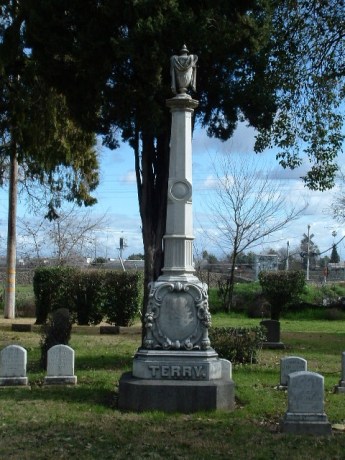
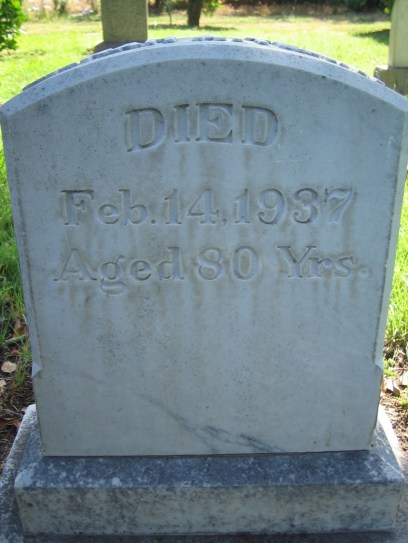
Sarah Althea Terry is buried next to her husband, David Terry, and his first wife Charlotte, in the Stockton Rural Cemetery. The age is wrong on her tombstone. She was not 80 at her death, but 87.

23199755_120352396562

David S. Terry’s monument (from findagrave.com)

23199755_124552735761

Her name is across the top, and her age is wrong.

7121880_125857122149

William Sharon’s grave site

William Sharon’s rather unusual table-style tombstone can be found at at Cypress Lawn Memorial Park in Colma, California, the cemetery city of San Francisco.

I took my information from the book Sarah & the Senator, by Robert H. Kroninger (1964) and newspaper articles accessed at the California Digital Newspaper Collection. The legal case is well set out by Mr. Kroninger, himself an attorney and judge, but it had so many bizarre twists and turns, and spun off so many side actions, that my un-legally-trained mind had difficulty following it all. I stuck to the more sensational aspects of the trials — pistols in the courtroom and love potions in the coffee.

51c+0t3GI6L._AC_UL436_

Everyone’s favorite font in 1969

This story has also been turned into a novel, The Devil’s Daughter, by Eleazar Lipsky (1969). According to a review that appeared in the ABA Journal for January 1970 (which I accessed at Google Books) it is a fictionalized treatment of the “fabulous series of cases” arising from Sarah Althea’s claim against Senator Sharon. Lipsky adheres closely to the narrative of the cases, leaving out most of the legal technicalities and changing all the names. At 633 pages, I think I can skip that one.

tf2779n8vr-FID3

Sarah Althea’s story would make a great novel though. Just imagine what Tolstoy or Thomas Hardy could do with such a fascinating woman and the larger-than-life men she knew. Her brilliant beginning, her tortuous pathway through the courts of law, her tragic end.

Not to mention little Nellie Brackett behind the bureau, faithful Oriental servant Ki, the mysteriously influential Mrs. Pleasant, and a small brigade of fortune-tellers, charm-workers, attorneys (weaving their own kind of spells), and judges. And behind it all, old San Francisco in its glory days.

What a story!

Posted in Sharon v. Hill | 1 Comment

The Scandalous Saga concluded

hill2

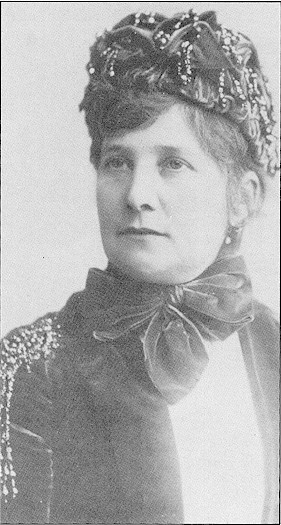
Mrs. Terry in mourning

Legal loose-ends remained to be tied up in the various cases brought forth by Sharon v. Sharon and Sharon v. Hill. Sarah Althea was still trying to establish that she had been married to William Sharon, so as to inherit her share of the property. There was a retrial of the divorce case, but Allie lost again. Her attorneys abandoned the case and her attempts to appeal came to naught. By the end of 1890 it was all over.

For the most part Allie stayed on the ranch near Fresno, mourning the death of her husband and protector, but in February 1892 she returned to San Francisco, exhibiting signs of mental illness. Her bizarre behavior put her name in the headlines once again.

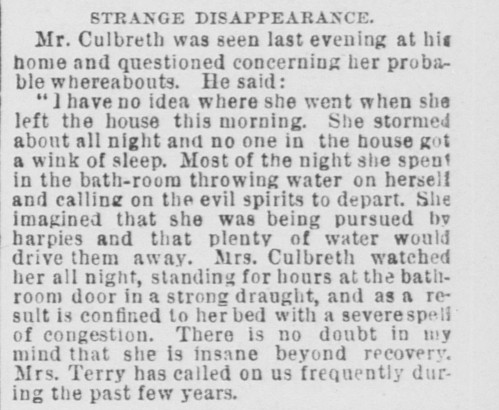
The friends she was staying with reported her disappearance after a night spent pacing her room and raving. She heard voices and communed with spirits. She slept and ate little, and her appearance had greatly aged.

SFC18920215.1.1-6655-3559-999-821-499w

San Francisco Call, 15 February 1892

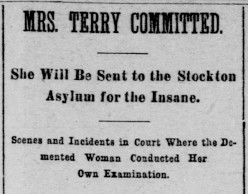
After she left the Culbreth home, she was found staying with her old friend, “Mammy” Pleasant. Mrs. Pleasant had supported her throughout her courtroom trials, and she again tried to help and protect her. But Allie was too much for her. She ruined fine clothing that Mrs. Pleasant gave her by continually pouring cold water over her head or laying in a bathtub for hours fully clothed. She had to be watched constantly to keep her from wandering off. Feeling she could no longer sustain her friend, Mrs. Pleasant had her arrested on an insanity petition. Allie appeared in court for the last time on March 10, 1892, where she put up a lively defense of herself, but also betrayed the sad condition of her mental capacities.

SFC18920311.1.7-3911-230-993-777-248w

The judge declared her insane and committed her to the state asylum. The next day she was taken to Stockton.

Sarah Althea Terry spent the next 45 years living in the state asylum. She was never considered a danger to herself or anyone else. She continued to think of herself as a grand society belle and dressed in her fine Victorian gowns and hats. She wrote checks on scraps of paper and gave them to other patients. She could talk lucidly on many topics and yet she also told delusional tales of past and present grandeur.

Sarah Althea Hill Terry died on February 14, 1937, long after all the other participants in her drama had left the stage.


Posted in Sharon v. Hill, Uncategorized | 1 Comment

The Scandalous Saga continued — Showdown at the Depot

DAC18890815.1.1-1064-862-961-1885-240w

Daily Alta California, 15 August 1889

Justice Stephen J. Field had earned the undying enmity of the Terrys when he ruled against them in September 1888, and even more so when he sent them to jail for their violent antics in court. David S. Terry, who thirty years earlier had shot David C. Broderick in a duel, was still a man who knew how to hold a grudge. And how to act on it.

Terry served his six months in the Alameda County Jail and then retired to his ranch near Fresno. There is no indication that he laid plans against Judge Field. Only a happenstance encounter at the Lathrop Railroad Depot brought the drama to its bloody end.

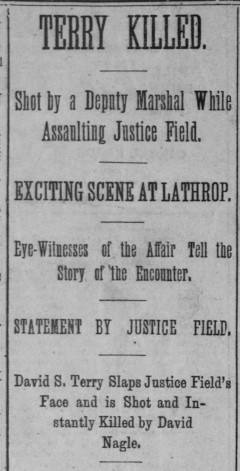
Because Terry had uttered verbal and written threats against Field, a deputy U.S. marshal was assigned to Field as a bodyguard when Field returned from Washington, D.C. to California to sit on federal cases in the Ninth Circuit. The deputy marshal was David Neagle, the same man who had disarmed David Terry during the melee in the courtroom the previous September.

DAC18890815.1.1-4738-1661-969-829-484w

Daily Alta California, 15 August 1889

Field and Neagle boarded a train in Los Angeles on August 13th, 1889, bound for San Francisco. Knowing that Terry lived near Fresno, Neagle watched as the train took on passengers in Fresno at midnight. He saw the Terrys as they boarded. They were unaware that their nemesis was aboard the same train.

Early in the morning the train stopped at Lathrop, a town just south of Stockton. Passengers alighted to take breakfast in the depot hotel. Field and Neagle had just sat down to eat when the marshal saw the Terrys enter the restaurant. Allie (Mrs. Terry) wheeled around and went back to the railroad car to get her handbag (where she kept a pistol). David Terry went to sit at a table, and then spying Justice Field, he walked over to where the judge was seated, came up behind him, and slapped him twice on the face.

Neagle yelled “Stop that!” and placed himself between Terry and Judge Field. Quickly  pulling his revolver, he thrust it against Terry’s chest and fired. As Terry collapsed to the floor, he fired again at his head.

act2scene1

The restaurant erupted in pandemonium as some customers fled the room and others moved to surround Terry’s body. Neagle loudly  declared himself an officer of the law. At that moment Allie came into the room, saw her husband lying on the floor covered in blood, and rushed to him to cradle his head and weep over his body.

Sarah swore out an arrest warrant against Deputy Neagle and Justice Field for the murder of her husband.  Both were arrested and Deputy Neagle was taken to jail, but Justice Field was released on his own recognizance. The charges against Field were later dropped. Neagle’s case went all the way to the U.S. Supreme Court, which upheld his actions “as he was acting under the authority of the law of the United States.”

This incident, and the precedent it set in the case of Deputy Neagle, is lad out in full at the webpage for the U.S. Marshals Service.

Next: The Sad End of Sarah Althea Hill Sharon Terry

Posted in Sharon v. Hill, Uncategorized | Leave a comment