Bidwell as Land Monopolist

wasp-combined

The San Francisco Wasp published this two-page cartoon on June 18, 1892. (Look below for larger versions of the pages.) On the left are farmers in Kansas, desperately fleeing tornadoes and floods. On the right, entrance to sunny, fertile California is blocked by the large landowners, building a wall to keep the small farmer out. Prominent among these land hogs is John Bidwell.

waspjanjune1892unse_0516

One name you might recognize on a building block is “Glenn Estate 42,000 [acres].” Dr. Hugh Glenn, for whom Glenn County is named, had the largest wheat farm in the state, but had died in 1883.

waspjanjune1892unse_0517

And here is California, the most desirable farmland in the world. Lined up to build the wall are Cox, Bidwell, B. Murphy, and J.S. Cone. It’s a very good likeness of John Bidwell. I don’t know Murphy or Cox. Cone had extensive holdings in Tehama County and he and Bidwell served on the Board of Trustees for the Chico Normal School.

Bidwell was often accused of being a land monopolist, especially since he was anti-monopoly when it came to rail and steam transportation, a position shared by other farmers. He ran for governor of California in 1875 on a third-party, anti-monopolist ticket, and the two major parties maligned him as a fraud and a land-grabber.

SDU18750712.1.2-1300-462-971-889-485wB

Sacramento Daily Union, 12 July 1875

It was almost the only thing that Bidwell could be accused of, since he was well-known for his honesty and upright principles. But in political fights you have to have mud of some sort that you can fling at your opponent, and his extensive land holdings were almost the only dirt around (as it were).

The Wasp deplored the greed of the large landowners, saying that they drained the wealth from the rich valley lands and lived in luxury in San Francisco, while depriving poor-but-honest workingmen from acquiring a living on the land. This doesn’t really apply to Bidwell, who ran his ranch himself, gave employment to hundreds, and had already begun selling parts of the ranch. In 1888 lots in Chico Vecino had gone on sale, and even more land would go up for sale as time went on.

Posted in Wasp | Leave a comment

Hydraulic Mining

farmerminer

The Wasp 16 January 1892

Here you have a cartoon showing a fat “Sacramento Farmer” beating down the poor “Hydraulic Miner” with his club of “Unreasonable Prejudice.” Uncle Sam is about to step in, saying, “See here, Rusticus, drop that [word lost in the gutter] and fight fair or I’ll take a hand in this little scrimmage myself.”

As much as I like the work of the cartoonist, Charles Saalburg, this is hardly an accurate depiction of the situation.

Placer mining (i.e., surface and stream mining) soon gave way to more aggressive ways of getting at the gold and the red-shirted independent miner became a figure of former times. Hydraulic mining was not something done by the lone miner or a small group of pals. It took a serious investment of capital and organization of technology to get at the gold, and the payout could be enormous.

Cherokee

Hydraulic mining at Cherokee

We have a fine example of the remains of hydraulic mining here in Butte County at Cherokee. Another even larger land scar can be seen at Malakoff Diggins State Historic Park. Vast quantities of earth and rock were blasted from the mountain face by powerful water cannons, known as monitors.

malakoff-the-diggins

The Diggins at Malakoff

The Wasp supported hydraulic mining, writing, “Shall an industry be suppressed which promises to put at least $200,000,000 of virgin gold into circulation?” I don’t know how accurate that figure is, but there was certainly a lot of gold still in those hills. and the gold would pass through the U.S. Mint at San Francisco, making it an important part of San Francisco’s economy. No wonder that the San Francisco Wasp supported hydraulic mining.

At the same time, farming was a vital and growing part of California’s economy, and “slickens” from the mines were devastating fields and orchards. The first lawsuit brought by a farmer against a mining company, Crum v. Spring Valley Mining Company, pitted Butte County farmer A.J. Crum against the mine at Cherokee. Crum sued in 1872 after he found four feet of mud smothering his peach orchard.

A.J. Crum lost his suit. The jury found, among other points, that

  • Mining was there before farming
  • The slickens came from numerous mines and Crum could not prove its source
  • The mines produced more revenue than the farms and were hence more valuable

To its credit, the Spring Valley Mining Company at Cherokee mitigated the damage it caused by building a canal to carry water from the mine away from the farms. It also offered to buy damaged farmland, and built a dam to capture debris and silt from the mining operations. It was the only company in California to do so.

In 1882 farmer Edward Woodruff filed suit against the North Bloomfield Gravel Mining Company for damage to his fields. Judge Lorenzo investigated and deliberated for two years. The Sawyer decision of 1884 brought an end to the heyday of hydraulic mining and is considered California’s first environmental law. And yet the argument was still going on in 1892, when the Wasp published this cartoon.

I took the information about hydraulic mining here from Ron Womack’s introduction to The Road to Cherokee, a book published by ANCHR in 2016.

Posted in ANCHR, hydrulic mining, Wasp | Leave a comment

The First Pioneer Child Born in California

Ann Gregson Reid wrote or dictated her memories for the Golden Jubilee edition of the San Francisco Call, January 23, 1898. She had seen fifty years of California history.  Here is her memoir:

Being the first white child born in California*, perhaps I take a deeper interest in her welfare than others. I was born at Sutter’s Fort on September 3, 1846. My father, John Gregson,** and mother [Eliza] had come to California the year before from Illinois. They arrived at Johnston’s ranch, on Bear Creek, on October 20, 1846, and a couple of weeks later they moved to Sutter’s Fort, where father obtained employment at his trade of blacksmithing. Here my birth occurred the following fall. The fort at that time consisted of about one hundred men and a few women. But the discovery of gold soon made the place a bustling headquarters for mining men. Shortly after my birth father joined a company that was organized to go to General Fremont at Monterey. They took down a drove of horses. When General Vallejo was a prisoner of the Bear Flag party at the fort father was one of the guards in charge of the distinguished personage. My birth, according to my parents’ version, created great excitement at the little fort.

jameseli

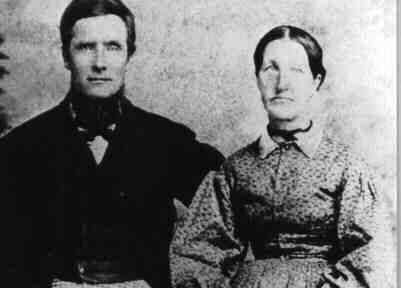
James and Eliza Gregson

When the Indians heard of me, they, too, must see the little paleface. They were amused, but skeptical; and insisted on pinching me to make me cry before they were satisfied I was alive. The squaws hung around the place and watched me for hours at a time. Captain John Sutter was so pleased over the event that he wanted my parents to call me John Sutter Gregson,*** and said he would give me a league of land if they would do so. But they hardly thought John Sutter a proper name for a girl, and I was called Ann Gregson, and his wish went unfulfilled.

In February, 1848. father went to Coloma to assist Marshall in building the millrace in which gold was discovered. He was with Marshall at the time he found the gold. The pick which was used on the ditch and which was really instrumental in the gold being discovered, was made by my father at Sutter’s Fort. It was the first pick made in California. The news of the existence of gold California soon spread, [and men left] their homes in the East and flocked to the Pacific Slope by the thousands.

My folks removed to Green Valley. Sonoma County, in 1850. There my girlhood was spent. The mining excitement was then at its height, and but little attention was paid to children. Everything was primitive, and the boys and girls of my time enjoyed none of the toys and playthings that the children of to-day get.

cradle

A gold-washing cradle

There were no cradles in California when I was a baby, and when one day the miners put me in an old miner’s cradle and rocked me. I thought mining was the greatest pleasure on earth.

We lived in a three-room log cabin, and with other children I attended a school presided over by a middle-aged Irishman. The school was of logs. Rough boards formed the benches and there were no desks. A shelf along the side of the room was where the children did their writing. The teacher was an incessant smoker and had his pipe in his mouth all day long. The gold fever even had possession of the children. I remember on one occasion three or four little companions and myself found some rich specimens of mica. We thought the glittering stuff gold and the whole afternoon we labored in carrying pieces of it home How tired we were at night and how crushed our spirits were when father returned at night and pronounced it “false” gold. The visions of cakes and candy that filled our heads during the afternoon soon filled and gave way to disappointment.

I have witnessed the transformation of California into one of the brightest States in the sisterhood.

Ann Elizabeth Gregson Reid

Posted on findagrave.com by Harry Noel

I am the mother of five native sons and seven native daughters. Two others are dead. I also have two grandchildren. So I have done my share toward populating the State. My husband, Robert M. Reid, died six years ago. John Gregson. my father, still lives at Green Valley, Sonoma County, and is upward of 70 years of age.

The present Golden Jubilee celebration is a fitting one, for the half-century that has passed since Marshall made the discovery that brought the world to California’s feet. It should be a grand reunion and serve to reunite the acquaintances and friendships formed by the sturdy pioneers in the early days. MRS. R. M. REID. (Nee Gregson)

* “The first white child born in” someplace, formerly a favorite trope, is not much heard anymore. Nancy Kelsey had actually given birth at Sutter’s Fort to a male infant in December 1841, but since he did not survive, we can let Mrs. Reid’s claim stand.

** Her father’s name was James, not John, which leads me to think this was dictated to a reporter.

*** Why not Johanna or Joanna Gregson? After all, Sutter’s first name was really Johann.

The Library of Congress has published the “Gregson Memoirs” by James and Eliza Gregson, online and they are well worth reading for a look at the emigrant experience and life in early California.

Posted in Gregson Family, Uncategorized | Leave a comment

The Man in the Red Flannel Shirt

waspjulydec1891unse_0353B

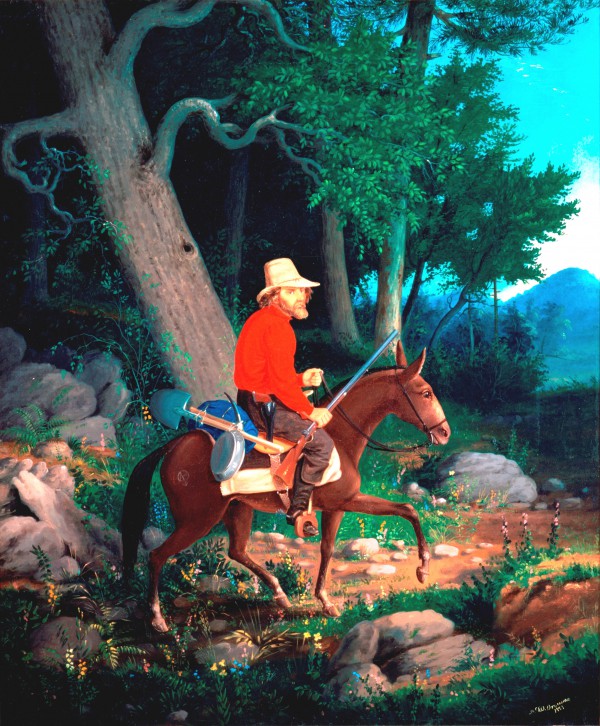
Who doesn’t love a picture of a miner, a gold prospector, a forty-niner? Here he is, on the cover of the Wasp for October 17, 1891, in his red flannel shirt, blue Levis, tall brown boots, and broad-brimmed hat. Those clothes, together with a beard, was how you knew the cartoon was depicting a miner. Plus he always had a shovel and/or a pickax. Probably a gold pan too.

Why is he perplexed? I’ll get to that in a moment. For now, let’s look at a few more images:

loneprospector

Courtesy of the Oakland Museum of California

The “Lone Prospector” by Alburtus Del Orient Browere (what a name!), painted in 1853. Shovel? Check. Pickax? Check. Gold pan, pistol, mule? Check, check, check.

DSCF2760

An advertisement for Coats thread, excellent for mending those blue jeans.

6BPNHDE2BEY3N1H8B8IFCRMM27CQEL

The cover sheet of a special supplement to the San Francisco Call, celebrating the 50th anniversary of the discovery of gold at Sutter’s Mill. A forty-niner for sure, with his red flannel shirt.

And why is that first miner perplexed? It’s a matter of hydraulic mining versus farming. The Wasp was fully in support of hydraulic mining, which brought money into San Francisco, while the farmers in the valley strongly opposed it, on account of the massive amounts of “slickens” (silt and debris) that washed down onto the valley farms.

A little bit more about hydraulic mining next time. For now, just enjoy the sight of a handsome young miner in his red flannel shirt.

golden jubilee

Courtesy of the California State Library


Posted in Uncategorized | 2 Comments

Bidwell and the Bear Flag


bearflag-l

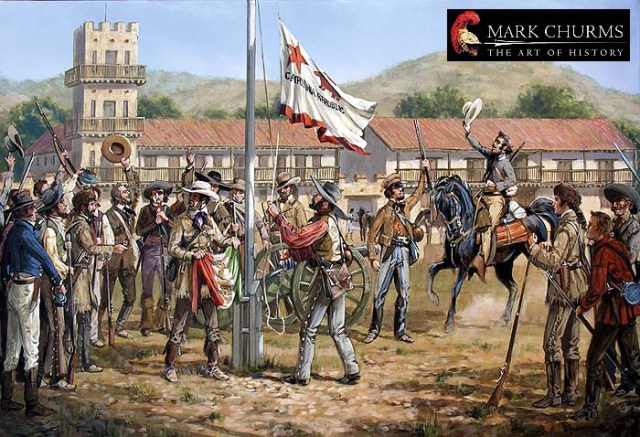
Not the way it happened according to John Bidwell

What did John Bidwell think of the Bear Flag Revolt and the famous Bear Flag raised at Sonoma? Not much, if you asked him, and more than one person did ask.

He mentions it briefly in “Fremont in the Conquest of California,” published in the Century Magazine in February 1891. Another version appeared shortly thereafter in the big midsummer edition (4 July 1891) of the popular San Francisco magazine The Wasp. His account from the Century is well known — it appears in Echoes of the Past and online at The Museum of the City of San Francisco.  The version he told the Wasp is fuller, but less well known.

With regard to the bear flag incident, which has been so much heralded in romance and history, there was no further basis than a spirit of amusement among a few of the men. In the plaza in front of the residence of Gen. Vallejo, in Sonoma, stood a flag-staff which that gentleman had used when he was Military Commander of California, previous to the time of Castro. The Mexican flag had not floated on it for several years or since the retirement of Vallejo from office. When Fremont’s vanguard of mountaineers took possession of Sonoma, after sending Gen. Vallejo and other as prisoners to Sutter’s Fort, it was suggested that some kind of a flag be made and put on the deserted pole. Some one suggested that the new flag should represent a bear rampant, with lifted paw in the act of crushing a coyote, but that was too much for the artistic ability of any one present, so the plan was simplified to a plain bear. This was simply for amusement and without any idea of selecting the emblem of an independent movement against the Mexican authorities.

One of the men was William Todd (since the war of the Rebellion I met Mr. Todd and learned from him that he was a nephew of Mrs. Abraham Lincoln, and brought up in Abraham’s family), who found a small quantity of old reddish paint and with it attempted to make, on a piece of common brown cloth, the representation of a bear, and the same was run up on the flag-pole. The whole affair was ludicrous. Only a few men – two or three – possibly four or five at most – had anything to do with it, and certainly no officer or prominent men took any part. Mexicans looking at the flag were heard to say “coche,” a localism for pig or small hog. The flag was flying when Fremont was in Sonoma, but I doubt he ever noticed it or knew it was there, and this is all there was at the time to the bear flag incident, but it seemed to lend itself readily to romance, and in a short time was distorted and misrepresented until the story went out to the world that an independent movement on foot in California had formally adopted this flag as a standard.

BearFlag2

Grizzly bear or pig — you decide.

So it was all just a lark. Making up a flag while waiting for the real war to happen. Or so John Bidwell says. He didn’t get to Sonoma until a few days after the Bear Flag had been run up the flagpole.

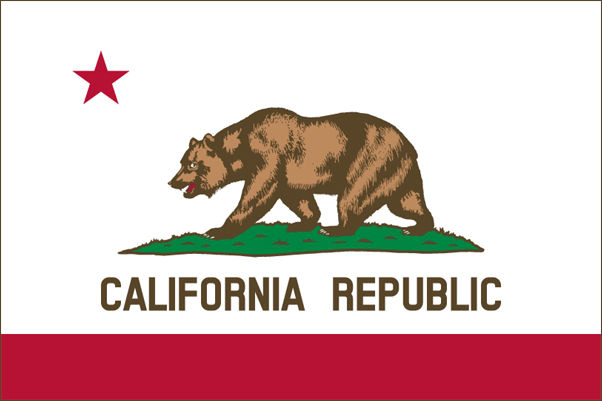
John Bidwell never saw the California state flag as we know it today. California didn’t have a state flag until 1911. (There is an excellent history of the Bear Flag at the virtual Bear Flag Museum.) The 1846 Bear Flag was the inspiration for the flag we know and love today, and I think John Bidwell would have liked the way it turned out.

california-flag-bear-flag

Posted in Uncategorized | Leave a comment

How to Write a Constitution, According to the Wasp

More cartoons!

constitutions

The Wasp, 20 July 1889

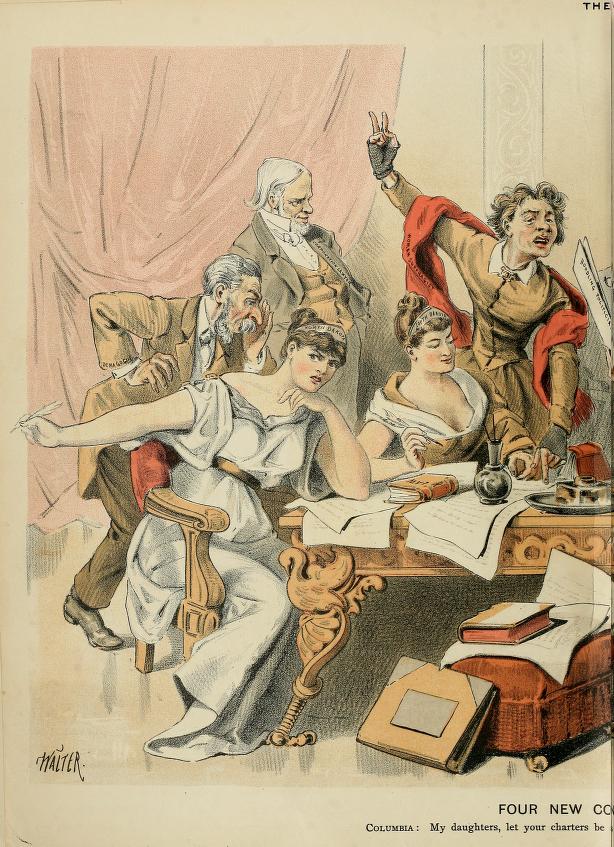
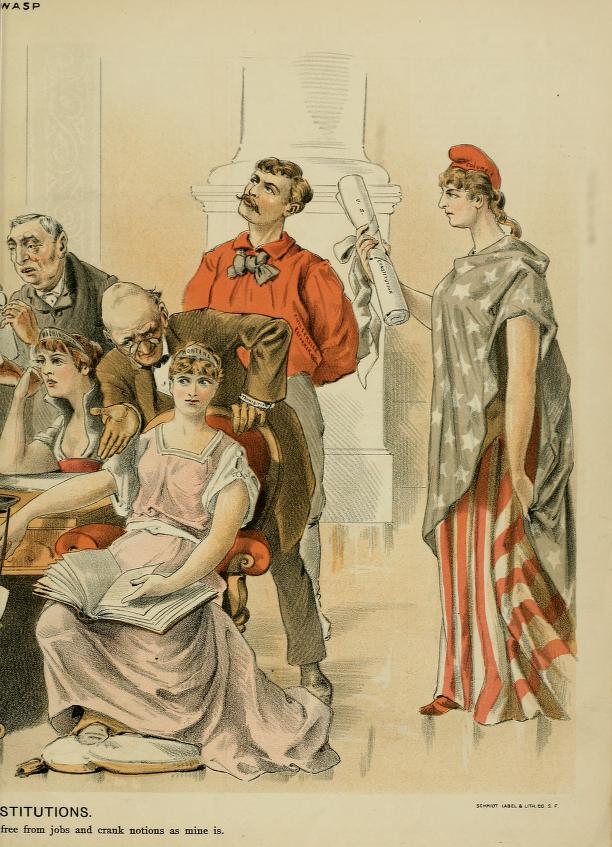
1889 was the year that North Dakota, South Dakota, Washington, and Montana all were admitted to the Union. And here we have those four fair ladies, sitting down to write their state constitutions. Columbia, on the right, is saying, “My daughters, let your charters be as free from jobs and crank notions as mine is.”

And what were those crank notions that beset the political mind in 1889? Behind the ladies, left to right, are a demagogue, a corporation lawyer, a proponent of women’s suffrage, a “boodling” politician, a prohibitionist, and a civil service reformer (in a red shirt). Is the civil service reformer meant to look innocent or devious? I’m not sure.

“Boodle,” in the political jargon of the day, was money gotten from bribes and graft.

A closer look:

waspjulydec1889unse_0052

Not a fan of “Votes for Women,” were they?

waspjulydec1889unse_0053

ColumbiaStahrArtworkColumbia is wearing a Phrygian cap, or liberty cap, which dates back to ancient times and during the French Revolution became a symbol of liberty. Here’s a World War I poster showing Columbia with her American flag drapery and liberty cap.

Uncle Sam is still a common symbol of the USA, but we don’t see Columbia much anymore. Maybe it is time to bring back Columbia.


waspjulydec1889unse_0466Here’s a bonus Phrygian cap for you, from the December 28th, 1889 issue of the Wasp. “The Advance of Republicanism Startles the World.” Our goddess here is not Columbia (no stars and stripes), but Liberty or the ideal of a Republic. The startled nations are Austria, England (with Spain clutching her robe), bearded Russia, and on the battlement, Prussia.


Posted in Uncategorized | Leave a comment

A Scandalous Saga of Cartoons

The Wasp delighted in lampooning the Sharon trial in cartoons. There were far more than it is worth showing here. So — one more cartoon, probably the last, showing what the principal players would look like if the trial dragged on for another 25 years, as it felt like it might.

waspjanjune188412unse_0373B

Poor old William Sharon and Sarah Althea Hill, who claimed to be his wife, are featured in the center. If Sharon had lived until 1910, he would have been 89 years old, a not impossible age, but in reality he died in 1885, at the age of 64, a year after this cartoon appeared. Althea, who did indeed love to deck herself in roses, lived until 1937 (!), unfortunately dying in the state asylum for the insane.

Surrounding the pair are their attorneys, with Judge Sullivan (who must have had a tendency to fall asleep on the bench) at the bottom.

The two figures who draw our eye are Ki, on the left, and Mrs. Plaisance, on the right. Artists in the Wasp drew minorities and people of color in the harshest style of caricature. Ki was Sharon’s Chinese manservant — there is no photograph of him that I know of, so I don’t know if he really wore a queue and a Fu Manchu mustache. That was just the way the artist would invariably indicate a man from China.

BTJPAM-715x899“Mrs. Plaisance” is Mary Ellen Pleasant, usually labeled Mammy Pleasant. She was a friend and supporter of Althea, a successful businesswoman, and a fascinating figure in her own right, who looked nothing like this cartoon.
Here is the only undisputed photograph of Mary Ellen Pleasant. This is how Sarah Althea Hill would have known her.


Posted in Sharon v. Hill, Uncategorized | Leave a comment

Allie and Judge Sullivan

“The trial of Althea’s divorce suit began in March of 1884, without a jury, before Judge Jeremiah Sullivan of the superior court of San Francisco. It continued, off and on, until September. In court, Althea told her story with a goodly number of embellishments, many of them rather transparently false.” (Maccracken, Brooks W., “Althea and the Judges,” American Heritage, June 1967)

At the end of this months-long trial, once every argument, witness, and participant had been exhausted, Judge Sullivan gave his opinion that the marriage of William Sharon to Sarah Althea Hill was valid, based on the piece of paper Allie produced. He was reluctant to believe that lovely Althea, educated at a convent, could be a liar.

There were no witnesses to the contract. It was simply her word against his. How it could be a valid marriage when there were no witnesses, no ceremony, and no filing of a marriage certificate, was never addressed. Judge Sullivan opined that “mutual consent without any form of solemnization, followed by copulation, constitutes a valid marriage.” (quoted in The Wasp, 3 January 1885) Neither contestant denied the copulation part. The contract, however, was labeled a forgery by William Sharon, who said he was “too old a fish” to be caught like that.

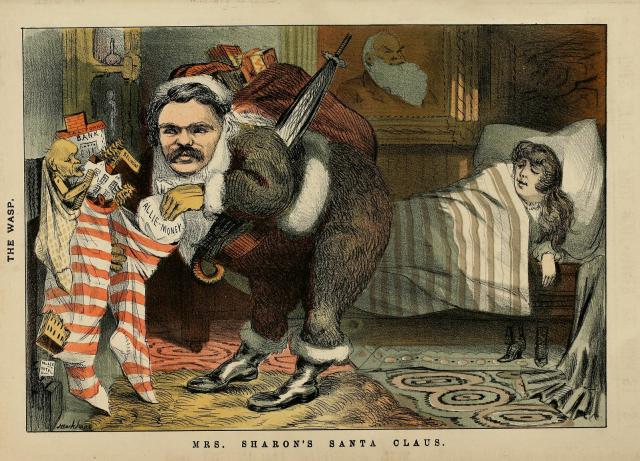
Judge Sullivan granted Althea a divorce and $2,500 a month alimony. The Wasp caricatured Judge Sullivan as Santa Claus, stuffing Althea’s Christmas stocking with “Allie-money” . . .

waspjanjune188514unse_0024

The Wasp, 3 January 1885

. . . And as a zookeeper in charge of a cage full of ravening creatures. “Sarah Althea” is the shrieking cat, and the two gorillas are her attorneys, G.W. Tyler and son. Senator Sharon is the baby being held by his attorney, Barnes.

waspjanjune188514unse_0256


Posted in Sharon v. Hill, Uncategorized | Leave a comment

The Wasp Loved a Juicy Scandal

And there was none juicer in 1880s San Francisco than the case of Sharon v. Sharon, which pitted elderly millionaire William Sharon against his mistress/wife (take your pick) Sarah Althea Hill. I wrote about this Scandalous Saga last year and you can follow the whole story by clicking through to that post and subsequent posts. It is a story replete with civil suits ranging from divorce to libel to slander; criminal prosecutions from adultery to larceny to murder; allegations of forgery, blackmail, and voodoo, and pistols and knives drawn in the courtroom. It has it all!

At the time I found a couple of cartoons from the Wasp about the scandal and courtroom drama, but now I have a few more to show you.

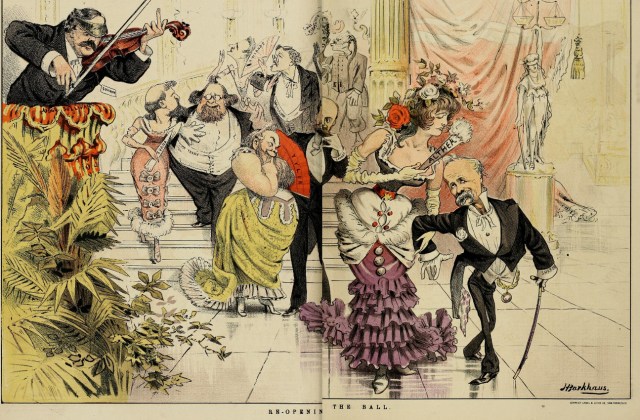
After the court dismissed the suit against William Sharon for adultery on a technicality, Sarah Althea Hill promptly sued for divorce, claiming that they had a secret marriage. Hence we have this cartoon titled “Re-Opening the Ball.” Althea, decked out in extravagant fashion, is on the arm of wizened old ex-Senator Sharon (or he is on her arm).

althea ball

Judge Sullivan starts up the music, while the crowd of attorneys promenades in. The fat man with the spade beard and spectacles is David S. Terry, who will later marry Althea and come to a Very Bad End.

The bearded gentleman dressed up as a lady in yellow with a bright red fan is Althea’s attorney, George W. Tyler. He is also the central figure in the scene of courtroom mayhem below. As he questioned Mrs. Shawhan, and implied that she was less than respectable, she fingered a pistol in her pocket, and Tyler reached to draw his own pistol. Pandemonium ensued — you can read about it in the Pistols in the Courtroom post.

waspjanjune188412unse_0290

Posted in Uncategorized | Leave a comment

Sacramento History Tours

The Sacramento History Museum has some fun and short video tours you can enjoy during this time of confinement. The museum is closed, and they probably don’t encourage you wandering around the streets of Old Sacramento, but there are still some fun things to do virtually.

Anytime Tours

Take a few minutes to take an Anytime Tour. They have Anytime Tours in Old Sacramento and Anytime Tours at the Old City Cemetery, presented by costumed guides. The stories about bold businesswomen of early Sacramento are a particular treat.

Posted in Uncategorized | 1 Comment